On this page
How to identify it
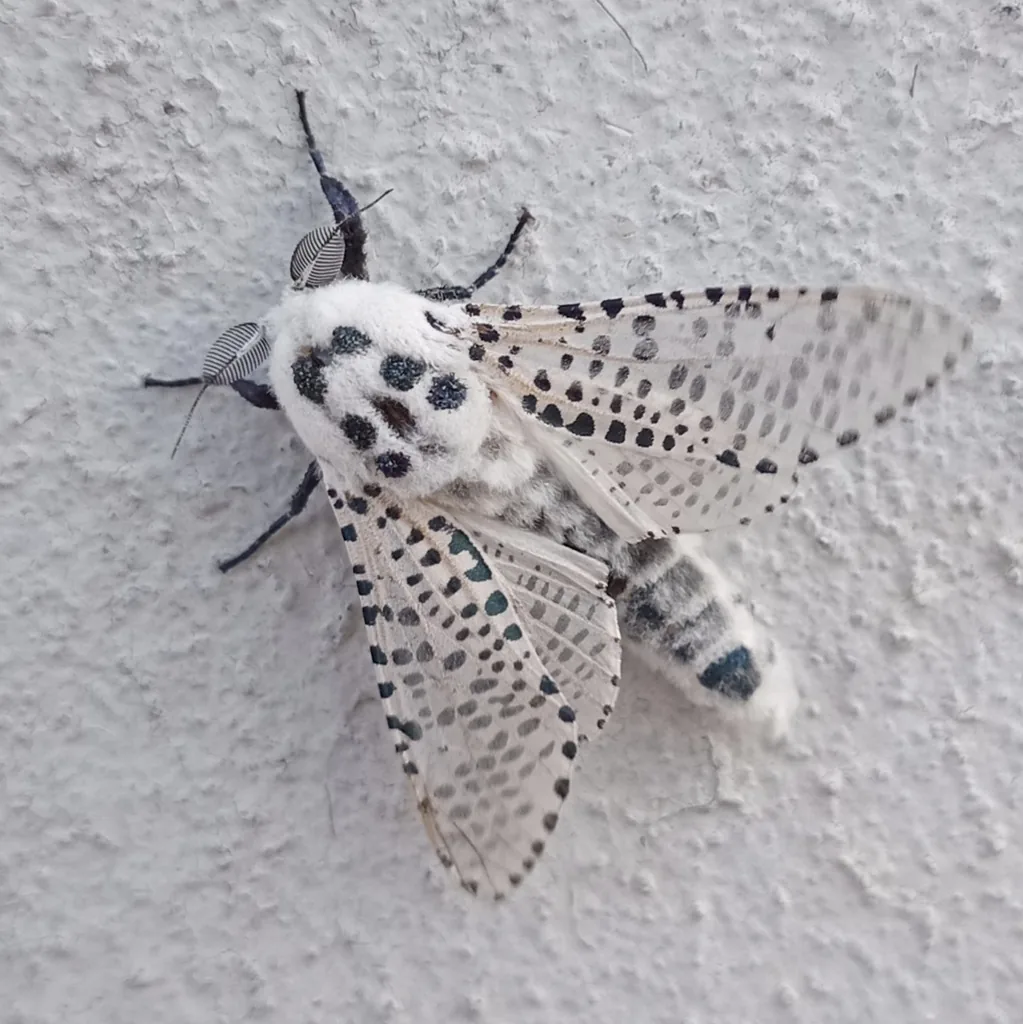
- Adults are white moths with many black spots; the Forest Service says the thorax has six large black spots and females are much larger and heavier than the slender males. Size is given differently: see where the sources disagree.[1][2][3]
- Caterpillars are pale yellow to cream, sometimes pinkish, with a black head and small black dots, up to about 2 inches long when grown.[1][2][3]
- Large, coarse pellets of frass pushed out of bark cracks or tunnel openings show where a borer is feeding, and empty pupal cases may stick out of exit holes.[1][2][3]
Look-alikes
| Look-alike | How to tell them apart |
|---|---|
| Carpenterworm | A native wood-boring caterpillar, also called a carpenterworm, that causes similar damage on overlapping hosts.[1] |
Where it lives
Introduced from Europe and first reported in New Jersey in the 1880s. The Forest Service handbook (1995) says it spread slowly because females fly poorly and is found mostly along the Atlantic seaboard from Philadelphia to Massachusetts; UMass says it has spread westward and southward.[1][3]
Biology and life cycle
Adults fly from about May to September, most commonly early July to mid-August in New Hampshire. They don't feed and live only a few days, and males are drawn to lights.[1][2][3]
Females lay eggs in bark crevices; young caterpillars bore in, often at a bud, twig or branch crotch, and move to larger branches as they outgrow the first.[1][2][3]
The life cycle takes two years, sometimes three, and pupation happens inside the tunnel near the bark.[1][2][3]
Damage and signs
- Hosts include apple, ash, birch, cherry, elm, maple, oak, pear and willow; the Forest Service says almost any woody plant of suitable size except evergreens is susceptible, and that elms and maples were preferred in New York.[1][2][3]
- Early signs are girdled or broken twigs with wilted yellow leaves. Small trees and branches suffer most; branches can break in wind, and in apples it often shows up in young trees with mechanical injury.[3][1][2]
- How serious it is depends on the source; see where the sources disagree.[1][2][3]
Health risk
It bores in trees. UMass, UNH and the USDA Forest Service describe tree damage only and don't mention any risk to people or pets.[1][2][3]
Control
Prevention
Keep trees vigorous, especially with adequate water, and avoid mechanical injury to trunks.[1][2][3]
Sanitation
The Forest Service handbook recommends removing and destroying infested branches and heavily damaged trees, planting species other than elms and maples, and spacing trees so crowns don't touch.[3]
Traps and physical control
Tunnels are fairly straight, so a borer can often be killed by probing the opening with a flexible wire.[2]
Biological control
Woodpeckers and other birds are its main predators; the Forest Service also lists a parasitic wasp, Copidosoma truncatellum, and squirrels.[1][2][3]
Where the sources disagree
First U.S. report: UMass says New Jersey in 1887; the Forest Service handbook says Hoboken, New Jersey, in 1882.[1][3]
Adult size: UMass says up to 1.5 inches long and UNH about 3/4 inch long; the Forest Service gives a female wingspan of 62 to 75 mm (about 2.4 to 3 inches).[1][2][3]
Eggs: UMass says up to 800 in masses or clusters; the Forest Service says 400 to 800, laid singly or in small clusters.[1][3]
Hosts: UMass and UNH say more than 125 kinds of trees; the Forest Service says over 100 trees and shrubs.[1][2][3]
Severity: UMass and UNH say populations generally stay low and it isn't an important pest in New England. The Forest Service says heavily infested trees often die and seedlings and small trees are sometimes girdled and killed.[1][2][3]
Regulatory status
EPPO's database lists Zeuzera pyrina on the A1 quarantine lists of Argentina and Chile (2019), Brazil (2018), Uruguay (1995) and Bahrain (2003), as a quarantine pest in Mexico (2018), and on the A1 list of COSAVE, the South American regional plant protection organization (2018). It lists no U.S. categorization.[4]
Common questions
- What is the white moth with black spots at my porch light?
- In the Northeast in summer, possibly a leopard moth; males are attracted to lights.[1][2]
- How do I kill a leopard moth borer in my tree?
- Find the opening where coarse frass is pushed out and probe the tunnel with a flexible wire; the Forest Service says badly infested branches should be removed and destroyed.[2][3]
Sources
- UMass Extension Landscape, Nursery and Urban Forestry Program (Landscape Insect & Mite Guide), “Zeuzera pyrina (Leopard Moth).” www.umass.edu/agriculture-food-environment/landscape/publications-resources/insect-mite-guide/zeuzera-pyrina (accessed 2026-11-13)
- UNH Cooperative Extension, “Borers in New Hampshire Apple Trees (fact sheet).” extension.unh.edu/resource/borers-new-hampshire-apple-trees-fact-sheet-0 (accessed 2026-11-13)
- USDA Forest Service, “Guide to Insect Borers in North American Broadleaf Trees and Shrubs (Agriculture Handbook AH-706): Zeuzera pyrina, leopard moth.” research.fs.usda.gov/download/treesearch/22150.pdf (accessed 2026-11-13)
- EPPO Global Database, European and Mediterranean Plant Protection Organization, “Zeuzera pyrina (ZEUZPY): Categorization.” gd.eppo.int/taxon/ZEUZPY/categorization (accessed 2026-11-13)
- Global Biodiversity Information Facility (GBIF), “Zeuzera pyrina Linnaeus, 1761 (GBIF Backbone Taxonomy).” api.gbif.org/v1/species/1730978 (accessed 2026-11-13)
- iNaturalist, “Zeuzera pyrina taxon page (order and family).” www.inaturalist.org/taxa/200930 (accessed 2026-10-06)