On this page
How to identify it
- Fine, reddish sawdust-like frass in the lower bark furrows of European linden, especially in May and June, is the sign to look for. Underneath, the inner bark is honeycombed by larval tunnels, and in some reports the outer bark is so damaged it crumbles by hand.[1]
- The larvae live inside the bark; UMass says they pupate once they reach about 6 mm long.[1]
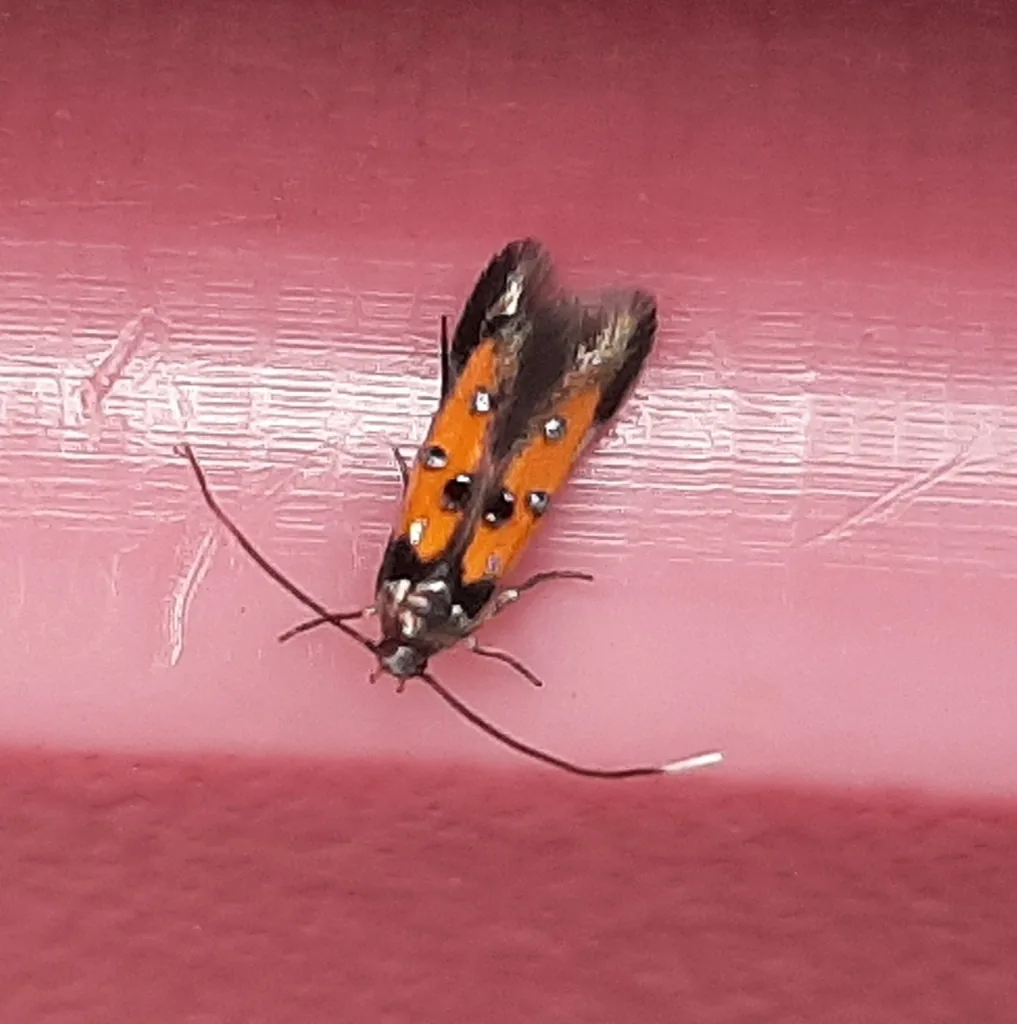
- The adults are small, brightly colored day-flying moths; in Canada clouds of hundreds or thousands have been seen flying around infested trees.[1]
Look-alikes
| Look-alike | How to tell them apart |
|---|---|
| Linden looper | The linden looper (Erannis tiliaria) is a foliage feeder: a USDA Forest Service caterpillar guide describes a caterpillar with lemon yellow sides and 4 or 5 pairs of wavy black stripes on the back that feeds on broadleaf trees from May to July. The linden bark borer's larvae instead feed inside the bark.[2][1] |
Where it lives
Introduced from Europe. UMass Extension says it was first reported in North America from New York City in 1928, with later reports from New Jersey, Connecticut, Vermont, near Boston and parts of Canada, and that further study is needed to confirm its pest status in Massachusetts. GBIF holds about 790 records, about 235 from Canada and 200 from the US, with the rest from Europe; its 170 US records since 1990 come mostly from New York, Massachusetts and Illinois.[1][4][5]
Biology and life cycle
UMass says reports have adults flying from about May to August, but that in Massachusetts they may fly in early June for 7 to 10 days.[1]
The larvae feed in the bark and push out rusty colored frass. Pupation is reported in early spring, once larvae reach about 6 mm.[1]
A single generation a year is reported, but little about the biology of this species is known.[1]
Damage and signs
- Larval feeding leaves the inner bark of European linden looking like a honeycomb, from ground level up high into the crown, and in some reports even the outer bark is severely damaged. UMass says the long-term and short-term effects on the host still need to be investigated.[1]
Health risk
UMass Extension describes it only as a bark-feeding moth of linden; no cited source describes any risk to people or pets.[1]
Control
Prevention
Check European lindens for reddish, fine frass in the lower bark furrows in May and June; this is the only monitoring method UMass gives. Information on cultural management and natural enemies is currently unavailable.[1]
Pesticides
UMass lists several insecticide active ingredients whose Massachusetts labels cover lepidopterous larvae or borers in general; none is labeled for this species by name. It advises applying after bloom to protect pollinators. Check that any product is currently registered and that its label covers the use.[1]
Where the sources disagree
Flight period: UMass says reports have adults flying from about May to August, but that in Massachusetts the flight may last only 7 to 10 days in early June.[1]
Spelling: UMass and this page use Chrysoclista linneella; GBIF's backbone lists the species as Chrysoclista linneela (Clerck, 1759), in the family Elachistidae.[1][3]
Common questions
- What is the rusty sawdust in the bark furrows of my linden?
- Frass pushed out by linden bark borer larvae tunneling in the bark; it is most visible in the lower furrows of European linden in May and June.[1]
- Will the linden bark borer kill my tree?
- Nobody knows for sure. Heavy infestations honeycomb the inner bark from the ground into the crown, but UMass says the short- and long-term impacts on the host still need study.[1]
- Where did this moth come from?
- UMass says it is native to Europe and was first reported in North America from specimens collected in New York City in 1928.[1]
Sources
- UMass Extension Landscape, Nursery and Urban Forestry Program, University of Massachusetts Amherst, “Chrysoclista linneella (formerly Glyphipterix linneella), Linden Bark Borer Moth, Insect & Mite Guide (Professional Guide for IPM in Trees and Shrubs).” www.umass.edu/agriculture-food-environment/landscape/publications-resources/insect-mite-guide/chrysoclista-linneella-formerly-glyphipterix-linneella (accessed 2026-11-13)
- USDA Forest Service, Forest Health Technology Enterprise Team, “Caterpillars of Eastern Forests, FHTET-96-34 (D. L. Wagner, V. Giles, R. C. Reardon and M. L. McManus, 1997).” www.fs.usda.gov/foresthealth/technology/pdfs/Caterpillars_of_Eastern_Forests.pdf (accessed 2026-11-13)
- Global Biodiversity Information Facility (GBIF), “Chrysoclista linneela (Clerck, 1759) (GBIF Backbone Taxonomy).” api.gbif.org/v1/species/4529248 (accessed 2026-11-13)
- Global Biodiversity Information Facility (GBIF), “Chrysoclista linneela: occurrence records by country (GBIF occurrence search).” api.gbif.org/v1/occurrence/search?taxonKey=4529248&facet=country&facetLimit=20&limit=0 (accessed 2026-11-13)
- Global Biodiversity Information Facility (GBIF), “Chrysoclista linneela: U.S. occurrence records since 1990 by state (GBIF occurrence search).” api.gbif.org/v1/occurrence/search?taxonKey=4529248&country=US&hasGeospatialIssue=false&occurrenceStatus=PRESENT&year=1990%2C2026&facet=stateProvince&facetLimit=400&limit=0 (accessed 2026-11-13)