On this page
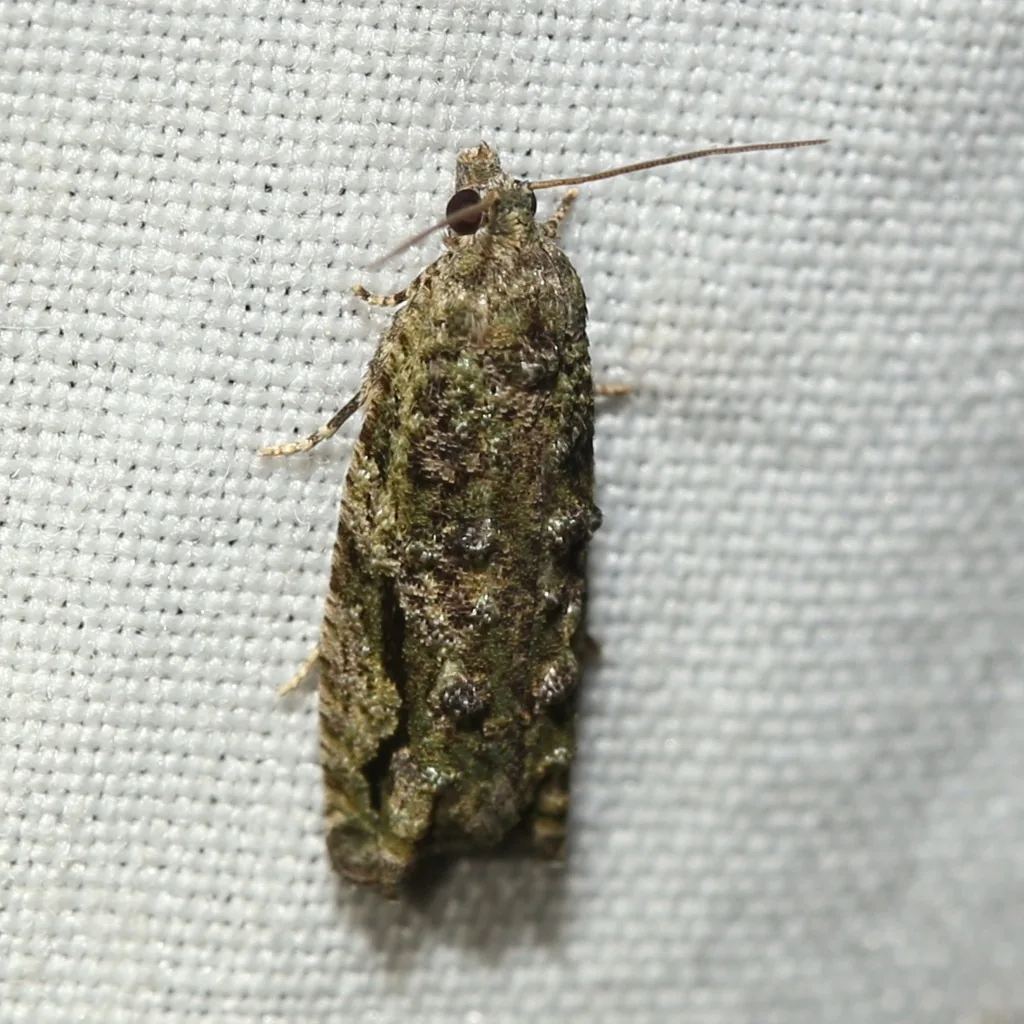
How to identify it
Where it lives
UK Extension says it occurs across much of the United States and southern Canada, from Oregon and southern Alberta to the East Coast and south through Kentucky and Tennessee to Mississippi.[1]
Biology and life cycle
In Kentucky, moths fly from mid-March to early May, peaking in early to mid-April; Tennessee State says mid-March to April. Females lay eggs, most likely on twigs near opening buds, just before bud break, and the larvae bore into the new shoots and feed until late May or early June.[1][2][4]
Red and Freeman maples are the main hosts, and sugar maple is a fairly common one; Tennessee State adds silver maple. Ohio State calls it mainly a pest of young maples, especially red, Freeman and sugar maples.[1][2][3]
Damage and signs
- Stems and leaves above the tunnel wilt and die, with flagging first showing in late April or May. Losing the leader causes a fork, and Tennessee State says this can ruin the tree's quality.[1][2]
- In University of Kentucky studies of newly transplanted red maple liners, as many as 100 percent of trees in some fields were infested and 22 to 36 percent had a flagged leader.[1][4]
Health risk
It is a shoot-boring caterpillar of maples. UK, Tennessee State and Ohio State Extension don't mention any risk to people or pets.[1][2][3]
Control
Prevention
Ohio State says control isn't needed for maples growing in a forest; the pest is mainly a concern for nurseries.[3]
Traps and physical control
Through most of May, slicing open a flagged shoot reveals the tunneling larva, which confirms the cause.[1]
If the leader has already been killed and a fork is starting, Tennessee State says to act quickly: prune out the weaker fork, leaving a short stub, and in late afternoon, when shoots are most flexible, tie the remaining shoot to that stub as the new leader with tape or a stapled index card. Prune off the dead stub the next winter.[2]
Biological control
Natural enemies include parasitoid wasps in the families Braconidae and Eulophidae; the 2008 study recorded three parasitoid species as new host records.[1][4]
Pesticides
In nurseries, a single pyrethroid (bifenthrin) spray timed from just before bud break until shoots have two pairs of small leaves gave 96 to 100 percent control in Kentucky research. Tennessee State says that window is often no more than a week: too early and the insect isn't there yet, too late and the caterpillar is already inside the shoot. Follow the label.[1][4][2]
Where infestations start
A 2008 University of Kentucky study that developed a pheromone lure found that flight starts in March and peaks in early spring, larvae develop in April and May, and no more larvae appeared in maples after the late-spring flight. Maples shipped dormant from Oregon were free of the borer, so trees are infested after planting, from eggs laid in early spring.[4][1]
Because the receiving nursery's own moths infest the trees, UK Extension says managing this pest is the receiver's job, not the shipper's.[1]
The same study found a different tortricid moth, Episimus tyrius, tying maple leaves in late summer, so late-season leaf damage is not maple shoot borer.[4]
Tennessee State notes that other Proteoteras species damage horsechestnuts and buckeyes.[2]
Where the sources disagree
The late-spring moths: UK Extension and the 2008 study found no shoot damage after the second, smaller flight in late May and June and suggest those moths seek overwintering sites; Tennessee State says they may either lay more eggs or overwinter, and that the second generation generally does less damage than the first.[1][4][2]
Overwintering: Ohio State states that it overwinters as an adult; UK Extension calls that possible, and the 2008 study says sporadic moth captures into November suggest adults overwinter.[3][1][4]
Flight: UK Extension says moths are active from mid-March to early May; Tennessee State says mid-March to April.[1][2]
Spray window: UK Extension says any time from just before bud break until most shoots have their first two pairs of small leaves; Tennessee State says this window is often no more than a week.[1][2]
Name: UK, Tennessee State and Ohio State spell the genus Proteoterus; GBIF and the 2008 study use Proteoteras.[1][2][3][5][4]
Common questions
- Why did the top shoot of my young maple wilt in spring?
- Maple shoot borer larvae tunneling in new shoots cause wilting and dieback from late April into May; look for a small hole with frass and silk near a leaf stalk.[1]
- Did my nursery tree come with the pest?
- Probably not. Kentucky research found dormant maples shipped from West Coast nurseries weren't infested; eggs are laid on the trees shortly before bud break after they arrive.[1][4]
Sources
- University of Kentucky Entomology (ENTFACT), “Maple Shoot Borer (ENTFACT-455).” entomology.mgcafe.uky.edu/ef455 (accessed 2026-11-13)
- Tennessee State University Cooperative Extension, Otis L. Floyd Nursery Research Center, “The Maple Tip Borer (ANR-ENT-01-2015).” www.tnstate.edu/extension/documents/Maple_Shoot_Borer_2020%201.pdf (accessed 2026-11-13)
- Ohio State University Extension, “Insects and Mites that Feed on Maple Trees (Woodland Stewards maple toolkit, 2025).” woodlandstewards.osu.edu/sites/woodlands/files/imce/MAPLE_toolkit_insects&mites_250717.pdf (accessed 2026-11-13)
- Pest Management Science 64, via PubMed, “Seagraves BL, Haynes KF, Redmond CT, Tittle S, Potter DA (2008), Seasonal biology and management of the maple shoot borer, Proteoteras aesculana, in production nurseries.” pubmed.ncbi.nlm.nih.gov/18498082/ (accessed 2026-11-13)
- Global Biodiversity Information Facility (GBIF), “Proteoteras aesculana Riley, 1881 (GBIF Backbone Taxonomy).” api.gbif.org/v1/species/1748149 (accessed 2026-11-13)
- iNaturalist, “Proteoteras aesculana taxon page (order and family).” www.inaturalist.org/taxa/228844 (accessed 2026-10-06)