On this page
How to identify it
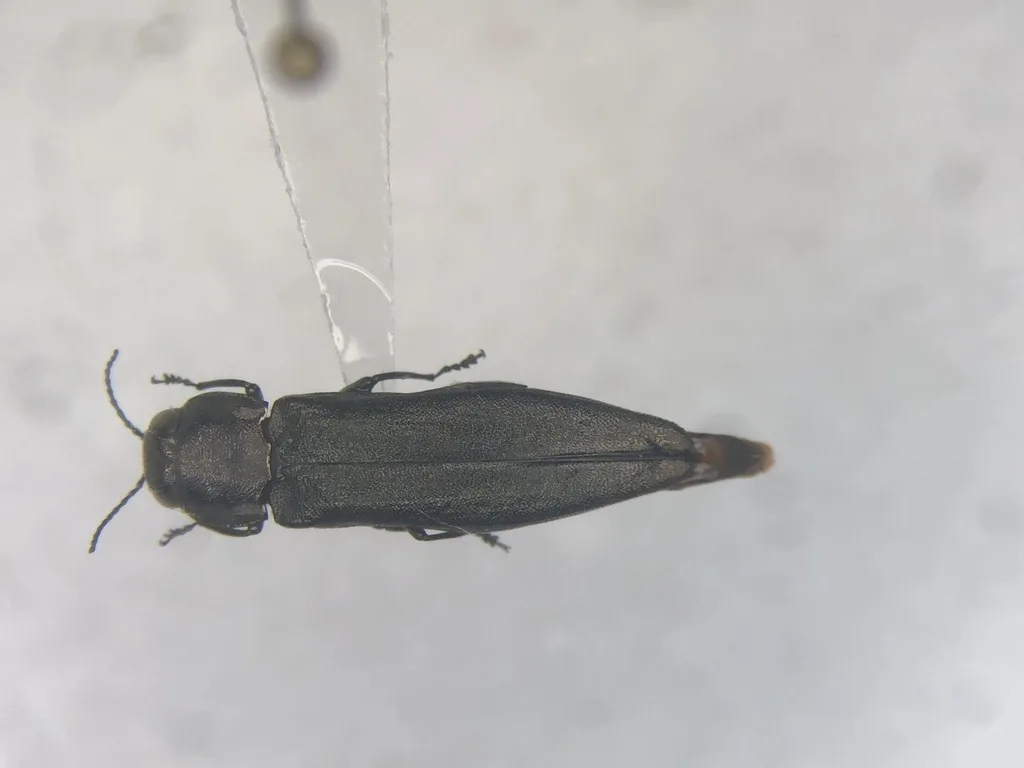
- Adults are slender, dark beetles about 1/4 to 1/2 inch long (Natural Resources Canada gives 6 to 12 mm), olive green to bronze with an iridescent sheen.[5][2][3]
- Larvae are pale, flattened and up to about 1 inch long, with a pair of small pincer-like spines at the tail end.[5][2][3]
- Emerging adults leave small D-shaped exit holes in the bark, 1/8 inch (Minnesota) to 3/16 inch (New Hampshire) across. Oregon State says on mature trees they're usually in the top third of the tree.[5][2][4]
- Sawdust-packed, S-shaped tunnels under the bark cause raised ridges on trunks and branches as the bark calluses over them.[2][1]
Look-alikes
| Look-alike | How to tell them apart |
|---|---|
| Emerald ash borer | A metallic green beetle from Asia that attacks and kills ash trees, while the bronze birch borer is a native, bronze-colored beetle of birches.[6][1][2] |
| Twolined chestnut borer | A closely related borer that attacks stressed oaks; adults are bluish-black with two parallel yellow stripes down the wing covers.[2] |
Where it lives
Native to North America and found throughout the range of birch in the United States and Canada. Oregon State says it was first detected in Oregon in 2003, in Portland, and has caused heavy losses in Klamath Falls since 2017.[1][5][3][4]
Biology and life cycle
Larvae overwinter under the bark and pupate in spring. In Minnesota adults start emerging in early June, when Vanhoutte spirea and black locust bloom, and continue into July; Natural Resources Canada describes emergence over about six weeks from May to July.[2][5][3][1]
Adults feed on leaves for a few weeks, then females lay eggs in bark cracks, usually on sunny, unshaded parts of the tree.[5][2][1]
Larvae hatch in about two weeks and tunnel into the phloem, the sap-carrying layer just under the bark.[5][1]
The life cycle takes one or two years depending on climate and tree vigor; New Hampshire reports two years and Minnesota usually one.[2][5][3][4]
Besides birches, it has been recorded on aspens and cottonwoods.[1]
Damage and signs
- Larval tunnels girdle branches and trunks, cutting off sap flow, and dieback starts at the top of the crown and works downward. Minnesota notes other problems can cause similar crown dieback.[2][4][5]
- Oregon State says wilted leaves at the top are often the first sign, and a tree may recover if less than 40 percent of the canopy is affected, but nothing will save it once more than half is affected.[4]
- European white, Himalayan (Jacquemontii) and other white-barked Asian and European birches are the most susceptible; Natural Resources Canada calls introduced European white birch highly susceptible.[1][2][4][3]
Health risk
It bores in birch trees. UMass, UNH, University of Minnesota, Oregon State and Natural Resources Canada describe tree damage only and don't mention any risk to people or pets.[1][5][2][4][3]
Control
Prevention
Keep birches vigorous: mulch the shallow roots, water deeply during dry spells and protect roots from compaction and construction damage.[2][5][4]
Plant resistant birches. River birch, including 'Heritage', is widely recommended, and Oregon State says native birches are the most resistant, while Jacquemontii, European white, weeping and cutleaf birches are most susceptible.[1][2][4]
Sanitation
Prune out and destroy dead or infested branches before adults emerge; UNH says by early May. Natural Resources Canada says infested wood should be chipped, burned or left in full sun to kill larvae, and Oregon State warns that moving firewood spreads the borer.[5][3][4]
Pesticides
Soil-applied systemic insecticides such as imidacloprid or dinotefuran can help trees in early decline only; Minnesota says they don't work once 40 to 50 percent of the canopy is dead, and Oregon State says fall applications are of little use.[2][4]
Apply systemic products only after birches finish flowering, to reduce exposure to bees.[2][4][1]
When to call a professional
Hire a professional tree care company for large trees; they have access to products and methods unavailable to homeowners.[2]
Where the sources disagree
Preferred hosts: UNH lists paper and yellow birch as preferred hosts, while UMass, Minnesota and Oregon State say European and Asian white-barked birches are most at risk and native birches are more resistant when healthy.[5][1][2][4]
Asian white birch: UMass lists Betula platyphylla 'Japonica' and monarch birch among resistant birches; Minnesota says to avoid planting Asian white birch and Japanese monarch birch.[1][2]
Fertilizing: UNH includes fertilizing among the practices that keep birches vigorous; Minnesota says not to fertilize stressed trees.[5][2]
Pruning: UMass says to avoid routine birch pruning until late summer; Oregon State says not to prune while adults are active.[1][4]
Regulatory status
Natural Resources Canada says the European Union has declared bronze birch borer a quarantine pest, and imported birch wood products, including wood packing, must have the bark and outer sapwood removed or be irradiated under official supervision.[3]
Common questions
- Why is my birch tree dying from the top?
- Top-down dieback in a birch, with wilted top leaves, thin foliage and ridged bark, is a classic sign of bronze birch borer, though Minnesota notes other problems can cause similar dieback. D-shaped exit holes confirm it.[2][4]
- Can a birch with bronze birch borer be saved?
- Sometimes, if caught early. Oregon State says recovery is possible when less than 40 percent of the canopy is affected, and Minnesota says treatments don't work once 40 to 50 percent has died.[4][2]
Sources
- UMass Extension Landscape, Nursery and Urban Forestry Program, “Agrilus anxius (Landscape Insect and Mite Guide).” www.umass.edu/agriculture-food-environment/landscape/publications-resources/insect-mite-guide/agrilus-anxius (accessed 2026-11-13)
- University of Minnesota Extension, “Bronze birch borer and twolined chestnut borer.” extension.umn.edu/garden-and-home/yard-and-garden/yard-and-garden-insects/metallic-wood-boring-beetles (accessed 2026-11-13)
- Natural Resources Canada, Canadian Forest Service: Trees, insects and diseases of Canada's forests, “Bronze birch borer (V.G. Nealis, revision 2024).” tidcf.nrcan.gc.ca/en/insects/factsheet/283 (accessed 2026-11-13)
- Oregon State University Extension Service, “Homeowner Guide to Managing Bronze Birch Borer: An Insect Killing Birches in the PNW (EM 9189, Sanchez and Leavell, revised July 2023).” extension.oregonstate.edu/catalog/em-9189-homeowner-guide-managing-bronze-birch-borer (accessed 2026-11-13)
- University of New Hampshire Extension, “Bronze Birch Borer [fact sheet].” extension.unh.edu/resource/bronze-birch-borer-fact-sheet (accessed 2026-11-13)
- USDA Animal and Plant Health Inspection Service, “Emerald Ash Borer.” www.aphis.usda.gov/plant-pests-diseases/eab (accessed 2026-11-13)
- Global Biodiversity Information Facility (GBIF), “Agrilus anxius Gory, 1841 (GBIF Backbone Taxonomy).” api.gbif.org/v1/species/6003913 (accessed 2026-11-13)
- iNaturalist, “Agrilus anxius taxon page (order and family).” www.inaturalist.org/taxa/123961 (accessed 2026-10-06)