On this page
How to identify it
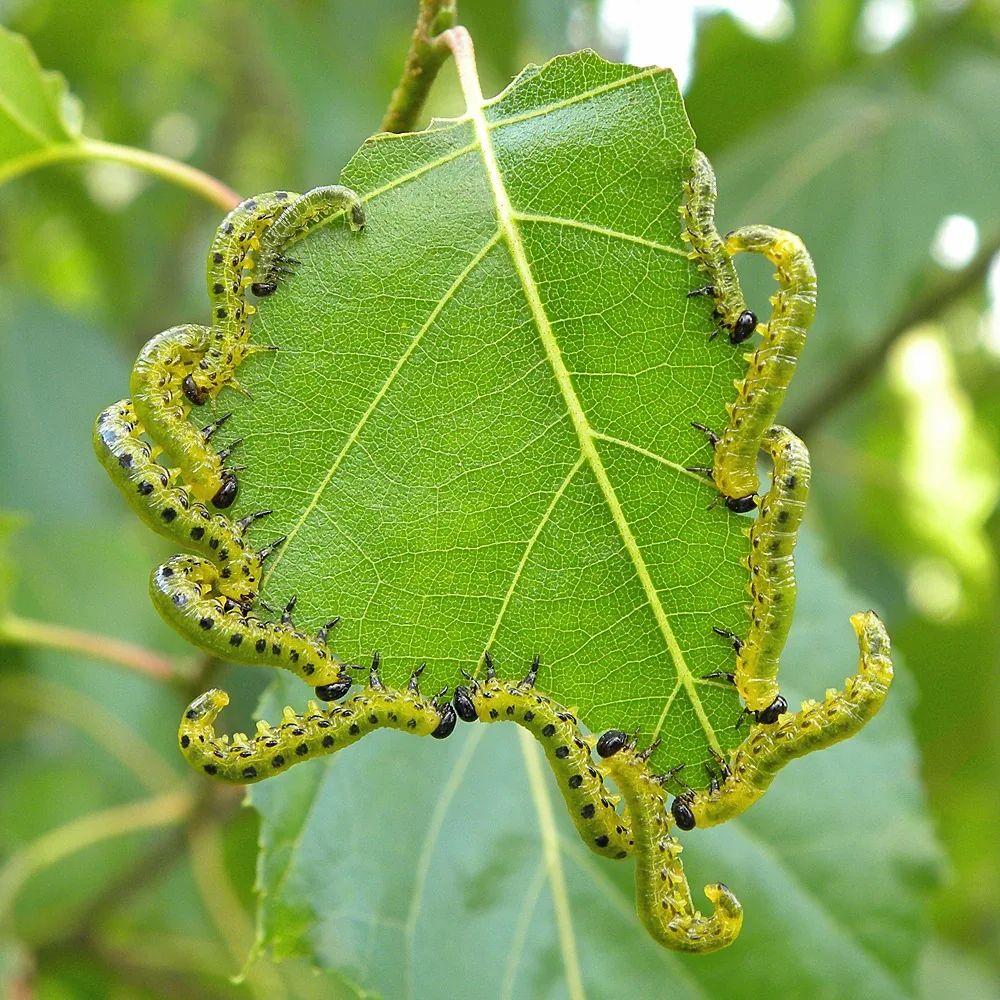
- Larvae have shiny black heads and rows of black spots. Young larvae are dark gray, then greenish gray, and yellowish green and up to about 1 inch long when grown.[2][3][1][4]
- Disturbed or resting larvae hold an S-shaped pose with the rear end raised.[1][3][5]
- Adults are about 1/2 inch long and look like small black wasps.[1]
- Like other sawfly larvae, they have six or more pairs of prolegs on the abdomen; caterpillars have five or fewer.[5][3][4]
Where it lives
NC State says it's found throughout the United States. It's reported on birches in Massachusetts, Minnesota, Vermont, Ohio and North Carolina, and Ohio State calls it a native insect.[5][1][2][4][3]
Biology and life cycle
Prepupae overwinter in cocoons in the soil, pupate in spring and emerge as adults to lay eggs on the leaves.[1][2][4]
Ohio State and NC State report two generations a year; Minnesota says first-generation larvae feed from May to early July and a second, overlapping generation feeds through September. Ohio State says the second generation usually does the most damage.[3][5][2]
Damage and signs
- Birches are the hosts. UMass lists gray, black, yellow, paper, river, red and Japanese white birch.[1][2]
- Young larvae eat all but the main veins and older ones eat whole leaves. Groups of 10 to 20 feeding from the edges can strip branches and defoliate small trees, though Ohio State says whole canopies are rarely affected.[2][1][3]
Health risk
It feeds on birch leaves. UMass, University of Minnesota, UVM, NC State and Ohio State describe leaf damage only and don't mention any risk to people or pets.[1][2][4][5][3]
Control
Traps and physical control
Drop larvae into a can of soapy water or prune out and destroy the branch section where a group is feeding.[1][5][4]
Pesticides
Check birches in spring and again in midsummer. UMass says numbers rarely reach levels that need chemical treatment, and NC State says the larvae seldom cause lasting harm.[1][2][5]
If treatment is wanted, NC State says horticultural oil works on young larvae and spinosad on larger ones, and Minnesota says insecticidal soap and horticultural oil work on small numbers of young sawfly larvae.[5][2]
Where the sources disagree
Favorite host: UMass and Minnesota name gray birch; NC State says river birch is most common in North Carolina landscapes, and Ohio State says it strongly prefers river birch.[1][2][5][3]
Generations: UMass says one or two a year and UVM up to two; Ohio State and NC State say two.[1][4][3][5]
Whether to act: UVM says feeding doesn't harm a healthy tree and no control is needed, though handpicking cuts damage; Ohio State says targeting the first generation limits damage that season; Minnesota says to use a pesticide if treatment is necessary.[4][3][2]
Scientific name: GBIF's Backbone Taxonomy and ITIS list it as Croesus latitarsus, the name the extension sources use; the Checklist of the Hymenoptera of Canada, Alaska and Greenland, as served by GBIF, lists it as Nematus latitarsus.[6][7][8]
Common questions
- What are the black-spotted larvae lined up on my birch leaves?
- Most likely dusky birch sawfly larvae, which feed in groups from the leaf edges and raise their rear ends into an S when disturbed.[1][2][5][3]
- Will Bt control dusky birch sawflies?
- No. Minnesota, NC State and Ohio State say Bt kills moth and butterfly caterpillars but not sawfly larvae.[2][5][3]
Sources
- UMass Extension Landscape, Nursery and Urban Forestry Program (Landscape Insect & Mite Guide), “Croesus latitarsus (Dusky Birch Sawfly).” www.umass.edu/agriculture-food-environment/landscape/publications-resources/insect-mite-guide/croesus-latitarsus (accessed 2026-11-13)
- University of Minnesota Extension, “Sawflies (Yard and Garden Insects).” extension.umn.edu/yard-and-garden-insects/sawflies (accessed 2026-11-13)
- Ohio State University Extension, Buckeye Yard & Garden onLine (BYGL), “Bothersome Birch Blighters (May 20, 2023).” bygl.osu.edu/node/2148 (accessed 2026-11-13)
- University of Vermont Extension, “Dusky Birch Sawflies (A. Hazelrigg, June 5, 2024).” www.uvm.edu/extension/news/dusky-birch-sawflies (accessed 2026-11-13)
- NC State Extension, Entomology, “Dusky Birch Sawfly, Croesus latitarsus (S. Frank; guest post by A. Dale, July 31, 2015).” entomology.ces.ncsu.edu/news/dusky-birch-sawfly-croesus-latitarsus/ (accessed 2026-11-13)
- Global Biodiversity Information Facility (GBIF), “Croesus latitarsus Norton (GBIF Backbone Taxonomy).” api.gbif.org/v1/species/1249666 (accessed 2026-11-13)
- Integrated Taxonomic Information System (ITIS), “Croesus latitarsus Norton, TSN 152807 (valid; dusky birch sawfly).” itis.gov/servlet/SingleRpt/SingleRpt?search_topic=TSN&search_value=152807 (accessed 2026-11-13)
- Global Biodiversity Information Facility (GBIF), “Nematus latitarsus (Norton, 1862), Checklist of the Hymenoptera of Canada, Alaska and Greenland (dataset record).” api.gbif.org/v1/species/179910313 (accessed 2026-11-13)
- iNaturalist, “Nematus latitarsus taxon page (order and family).” www.inaturalist.org/taxa/1354151 (accessed 2026-10-06)