On this page
How to identify it
Where it lives
Native to Europe, it was first recorded in the US in Connecticut in 1923.[1]
Biology and life cycle
It spends the winter in the soil beneath the tree (see where the sources disagree on the stage). Adults emerge in May and insert eggs one at a time into soft, newly expanding leaves.[1][2]
Larvae feed for two to three weeks inside the leaf, then drop to the soil.[1]
Damage and signs
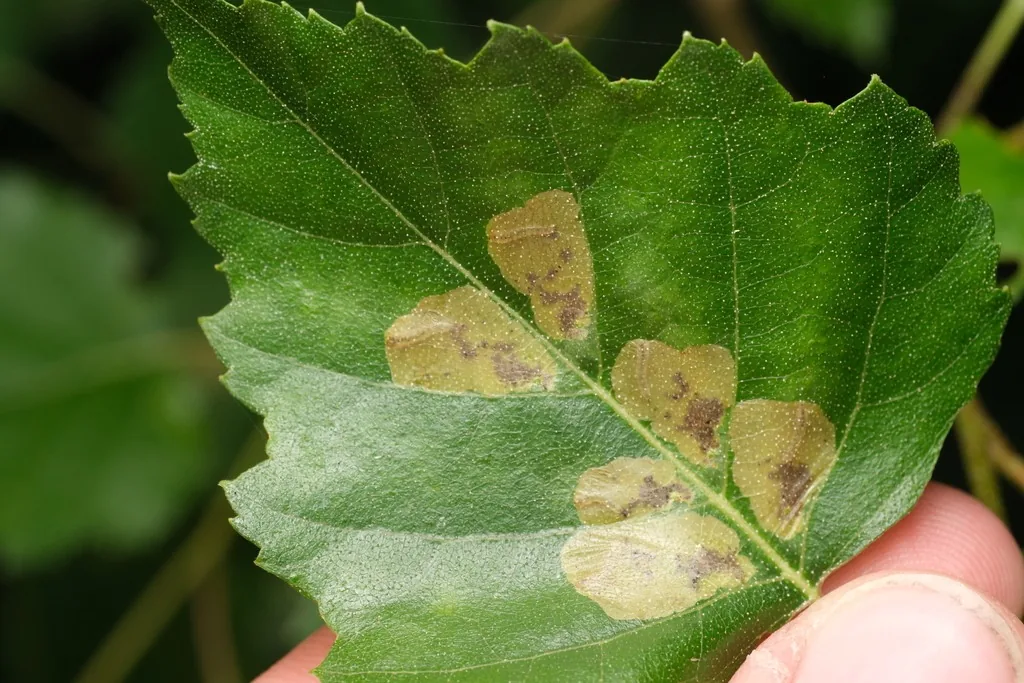
- Penn State says a healthy tree can lose part or all of its foliage without serious injury, but repeated defoliation may seriously weaken or kill it and let fungi and the bronze birch borer attack. Minnesota Extension says leafminer damage seldom reaches more than 40% of the leaves and that treating is unnecessary for the tree's health (see where the sources disagree on the borer).[1][2]
- Penn State says it seldom feeds on sweet, yellow or European white birch (see where the sources disagree).[1]
Health risk
It feeds inside birch leaves. Penn State Extension and Minnesota Extension describe it only as a tree pest and don't mention any risk to people or pets.[1][2]
Control
Prevention
Himalayan whitebarked, Dahurian and river birch are reported less susceptible.[1]
Pesticides
If needed, time registered sprays for adult activity in early May and the second generation in mid- to late June.[1]
More from UMN Extension
Leafminer damage seldom reaches more than 40% of a birch's leaves, and well-watered trees can tolerate even heavier losses.[2]
Scientific name
Penn State and Minnesota Extension call the birch leafminer Fenusa pusilla, and ITIS lists Fenusa pusilla as valid. A 2014 checklist of British and Irish sawflies lists Fenusa pumila Leach, 1817 and treats the use of pusilla (Lepeletier, 1823) for that species as a misidentification. GBIF lists both Fenusa pumila and Fenusa pusilla as accepted species and gives each the common name birch leafminer, so fact sheets and databases may give different names for the same birch pest.[1][2][3][4][5][6]
Where the sources disagree
Winter stage: Penn State says it overwinters as mature larvae in the soil and pupates in early spring; Minnesota Extension says it spends the winter in the soil as pupae.[1][2]
Bronze birch borer: Penn State says the stress of repeated defoliation may allow the bronze birch borer to attack; Minnesota Extension says there is no relation between leafminer feeding and bronze birch borer attack.[1][2]
Hosts: Penn State says it seldom feeds on European white birch and calls river birch less susceptible; Minnesota Extension lists gray, paper, river and European white birches as the trees it feeds in.[1][2]
Larval feeding time: Penn State says larvae feed for two to three weeks; Minnesota Extension says about two weeks.[1][2]
Common questions
Sources
- Penn State Extension, “Birch Leafminer.” extension.psu.edu/birch-leafminer (accessed 2026-11-13)
- University of Minnesota Extension, “Birch leafminers.” extension.umn.edu/garden-and-home/yard-and-garden/yard-and-garden-insects/birch-leafminers (accessed 2026-11-13)
- Integrated Taxonomic Information System (ITIS), “Fenusa pusilla (Lepeletier), TSN 152814.” www.itis.gov/servlet/SingleRpt/SingleRpt?search_topic=TSN&search_value=152814 (accessed 2026-11-13)
- Biodiversity Data Journal, “Checklist of British and Irish Hymenoptera - Sawflies, 'Symphyta' (Liston, Knight, Sheppard, Broad and Livermore 2014).” doi.org/10.3897/BDJ.2.e1168 (accessed 2026-11-13)
- Global Biodiversity Information Facility (GBIF), “Fenusa pumila Leach, 1817 (GBIF Backbone Taxonomy).” api.gbif.org/v1/species/4490761 (accessed 2026-11-13)
- Global Biodiversity Information Facility (GBIF), “Fenusa pusilla (Lepeletier, 1823) (GBIF Backbone Taxonomy).” api.gbif.org/v1/species/1249669 (accessed 2026-11-13). GBIF lists both Fenusa pusilla and Fenusa pumila Leach, 1817 (key 4490761) as accepted species, each with the common name birch leafminer.
- iNaturalist, “Fenusa pumila taxon page (order and family).” www.inaturalist.org/taxa/495099 (accessed 2026-11-11)