On this page
How to identify it
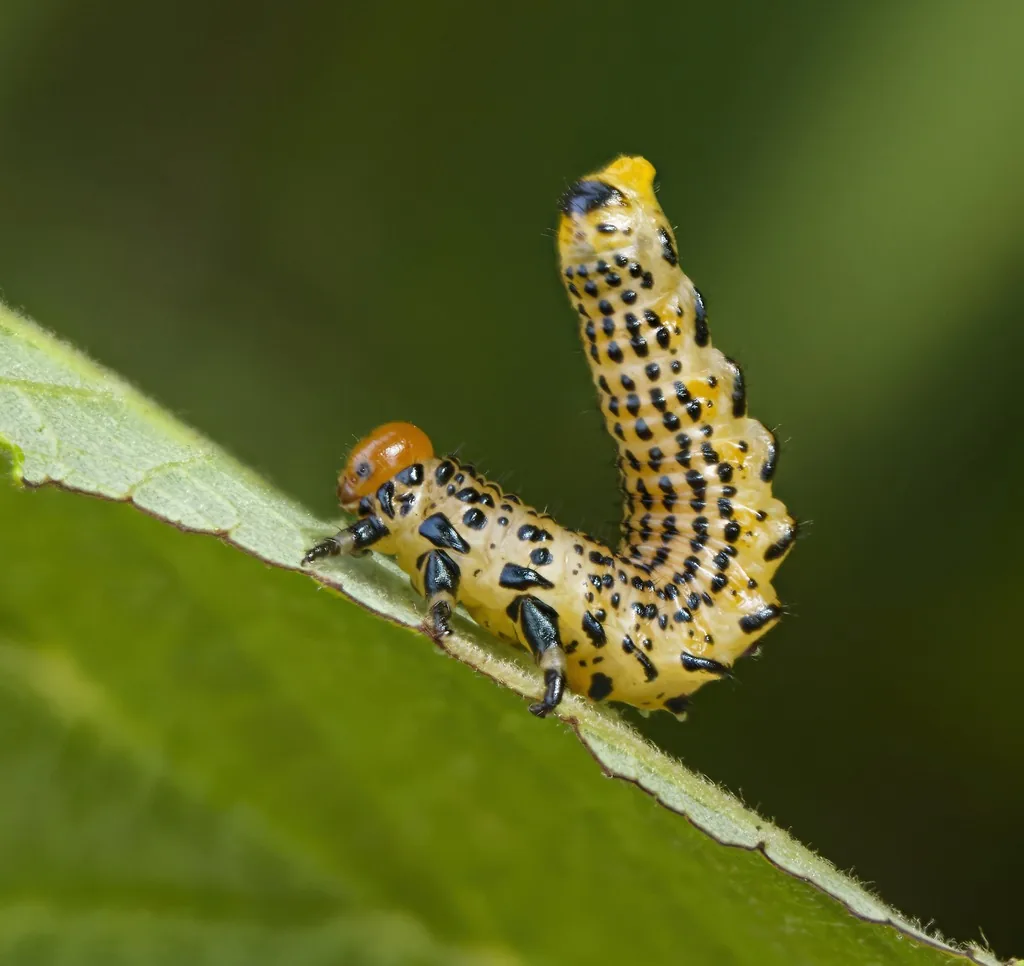
- Larvae are pale yellowish-green with rows of black spots and a dull orange to reddish-yellow head. Sources give slightly different sizes when grown: PNW says 0.75 inch, UMass 0.8 to 1 inch.[1][2]
- Feeding larvae often hold the end of the abdomen raised behind them.[1]
- Adults are wasp-like, about 0.3 inch long, with 3-segmented antennae and silvery membranous wings.[2][3]
Look-alikes
| Look-alike | How to tell them apart |
|---|---|
| Dusky birch sawfly | PNW says dusky birch sawfly larvae are smaller (about 0.5 inch), darker yellowish green with three dark spots on each segment, feed in groups with the abdomen flipped up over the back, and have two generations a year; UMass says their feeding looks like birch sawfly damage.[2][1] |
Where it lives
UMass says it occurs through Canada and parts of the northeastern United States; the PNW handbook covers it in the Pacific Northwest, and the Canadian Forest Service reports outbreaks in Nova Scotia, British Columbia and Quebec.[1][2][3]
Biology and life cycle
It overwinters in the leaf litter at the base of host trees: UMass says as pupae, while the Canadian Forest Service says as a prepupa inside a silk cocoon. Adults emerge in June and July and females cut slits along leaf edges and lay eggs in rows.[1][2][3]
Larvae are active from about mid-June into September (UMass); the Canadian Forest Service says groups of larvae are easy to see in July and that there is one generation a year.[1][3]
Damage and signs
- Birch is the main host; the Canadian Forest Service names grey, white and yellow birch. PNW also lists alder and willow, and UMass lists alder, hazelnut and willow as occasional hosts. Larvae eat leaves down to the midrib.[1][2][3]
- Sources differ on how serious it gets. PNW says damage is usually localized and larvae rarely cause significant defoliation; UMass says occasional large populations cause considerable defoliation, and the Canadian Forest Service says it has at times seriously defoliated birch in Nova Scotia and British Columbia, though infestations in Quebec have been localized and sporadic.[2][1][3]
Health risk
It feeds on leaves, and no cited source describes any risk to people or pets.[1][2][3]
Control
Traps and physical control
Watch for small larvae along leaf edges and prune out or crush them with a gloved hand.[1][2]
Biological control
Native natural enemies usually keep numbers down; PNW names stink bugs and other predatory bugs. UMass says it can and should usually be tolerated, and the Canadian Forest Service says no intervention is needed because infestations are short-lived.[1][2][3]
Pesticides
Bacillus thuringiensis kurstaki (Btk) won't work, because UMass says it kills only moth and butterfly caterpillars, not sawfly larvae. UMass says sawfly larvae have 6 or more pairs of fleshy prolegs, or none, while caterpillars have 5 or fewer.[1]
Common questions
Sources
- UMass Extension Landscape, Nursery and Urban Forestry Program (Landscape Insect & Mite Guide), “Arge pectoralis (Birch Sawfly).” www.umass.edu/agriculture-food-environment/landscape/publications-resources/insect-mite-guide/arge-pectoralis (accessed 2026-11-13)
- Pacific Northwest Insect Management Handbook (Oregon State, Washington State, University of Idaho), “Birch (Betula)-Sawfly (Hosts and Pests of Landscape Plants).” pnwhandbooks.org/insect/hort/landscape/hosts-pests-landscape-plants/birch-betula-sawfly (accessed 2026-11-13)
- Natural Resources Canada, Canadian Forest Service, “Birch sawfly, Arge pectoralis (Insects and diseases of Canada's forests, fact sheet 6150).” tidcf.nrcan.gc.ca/en/insects/factsheet/6150 (accessed 2026-11-13)
- Global Biodiversity Information Facility (GBIF), “Arge pectoralis (Leach) (GBIF Backbone Taxonomy).” api.gbif.org/v1/species/5023191 (accessed 2026-11-13)