On this page
How to identify it
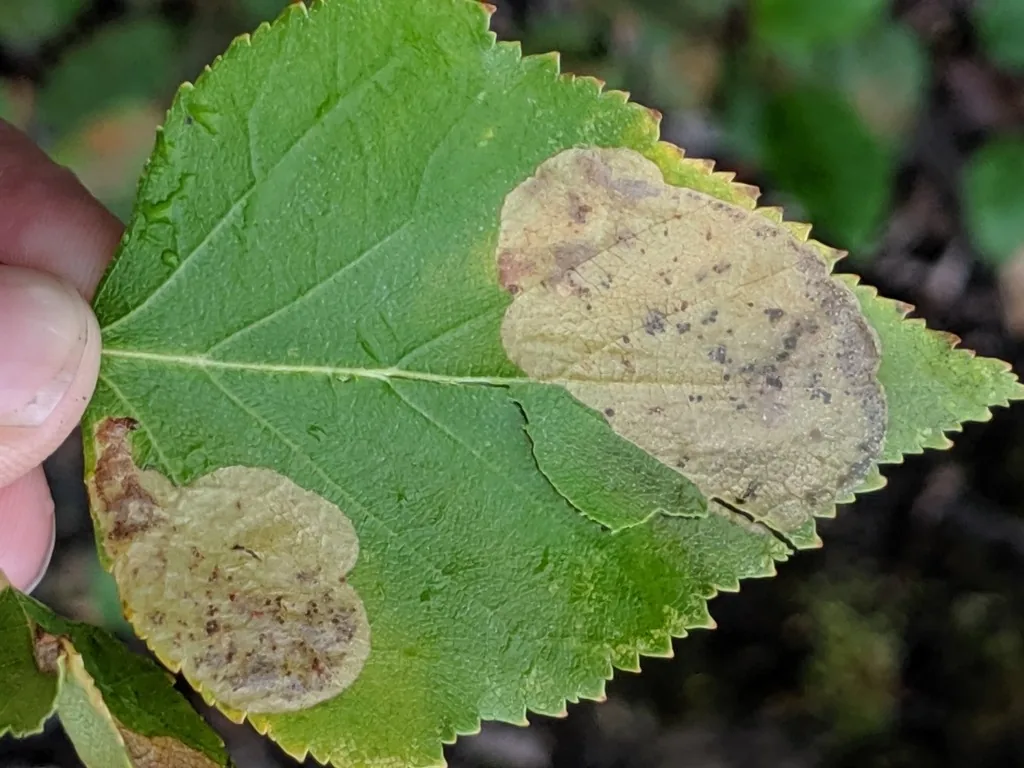
- Mines begin in the center of the leaf, usually near a major side vein, and expand outward. The leaf's upper and lower layers separate so the mine looks like a flattened or collapsed blister filled with dark frass.[1]
- Damage first shows in July as small, light blotches on the upper leaf surface. By late July and August mined leaves turn a sickly yellowish brown rather than the clear gold of natural fall color.[2][1]
- Opened before the larvae leave, a mine holds flattened yellowish larvae, 6 mm long according to the Forest Service and 7 mm according to Natural Resources Canada; several larvae can share one mine, and at heavily infested Alaska sites as many as 40 leafminer larvae have been seen on one leaf.[1][2]
- Adults are all female and emerge in late June and early July. The eggs are inserted under the upper epidermis in the middle of the leaf and hatch within about 12 days.[1][2]
Look-alikes
| Look-alike | How to tell them apart |
|---|---|
| Birch leafminer (Fenusa pumila) | The earlier-known birch miner that the amber-marked species was confused with in Canada until 1955. The Forest Service recorded no Fenusa pumila in Alaska in 2025, and amber-marked birch leafminer damage peaks late in the season, in late July and August.[2][1] |
| Late birch leaf edgeminer (Heterarthrus nemoratus) | Often in the same tree or even the same leaf. Its mines start at the leaf edge as a reddish ring expanding inward and contain little frass, because the larvae cut slits to eject it; amber-marked mines start in the leaf center and are full of dark frass. The edgeminer also pupates in fall inside the fallen leaf rather than in the soil.[1] |
| Birch casebearer | Amber-marked birch leafminer larvae never feed openly on the leaf surface: they live between the leaf layers and leave the leaf only to drop to the soil and spin a cocoon.[1][2] |
Where it lives
Long known in Europe and probably introduced, it was first reported in Canada in Quebec in 1959 and now occurs throughout Canada. In Alaska it was first reported in Haines in 1991, identified in Anchorage in 1996, detected in Fairbanks in 2002 and has since spread through Southcentral and Interior Alaska, reaching Delta Junction by 2018. Lathrolestes parasitoids have been linked to its decline in Alberta and the eastern United States.[2][1]
Biology and life cycle
Hosts are birches, including grey, white (paper) and yellow birch in Canada and Alaska paper, Kenai, resin, dwarf arctic and western paper birch plus horticultural varieties in Alaska.[2][1]
There is one generation a year. Adults emerge from soil cocoons in late June and early July. All are females that lay viable eggs without mating. Eggs are laid in slits cut into the midsection of the leaf and hatch within 12 days.[1][2]
Larvae mine between the leaf's epidermal layers through six instars over about 24 days, feeding during the first five. Mature larvae leave the leaf, drop to the ground and spin cocoons in the soil or litter, where they overwinter before pupating the next summer.[1][2]
Females prefer to lay on leaves that already carry eggs, so in heavy years leaves become overcrowded; as eggs per leaf approach ten, larval mortality approaches 100 percent. Natural Resources Canada says this food shortage quickly ends an infestation.[1][2]
It prefers shaded or semi-shaded foliage on small trees; open-growing ornamental birches are generally less susceptible. In Alaska both it and the edgeminer attack leaves throughout the canopy.[2][1]
Damage and signs
- Damage is mainly aesthetic. In outbreaks more than 90 percent of a tree's leaves can be mined, but most of the feeding happens late in summer after the tree has done most of its growth, and Alaska surveys have recorded no birch deaths from these insects.[1]
- Heavily mined trees are weakened and may become more susceptible to other insects, but generally do not die from the leafminer.[2]
- In 2025 aerial surveys mapped roughly 123,000 acres of birch leafminer damage in Alaska: about 94,000 in Southcentral, on the Kenai Peninsula and west of Anchorage, and 29,000 in the Interior, mostly around Fairbanks. Survey coverage was greatly reduced that year, so the Forest Service says damage is likely underrepresented. Ground surveys found Interior defoliation as heavy as in the previous five years but mostly trace levels in Southcentral.[1]
Health risk
These are stingless sawflies that feed inside birch leaves, and no cited source describes any risk to people or pets.[1][2]
Control
Prevention
Because the damage comes late in the season and even a severe infestation seldom lasts more than a year, control is generally unnecessary.[2]
Open-grown ornamental birches in full sun are generally less susceptible than small trees in shade or partial shade.[2]
Biological control
The parasitic wasp Lathrolestes thomsoni, linked to the collapse of leafminer populations in Canada and the eastern United States, was released in Alaska from 2004 to 2008 (more than 3,000 wasps, mostly around Anchorage). Mining then dropped 30 to 40 percent, but a similar decline at sites with no releases made its impact hard to judge. It is now established and spreading. It lays its egg in the sawfly larva, which still spins its cocoon; the wasp, not the sawfly, emerges the next spring.[1]
Crowding can also end outbreaks: females lay on already-occupied leaves, and larval mortality approaches 100 percent as eggs per leaf approach ten.[1][2]
Scientific name
The birch leafminer is named here Fenusa pumila, the name used by the U.S. Forest Service Alaska Region and accepted in the GBIF Backbone Taxonomy, which gives it the common name birch leafminer. The ITIS database still lists the birch leafminer as Fenusa pusilla.[1][3][4]
Where the sources disagree
Larva size: the Forest Service gives 6 mm, and Natural Resources Canada's photo caption 7 mm.[1][2]
How long outbreaks last: Natural Resources Canada says even a severe infestation seldom lasts more than one year, but the Forest Service reports heavy Interior Alaska defoliation in 2025 similar to the previous five years, and populations in Fairbanks intensifying over 15 years.[2][1]
What ends them: Natural Resources Canada says the food shortage in crowded leaves quickly ends an infestation. The Forest Service says the cause of the collapse in much of Southcentral Alaska needs more study, and could be egg crowding, parasitoids, competition with the late birch leaf edgeminer, a combination, or something else.[2][1]
Which leaves it uses: Natural Resources Canada says it prefers shaded or semi-shaded foliage on small trees, and research outside Alaska cited by the Forest Service suggests it favors the lower canopy, but in Alaska it and the edgeminer attack leaves throughout the canopy.[2][1]
The parasitoid's role: reductions in Alberta and the eastern United States have been associated with Lathrolestes thomsoni, but the Forest Service says its effect in Alaska is not yet determined.[1]
The name of the related birch leafminer: Fenusa pumila (Forest Service, GBIF) or Fenusa pusilla (ITIS).[1][3][4]
Common questions
- My birch is turning brown in early August. Is it fall already?
- Probably not. Look closely: leafminer-browned leaves are a dull yellowish brown, the two leaf layers are separated into a flattened blister, and the inside is full of dark frass, sometimes with flat yellowish larvae still present.[1]
- Will it kill my birch?
- Alaska forest health staff have recorded no birch mortality from these leafminers, and Natural Resources Canada says attacked trees generally do not die, though heavy mining can leave them more open to other insects.[1][2]
- How do I tell it from the late birch leaf edgeminer?
- Edgeminer mines are a reddish ring starting at the leaf margin and hold little frass; amber-marked mines start in the leaf center near a vein and are packed with dark frass.[1]
Sources
- USDA Forest Service, Alaska Region, “Birch Leafminers (Forest Health, Alaska Region).” www.fs.usda.gov/r10/natural-resources/forest-health/birch-leafminers (accessed 2026-11-13)
- Natural Resources Canada, Canadian Forest Service, “Ambermarked birch leafminer, Trees, insects, mites, and diseases of Canada's forests.” tidcf.nrcan.gc.ca/en/insects/factsheet/7926 (accessed 2026-11-13)
- Global Biodiversity Information Facility (GBIF), “Fenusa pumila Leach, 1817 (GBIF Backbone Taxonomy).” api.gbif.org/v1/species/4490761 (accessed 2026-11-13)
- Integrated Taxonomic Information System (ITIS), “Fenusa pusilla (Lepeletier), TSN 152814.” www.itis.gov/servlet/SingleRpt/SingleRpt?search_topic=TSN&search_value=152814 (accessed 2026-11-13)
- Global Biodiversity Information Facility (GBIF), “Profenusa thomsoni (Konow, 1886) (GBIF Backbone Taxonomy).” api.gbif.org/v1/species/4490774 (accessed 2026-11-13)