PestControlLibrary
Menu

Elm Leafminer

Fenusa ulmi (syn. Kaliofenusa ulmi)[3]

The elm leafminer is a small European sawfly whose larvae mine the leaves of elms in spring.[1][2]

Group
Insect
Order
Hymenoptera
Family
Tenthredinidae
US range
2 states in sources
Sources
3 cited
Updated
2026-11-12
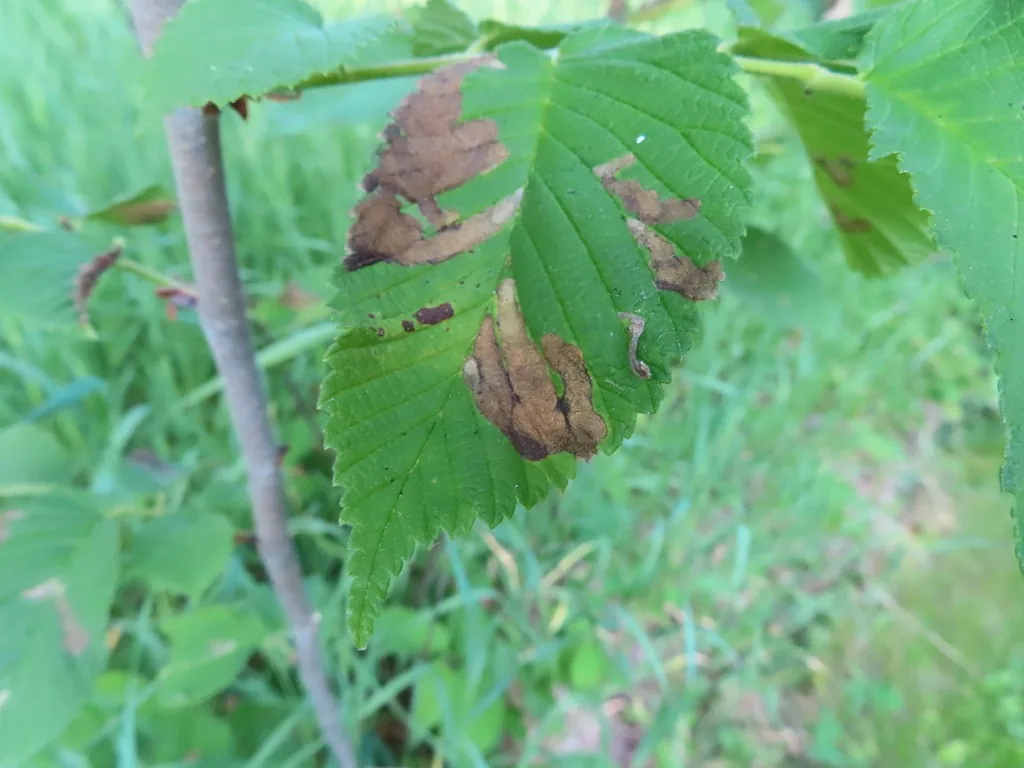
Elm leaf with several brown, papery blotch mines made by elm leafminer larvae, the damage most people notice in late spring
Elm leaf with several brown, papery blotch mines made by elm leafminer larvae, the damage most people notice in late spring. (c) Eric Schmidt, some rights reserved (CC BY) — via iNaturalist, CC BY 4.0
On this page
  1. Identification
  2. Look-alikes
  3. Where it lives
  4. Biology
  5. Damage and signs
  6. Health risk
  7. Control
  8. Related profiles
  9. Common questions
  10. Sources

How to identify it

  • Adults are about 3 mm long and look like tiny black wasps or flies; males are rare or absent.[1][2]
  • Larvae are tiny and white with pale brown heads, feeding inside the leaf.[2]

Look-alikes

Look-alikeHow to tell them apart
Elm leaf beetleAnother elm pest, whose larvae skeletonize leaves rather than mining them.[1]

Where it lives

A European sawfly introduced to the United States before 1898. UMass (Massachusetts) describes its timing in New England, and NC State covers it in North Carolina.[1][2]

US map: states named in the cited sources or covered by their state extension guides.

Biology and life cycle

Adults emerge as new elm leaves expand, in May in New England, and insert up to 25 eggs per leaf through slits cut with a saw-like ovipositor.[1][2]

Grown larvae drop to the soil, so damage is often discovered after they have left.[2]

Damage and signs

  • Blotch mines form between lateral veins and may merge; mined areas brown and may drop out, leaving holes.[1][2]
  • Heavy mining can defoliate trees, though most elms reflush and look fine by late summer; hosts include American, Camperdown, English, Scotch and Siberian elms.[1][2]

Health risk

None to people or pets.[1][2]

Control

Traps and physical control

On small trees, pick and destroy mined leaves.[1][2]

Pesticides

Where it was a problem before, target adults before egg laying or apply a systemic while mines are new; sprays after mid-July don't help.[1][2]

Common questions

Why are my elm leaves full of brown blotches in spring?
Elm leafminer larvae feeding between the veins are a common cause.[1][2]

Sources

  1. UMass Extension Landscape, Nursery and Urban Forestry Program (Landscape Insect & Mite Guide), “Fenusa ulmi (Elm Leafminer).” www.umass.edu/agriculture-food-environment/landscape/publications-resources/insect-mite-guide/fenusa-ulmi (accessed 2026-10-16)
  2. NC State Extension, “Elm Leafminer (PDIC Factsheet).” content.ces.ncsu.edu/elm-leafminer (accessed 2026-10-16)
  3. iNaturalist, “Fenusa taxon page (order and family).” www.inaturalist.org/taxa/176454 (accessed 2026-10-06)

Updated 2026-11-12. Built from sourced records. Spot an error? Tell us.