On this page
How to identify it
- The aphids are tiny, about 0.08 inch long, and coated with wax; see where the sources disagree on color. Uncurled leaves show them mixed with drops of honeydew.[2][3]
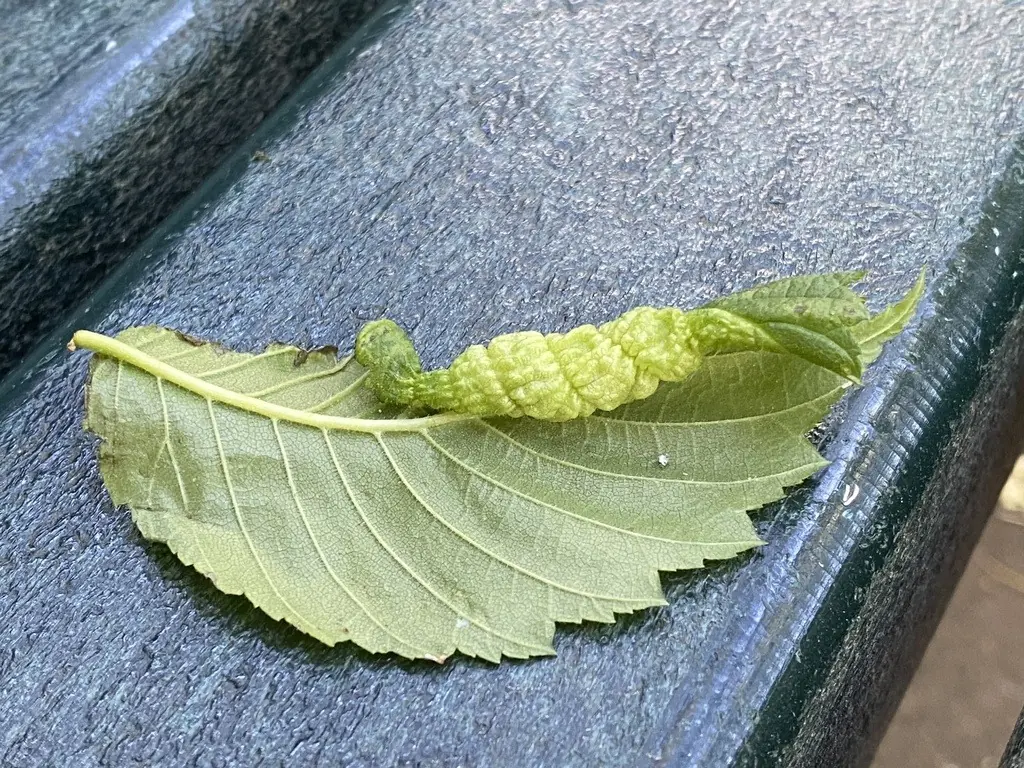
- Infested elm leaves roll under from the edge toward the midrib, curl and wrinkle, often turning reddish or brown, and fill with aphids and shed skins.[1][2][3]
- By late June the crowded leaf rolls overflow with aphids.[1]
Look-alikes
| Look-alike | How to tell them apart |
|---|---|
| Woolly apple aphid | A related Eriosoma aphid that also uses elm but spends the summer on apple, forming white woolly patches and galls on bark and roots.[2] |
Where it lives
Found on American elm in New England and on elms in the Pacific Northwest.[1][2]
Biology and life cycle
Eggs overwinter in elm bark crevices and hatch as leaves unfold; one wingless female can produce about 200 young without mating.[1][2][3]
Winged aphids leave the curled leaves for serviceberry, feed on its roots through summer, then fly back to elm in early fall to lay eggs.[1][2][3]
Damage and signs
- On elm the damage is mostly cosmetic: UMass calls it likely only of aesthetic interest and the Wisconsin DNR a minor pest, though the PNW handbook says heavy infestations can weaken small trees.[1][3][2]
- Root feeding can badly damage serviceberry seedlings; UMass cites a study where up to 85 percent of saskatoon berry seedlings were lost.[1]
Health risk
It feeds on elm and serviceberry. UMass Extension, the PNW Insect Management Handbook and the Wisconsin DNR describe plant damage only and don't mention any risk to people or pets.[1][2][3]
Control
Prevention
Avoid planting elm near serviceberry, although the winged aphids can travel long distances. The Wisconsin DNR says some American elm cultivars resist it; Kentucky researchers found no damage on the Lewis and Clark (Prairie Expedition) elm.[1][3]
Traps and physical control
On small trees, pick off and destroy curled leaves with aphids early in the season.[1]
Biological control
Lady beetles, lacewings, hover fly larvae, the plant bug Deraeocoris aphidiphagus and parasitoid wasps attack it; see where the sources disagree on how well they work.[1][2][3]
Pesticides
Check trees as they leaf out; once leaves are curled the damage can't be undone. See where the sources disagree on whether spraying helps.[2][3]
Where the sources disagree
Spraying: the PNW handbook says any pesticide has to go on before leaves curl; the Wisconsin DNR says chemical control is generally not necessary and rarely effective, because the aphids are sheltered in curled leaves and underground; UMass says it may not need management at all.[2][3][1]
Natural enemies: the PNW handbook says predators are often already at work when the aphids are noticed; UMass says their effectiveness has been questioned.[2][1]
Color: the PNW handbook describes light gray wax; the Wisconsin DNR describes pale gray to bluish-gray aphids.[2][3]
Common questions
- Why are my elm's leaves curled and full of white fluff?
- Woolly elm aphids feeding inside the curled leaves are a common cause; on elm the damage is mostly cosmetic.[1][2][3]
- Do woolly elm aphids hurt serviceberry?
- They feed on serviceberry roots in summer and can seriously damage seedlings; UMass cites a study where up to 85 percent of saskatoon berry seedlings were lost.[1][3]
Sources
- UMass Extension Landscape, Nursery and Urban Forestry Program (Landscape Insect & Mite Guide), “Eriosoma americanum (Woolly Elm Aphid).” www.umass.edu/agriculture-food-environment/landscape/publications-resources/insect-mite-guide/eriosoma-americanum (accessed 2026-11-13)
- Pacific Northwest Insect Management Handbook (Oregon State, Washington State, University of Idaho), “Elm (Ulmus)-Aphid (Hosts and Pests of Landscape Plants).” pnwhandbooks.org/insect/hort/landscape/hosts-pests-landscape-plants/elm-ulmus-aphid (accessed 2026-11-13)
- Wisconsin Department of Natural Resources, Forestry News, “Woolly Elm Aphid Causes Elm Leaves To Curl (L. Williams, Forest Health Specialist).” forestrynews.blogs.govdelivery.com/?p=11653 (accessed 2026-11-13)
- Global Biodiversity Information Facility (GBIF), “Eriosoma americanum (Riley, 1879) (GBIF Backbone Taxonomy).” api.gbif.org/v1/species/5159594 (accessed 2026-11-13)
- iNaturalist, “Eriosoma americanum taxon page (order and family).” www.inaturalist.org/taxa/454393 (accessed 2026-10-06)