On this page
How to identify it
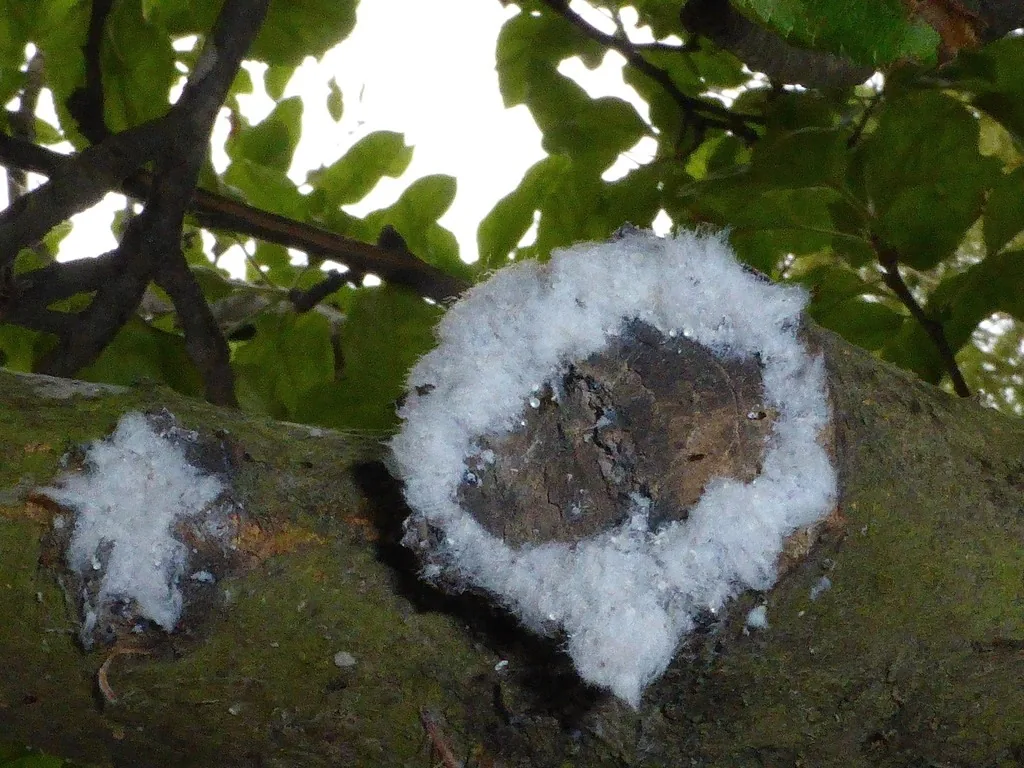
- Colonies hide under white, cottony wax in bark cracks, wounds, pruning cuts and leaf axils; UK Entomology says blowing on a colony shows the live aphids underneath.[1][2]
- The aphids are purplish, brown or reddish with short antennae and barely visible cornicles; see where the sources disagree on size.[1][2][3]
- Feeding raises globular, warty galls on branches, trunks and roots; NC State says bark can't heal over feeding sites.[1][3]
Look-alikes
| Look-alike | How to tell them apart |
|---|---|
| Mealybugs and whiteflies | Some mealybugs and whiteflies also produce white wax; check for the purplish aphids and warty bark galls underneath.[1][2] |
Where it lives
NC State says it's native to eastern North America and now found wherever apples grow. It feeds on apple, cotoneaster and pyracantha, less often pear, hawthorn and mountain ash, and UC IPM says it's especially a problem on apples in coastal areas.[3][1]
Biology and life cycle
It sucks sap from limbs, shoots, trunks, leaf axils and roots, entering through wounds; UK Entomology names pruning cuts, hail damage and periodical cicada egg scars.[1][2]
Aphids that overwinter above ground lack wax and are hard to see on bark. See where the sources disagree on where it overwinters.[1][3][2]
Damage and signs
- Root galls are what hurt: NC State and UK Entomology say infested roots end up short and fibrous, trees may have yellowish foliage, and young trees can be easily uprooted. Above-ground colonies matter little on mature trees.[1][3][2]
- Some varieties get infested at the calyx end of the fruit, and honeydew from colonies can lead to sooty mold.[1][2]
- NC State says colonies on leaves and shoots aren't a good guide to whether the roots are infested.[3]
Health risk
It feeds on apple and related plants. UC IPM, UK Entomology and NC State Extension describe plant damage only and don't mention any risk to people or pets.[1][2][3]
Control
Prevention
Where it's a serious problem, choose trees on resistant Malling-Merton rootstocks such as M106 or M111; UK Entomology says B9, M9, M26 and the P series are more susceptible.[1][2][3]
Don't bring infested nursery stock into a planting, NC State advises.[3]
Biological control
The wasp Aphelinus mali can completely control above-ground colonies if broad-spectrum insecticides aren't used; parasitized aphids turn into black mummies. Lady beetles, lacewings and syrphid fly larvae also feed on them.[1][2][3]
Pesticides
Horticultural oil or insecticidal soap give partial control of colonies above ground; UC IPM lists acetamiprid or imidacloprid only after petal fall to protect bees. See where the sources disagree on spraying.[1][2][3]
Where the sources disagree
Size: UC IPM says 1/20 to 1/10 inch; NC State says about 1/16 inch (1.8 mm).[1][3]
How serious: UK Entomology calls it a serious pest, especially of young trees; UC IPM and NC State say above-ground colonies do little harm and the root galls are what matter.[2][1][3]
Spraying: UC IPM lists products for above-ground colonies; NC State warns some carbamate and pyrethroid sprays can make things worse by killing parasites, and NC State and UK Entomology say no insecticide controls root colonies on bearing trees.[1][3][2]
Overwintering: NC State says it overwinters on elm as eggs or nymphs and stays on apple where there are no elms; UK Entomology says winged forms fly to elms in fall while some wingless forms stay on apple; UC IPM describes aphids overwintering on apple bark.[3][2][1]
Common questions
- What is the white fuzz on my apple tree bark?
- Likely woolly apple aphid colonies hidden under their own white wax; blow on the fluff to see the purplish aphids.[1][2]
- Do the bark galls hurt the tree?
- Not much above ground, especially on mature trees; root galls are what stunt young trees and can leave them easily uprooted.[1][3][2]
Sources
- University of California Statewide IPM Program, “Woolly Apple Aphid (Pests in Gardens and Landscapes).” ipm.ucanr.edu/PMG/GARDEN/FRUIT/PESTS/woolyapaph.html (accessed 2026-11-13)
- University of Kentucky Entomology, “ENTFACT-219: Woolly Apple Aphid.” entomology.mgcafe.uky.edu/ef219 (accessed 2026-11-13)
- NC State Extension, “Woolly Apple Aphid (J. Walgenbach, February 2015).” content.ces.ncsu.edu/woolly-apple-aphid (accessed 2026-11-13)
- Global Biodiversity Information Facility (GBIF), “Eriosoma lanigerum (Hausmann, 1802) (GBIF Backbone Taxonomy).” api.gbif.org/v1/species/2075983 (accessed 2026-11-13)
- iNaturalist, “Eriosoma lanigerum taxon page (order and family).” www.inaturalist.org/taxa/360308 (accessed 2026-10-06)