On this page
How to identify it
Look-alikes
| Look-alike | How to tell them apart |
|---|---|
| Green apple aphid | Nearly identical in looks and habits; NC State manages both the same way.[1] |
| Rosy apple aphid | Unlike rosy apple aphids, which move to plantain for part of the year, spirea and green apple aphids stay on apple.[1] |
Where it lives
Widely distributed; Illinois Extension says it's found in every state on spireas and crabapples, and NC State calls it very common in North Carolina.[3][1]
Biology and life cycle
It overwinters as glossy black eggs on bark or buds, and spring stem mothers give birth to live young without mating; K-State says each can produce up to 80 young.[1][2][3]
Winged forms appear when colonies get crowded and spread to other host plants, and several generations follow through the season.[1][2][3][4]
Heavy rain and wind knock aphids off plants, and Illinois Extension says a fungus can kill them in hot, humid weather.[2][3]
Damage and signs
Health risk
It feeds on plant sap. NC State, K-State, Illinois Extension and Clemson describe plant damage only and don't mention any risk to people or pets.[1][2][3][4]
Control
Traps and physical control
K-State says forceful water sprays, about twice a week, knock aphids off without disturbing their natural enemies.[2]
Biological control
Lady beetles, syrphid (hover) fly larvae and lacewing larvae feed on them; Clemson says these and parasites may keep them in check if insecticides are avoided.[1][2][4]
Pesticides
If treatment is needed, K-State and Clemson suggest insecticidal soap or horticultural oil, which work only on contact and need thorough coverage but are less harmful to beneficial insects.[2][4]
Where the sources disagree
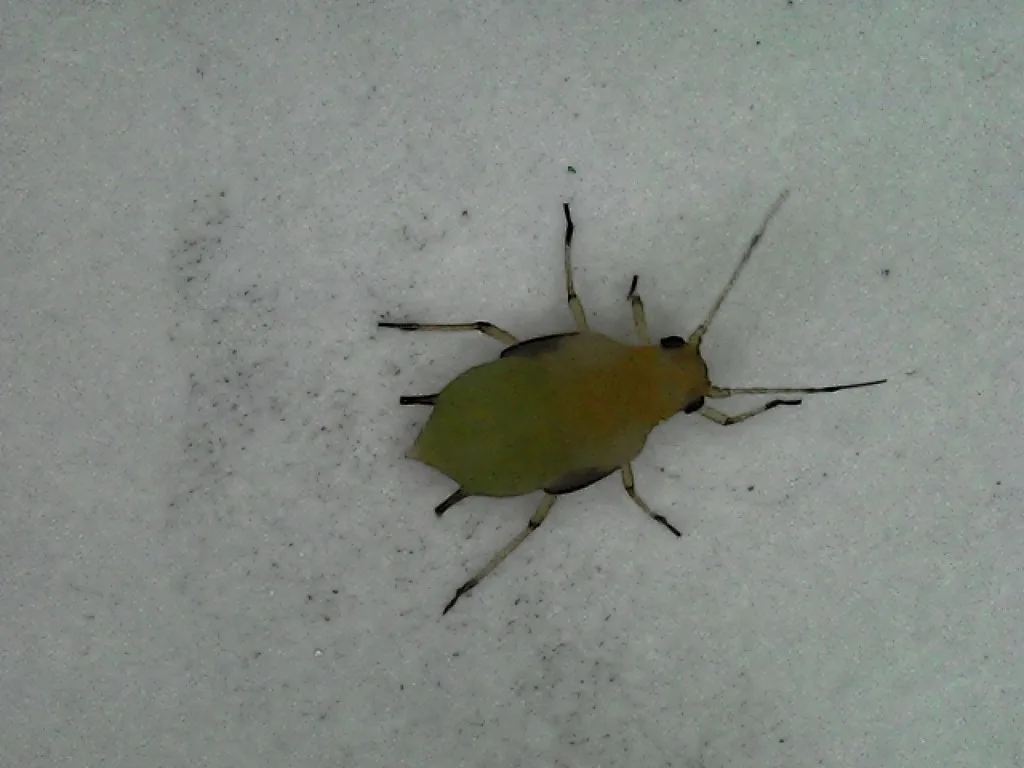
Color: NC State describes green bodies with pale brown heads, K-State says bright yellow-green, and Illinois Extension says a dark head and thorax with a pale green abdomen.[1][2][3]
Where eggs overwinter: NC State says spirea aphids stay on apple year-round and lay eggs on its bark; Illinois Extension says eggs overwinter on spirea in northern states.[1][3]
How much it matters: NC State says high populations usually don't affect fruit or yield on mature apple trees; Illinois Extension rates it common but low in severity, with heavy honeydew and sooty mold especially on spirea.[1][3]
Name: Illinois Extension uses Aphis citricola; GBIF lists the accepted name as Aphis spiraecola Patch, 1914.[3][5]
Common questions
- What are the green bugs covering my spirea tips?
- Often spirea aphids, which crowd the tender tips of spirea and apple relatives in spring and leave honeydew.[1][2][3]
- Do I need to spray?
- Usually not. Lady beetles, lacewings and hover fly larvae often keep them in check; K-State suggests forceful water sprays, and soap or horticultural oil if needed.[1][2][4]
Sources
- NC State Extension, “Green Apple Aphid and Spirea Aphid (PDIC Factsheet).” content.ces.ncsu.edu/green-apple-aphid-spirea-aphid (accessed 2026-11-13)
- Kansas State University Extension Entomology, “Spirea Aphid: Watch out for this 'Sucking' Insect (R. Cloyd, 2016, updated 2026).” blogs.k-state.edu/kansasbugs/2016/05/18/spirea-aphid-watch-out-for-this-sucking-insect/ (accessed 2026-11-13)
- University of Illinois Extension, “Spirea Aphid (Aphis citricola) (HortAnswers).” web.extension.illinois.edu/hortanswers/detailProblem.cfm?PathogenID=102 (accessed 2026-11-13)
- Clemson Cooperative Extension, Home & Garden Information Center, “Apple & Crabapple Insects (HGIC 2001, revised May 2025).” hgic.clemson.edu/factsheet/apple-crabapple-insects/ (accessed 2026-11-13)
- Global Biodiversity Information Facility (GBIF), “Aphis spiraecola Patch, 1914 (GBIF Backbone Taxonomy).” api.gbif.org/v1/species/2072761 (accessed 2026-11-13)
- iNaturalist, “Aphis spiraecola taxon page (order and family).” www.inaturalist.org/taxa/330185 (accessed 2026-10-06)