On this page
How to identify it
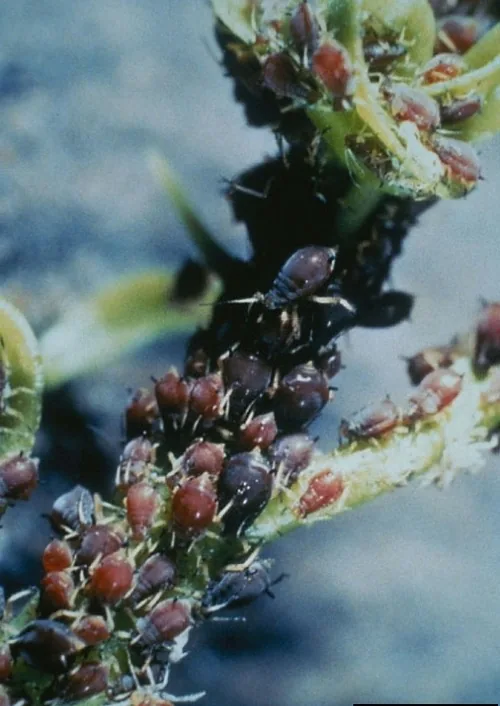
- Wingless adults are shiny black and 1.5 to 2.8 mm long; winged adults are shiny dark brown to black. Nymphs are reddish brown and resemble small adults.[2][1]
- Check the legs and antennae: there is a darker band where the two longest leg segments meet, and in wingless adults the antennae are not striped, with roughly the outer half dark. UF's field key puts it simply: the 'knees' of all three pairs of legs are very dark, and the dark part of the antenna is about 1/2 of its length.[2][1][4]
- The cauda (the short, dark tail) is slightly shorter than the cornicles (the two tailpipes on the rear of the abdomen) and carries about 30 hairs. UF's key says the siphunculi (tailpipes) are only slightly longer than the cauda.[2][4]
- In winged adults the three antennal segments closest to the head are black; EFSA notes the third segment contrasts with the partly pale fourth.[2][1]
- Colonies sit on tender new shoots, leaves and flower buds, often in large numbers on stems, leaf veins and leaf undersides, so a hand lens helps.[1][2]
- UF/IFAS says it is larger than the other aphids on citrus, with very shiny black wingless adults and dark reddish-brown nymphs. Winged adults are the easiest to recognize, but they are seen less often because they leave the colony soon after they develop, and mixed colonies of two or more species are common.[4]
Look-alikes
| Look-alike | How to tell them apart |
|---|---|
| Black citrus aphid | Black citrus aphid is somewhat smaller, its wingless adults have antennae banded black and white, and it doesn't leave a red smear when squashed on white paper, as the brown citrus aphid does. In UF's key, black citrus aphid adults are matte rather than shiny black, and darkened joints make the antennae look striped.[2][1][4] |
| Melon (cotton) aphid | Melon (cotton) aphid also carries citrus tristeza virus but is a less efficient vector, and it can live on citrus only while there is new flush, moving to and from other plants. UF's key adds that its tail is much paler than its tailpipes and its 'knees' are pale, and UF's citrus guide says it is dark but mottled rather than shiny black.[2][3][4][5] |
| Cowpea aphid | Usually dark 'knees' only on the hind legs, only about a third of the antenna dark, and tailpipes much longer than the tail. UF says the two can't always be separated in the field, though cowpea aphid is not very common on citrus.[4] |
| Spirea (green citrus) aphid | Yellow or green rather than black. UF's citrus guide says it is one of the most common aphids in Florida citrus and causes curling of young flush.[4][5] |
Where it lives
Native to tropical Southeast Asia (UCR says China), it has spread to most citrus-growing areas worldwide, including Africa, Asia, Australia, South America, the Caribbean and Central America, but not California or the Mediterranean basin apart from Madeira and northwestern Iberia. It was first reported in Florida at the end of 1995. UF's profile adds New Zealand and the Pacific Islands, and says Florida's first infestations were in Dade and Broward counties, mostly on dooryard trees. UF's 2026 citrus guide says it has since become rare in Florida, possibly because of intense spraying for psyllids.[1][3][4][5]
Biology and life cycle
It feeds and reproduces on the tender new shoots, leaves and flower buds of citrus and a few close relatives. Reports from plants outside the citrus family are uncertain. UF says some reports from other plants may be misidentifications, though there is a tendency to feed on the rose family in southern Africa and Mauritius.[1][4]
In most of the world there are no males and no eggs: every aphid is a female that gives birth to live young, so a single female can start a colony. Japan is an exception, with sexual reproduction reported there.[1][2]
New citrus growth stays suitable for it for about three to four weeks, so colonies have a narrow window to build up before their food source matures.[1]
Winged forms are produced as the colonized new growth matures or deteriorates, and they fly off to find fresh growth; plants for planting are the main way it travels long distances.[1][2]
Populations build very fast. UF/IFAS says nymphs mature in six to eight days at 20°C or warmer, and cites a calculation that a single aphid could give rise to over 4,400 in three weeks without natural enemies.[4]
Damage and signs
- Heavy colonies on young shoots weaken trees and stunt growth, roll leaves and twigs, and can make flower buds drop. Their honeydew grows sooty mold, which cuts photosynthesis and spoils fruit.[1][2][3]
- It is considered the most efficient vector of citrus tristeza virus, and it spreads strains that the melon aphid transmits poorly. UCR notes severe strains began to appear in Florida about ten years after it arrived. UF/IFAS says it is six to 25 times as efficient as the melon aphid, Florida's most efficient vector before 1995, and transmits some strains other aphids can't. Its narrow host range means a winged aphid leaving one citrus tree is likely to feed next on another citrus tree.[1][3][4]
- Trees on sour orange rootstock are particularly susceptible: they suffer and die from quick decline about one to five years after infection. Some aggressive strains harm trees even on tristeza-tolerant rootstocks. UF's citrus guide says trees on sour orange rootstock often die suddenly with fruit still attached.[3][2][1][5]
Health risk
The sources treat it only as a citrus pest; none mentions bites or any risk to people or pets.[1][2]
Control
Prevention
Plant only certified citrus nursery stock and budwood; EFSA calls a budwood certification program essential because the aphid carries tristeza, and moving infested plants is its main long-distance pathway. Nursery plants grown in screened houses carry much less risk.[1]
UF/IFAS says people move tristeza faster and farther than any aphid: one pickup truck of infected nursery stock can carry the virus several hundred miles in a few hours. The first step is making sure budwood and nursery stock are free of disease.[4]
Sanitation
Check new shoot growth regularly; winged forms can also be monitored with yellow sticky traps or suction traps.[1]
Aphids can fly 30 km or more, but most flight is probably local, so nearby sources matter most. UF/IFAS notes that abandoned or volunteer citrus and urban trees can harbor both the aphid and the virus.[4]
Biological control
The aphid has many natural enemies, and EFSA says their effect can be maximized by conserving them, for example with cover crops and selective pesticides. Ants that tend aphids for honeydew can interfere with those enemies.[1]
UF's citrus guide says lady beetles, hoverflies and lacewings normally keep aphids on citrus flush below levels that warrant treatment, and mature groves sustain little damage and should not need treatment. Treatment is warranted only in young groves (under 3 years old) when more than 50% of expanding shoots are infested, Surveys should be done early in each flush, and because trees take time to take up systemic products, those work only as preventive treatments, not as a response to an outbreak.[5]
Where the sources disagree
Status in Florida: UF's original profile expected it to spread throughout Florida; UF's 2026 citrus guide says it has become rare there.[4][5]
Native range: EFSA says it is native to tropical Southeast Asia; UC Riverside says it originated in China.[1][3]
Common questions
- How do I know if the black aphids on my citrus are brown citrus aphids?
- Look for shiny black wingless adults with a dark band at the leg joints, unstriped antennae dark over the outer half, or winged adults with the three inner antennal segments black. A brown citrus aphid leaves a red smear when squashed on white paper; black citrus aphids don't and have banded antennae.[2][1]
- Is the brown citrus aphid in California?
- EFSA's 2018 assessment lists California, along with the Mediterranean basin, as one of the citrus regions it had not spread to.[1]
- Why is the brown citrus aphid so dangerous to citrus?
- It spreads citrus tristeza virus far more efficiently than other aphids, and the virus can kill trees on sour orange rootstock quickly.[1][3]
- Is the brown citrus aphid still common in Florida?
- No longer. UF's 2026 citrus guide says it has become rare in Florida, possibly because of intense spraying for psyllids, though it remains the most important vector of citrus tristeza virus.[5]
Sources
- European Food Safety Authority (EFSA Journal), “EFSA Panel on Plant Health. Pest categorisation of Toxoptera citricida. EFSA Journal 16(1):5103 (2018) (abstract).” doi.org/10.2903/j.efsa.2018.5103 (accessed 2026-11-14)
- USDA APHIS PPQ Identification Technology Program (idtools.org), “Brown citrus aphid (Citrus Pests identification tool).” idtools.org/citrus_pests/index.cfm?packageID=63&entityID=363 (accessed 2026-11-14)
- Center for Invasive Species Research, University of California, Riverside, “Brown Citrus Aphid.” cisr.ucr.edu/invasive-species/brown-citrus-aphid (accessed 2026-11-14)
- University of Florida/IFAS Extension (Featured Creatures), “Brown Citrus Aphid, Toxoptera citricida (Kirkaldy), EENY-007/IN133 (S. E. Halbert and L. G. Brown).” ask.ifas.ufl.edu/publication/IN133 (accessed 2026-11-14)
- University of Florida/IFAS Extension (EDIS), “2026-2029 Florida Citrus Production Guide: Soft-Bodied Insects Attacking Foliage and Fruit, ENY-604/CG004 (L. Diepenbrock, L. Stelinski, X. Martini and J. Qureshi).” ask.ifas.ufl.edu/publication/CG004 (accessed 2026-11-14)
- iNaturalist, “Aphis citricidus taxon page (order and family).” www.inaturalist.org/taxa/1609507 (accessed 2026-11-14)