On this page
How to identify it
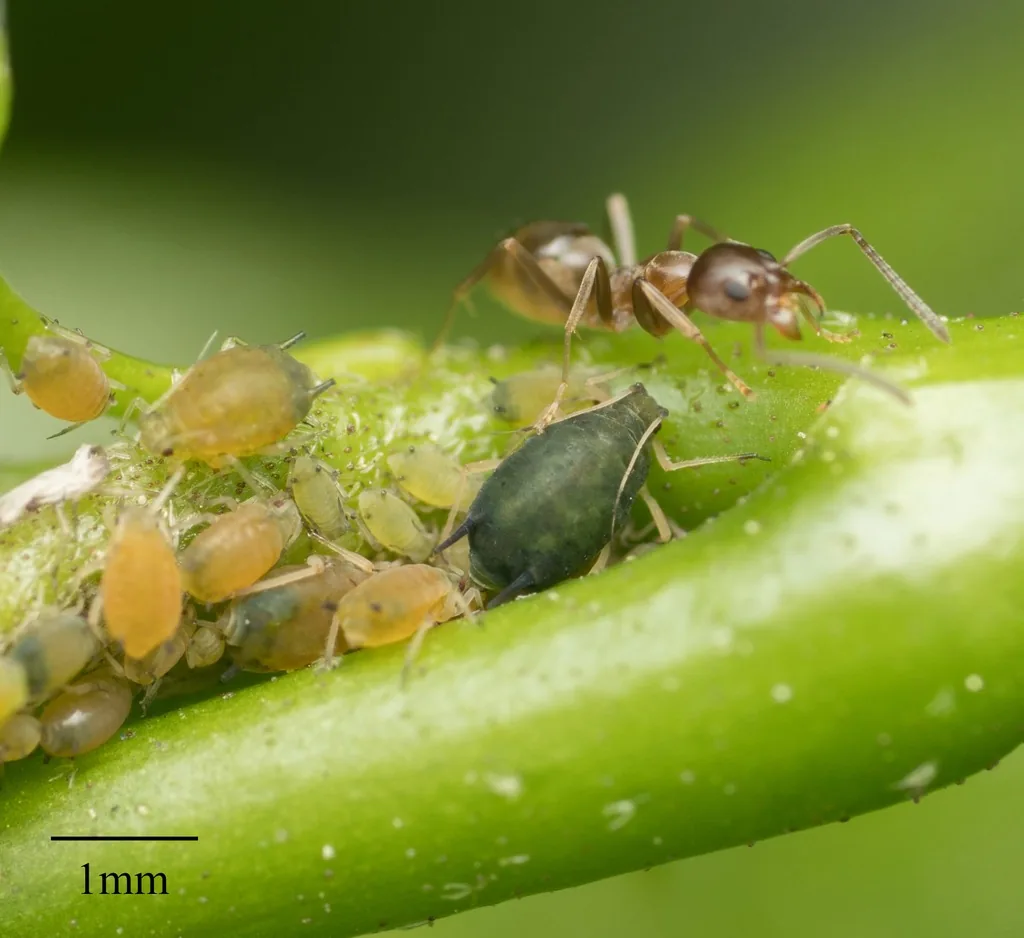
- Wingless adults are soft-bodied and about 1.0 to 1.5 mm long. They come in two color forms: yellowish green and a very dark green that looks black until seen in strong light. UF/IFAS gives wingless females as 1 to 2 mm, most often light green mottled with dark green but also whitish, yellow, pale green or dark green, with pale legs tipped in black and black cornicles. Small yellow forms appear when colonies are crowded or plants are stressed.[1][4]
- UC IPM notes that the darker green-to-black forms are larger and multiply much faster than the small yellow ones.[5]
- Winged adults are about 1.25 mm long, with a black head and thorax and a yellow to dark green abdomen. UF/IFAS gives 1.1 to 1.7 mm, a yellowish green abdomen with a darker tip, and brown wing veins.[1][4]
- The cornicles (the two tubes at the rear) are short, and there is no distinct notch at the base of the antennae.[6]
- Nymphs range from tan to gray or green, often with a darker head, thorax and wing pads, and look dull because they are dusted with wax.[4]
Look-alikes
| Look-alike | How to tell them apart |
|---|---|
| Green peach aphid | Its cornicles are long, about the length of the body, with only the tips black, and its head has a distinct indentation where the antennae attach.[6] |
| Spirea aphid | UF/IFAS says the spirea aphid is commonly confused with the melon aphid, and that one way to tell them apart is to examine the cauda, the tail-like tip of the abdomen.[4] |
Where it lives
It occurs worldwide. In the US it is an important pest of row crops such as cotton, of melons and other vegetables, and of many ornamentals; UC IPM calls it the most common aphid on cotton in California. UF/IFAS says it occurs in tropical and temperate regions worldwide except the northernmost areas, is regularly a pest in the Southeast and Southwest and occasionally damaging everywhere, and can show up almost anywhere because it overwinters in greenhouses and can arrive on spring transplants.[2][5][4]
Biology and life cycle
In summer there are no males: females give birth to live young without mating, and nymphs can be grown and giving birth within days. Mississippi State counts 7 to 10 days per generation and says there may be more than 30 generations a year.[2][1]
NC State says each female produces an average of 84 nymphs, and winged adults develop when colonies get crowded or food runs short, then fly to new plants.[1]
In the Southeast some spend part of the winter as wingless adults in soil or debris and feed on weeds during warm spells; in the northern US, melon aphids also produce males and have a more complex life cycle.[1][2]
Clones specialize: in one study, aphids collected from cotton could not colonize cucumber and those from cucumber could not colonize cotton, and host races on cucurbits, cotton, eggplant and pepper differed in which insecticides they resisted. UF/IFAS notes that aphids reared on cotton could be moved to okra but not to cucurbits.[7][8][4]
In the North, females hatch in spring from eggs on overwintering hosts such as catalpa and rose of Sharon, multiply without mating all summer, and late in the season produce males and egg-laying females. The eggs are yellow at first and soon turn shiny black, and they are the only stage that survives cold winters. In the South, at least as far north as Arkansas, sexual forms aren't important.[4]
UF/IFAS says that unlike many aphids it isn't hurt by hot weather. The nymphal period averages about seven days, adults reproduce for about 15 days, and the best temperatures for reproduction are about 69.8 to 80.6°F.[4]
Damage and signs
- Feeding causes distorted growth, lower yields, poorer quality and early-ripened fruit, and fruit can be coated with aphids, honeydew and cast skins. UF/IFAS says they feed on leaf undersides and vine tips; leaves may yellow and die early, and the curling cuts the plant's photosynthesis.[1][2][4]
- On cotton, heavy populations crinkle and cup leaves and stunt seedlings; honeydew grows sooty mold and, once bolls open, makes 'sticky cotton'.[5]
- Hosts include melons and other cucurbits, citrus, cotton, okra, beans, tomatoes, strawberries, asparagus, pepper, eggplant, hibiscus and many flowers and woody ornamentals. Clemson calls it a severe problem for watermelons, muskmelons, cucumbers and squash. UF/IFAS says it can be a serious pest of watermelon, cucumber and cantaloupe and, to a lesser degree, squash and pumpkin, and also lists beet, carrot, celery, parsley, pea and radish; cotton, an important host in the South, explains its other name.[1][9][3][2][10][4]
- It spreads several plant viruses, including cucumber mosaic virus. UC IPM notes that aphid-spread viruses are hard to prevent by killing aphids, because an aphid needs only a few minutes to pass the virus on. UF/IFAS names cucumber mosaic virus, watermelon mosaic virus 2 and zucchini yellow mosaic virus, which spread despite insecticide and oil sprays, probably because they can be transmitted within 15 seconds; melon aphids can also infect crops they don't colonize.[1][9][3][4]
Health risk
It is a plant pest that feeds on sap; none of the sources describes any harm to people.[1][2][3]
Control
Prevention
Silver reflective mulch repels aphids from seedlings and small plants and has reduced aphid-spread viruses in squash, melon and other vegetables; covers protect seedlings. UF/IFAS says fewer aphids land on plants over reflective silver or white mulch than over bare soil, with less aphid-spread virus and higher yields, and that row covers can hold aphid numbers down.[3][10][4]
Insecticides used for other pests can kill the aphid's natural enemies and let numbers balloon; in home gardens, relying on natural enemies is often enough.[2][5]
UF/IFAS cultural steps: destroy infested crops right after harvest, remove weedy overwintering hosts, and expect more trouble downwind of infested fields, since these weak fliers are blown about. A forceful water spray knocks them off sturdy home-garden plants.[4]
Biological control
Lady beetles, flower fly (syrphid) larvae, lacewings and tiny parasitic wasps attack it, and a fungal disease can wipe out large outbreaks. UC IPM names the wasp Lysiphlebus testaceipes as a key natural enemy; parasitized aphids turn into tan or brown 'mummies'. UF/IFAS says Lysiphlebus testaceipes sometimes parasitizes up to 99% of them and fungi also attack them, while ants that tend colonies for honeydew may hinder predators.[1][2][5][11][4]
In greenhouses, the parasitic wasp Aphidius colemani is released against melon and green peach aphids.[6][2]
Pesticides
Because melon aphids resist many insecticides, NC State suggests insecticidal soap or horticultural oil, applied with thorough coverage since thick foliage shelters them. UC IPM reports resistance to organochlorine, organophosphate, carbamate and pyrethroid insecticides, warns that repeated neonicotinoid use can bring resistance to the whole class, and notes pyrethroids can make cotton aphid numbers climb. UF/IFAS adds that treating spotty early-season infestations promptly can prevent much greater damage later, and that resistance to chlorinated hydrocarbon, organophosphate and pyrethroid insecticides is widespread.[1][5][2][4]
Where sources disagree
Host range: NC State says melon aphids have been found on plants in 25 plant families; Mississippi State says more than a hundred. UF/IFAS counts at least 60 host plants in Florida and perhaps 700 worldwide, noting that some records may be wrong because the species' taxonomy is uncertain.[1][2][4]
Speed: NC State says a nymph can mature in about 5 days; Mississippi State gives 7 to 10 days per generation. UF/IFAS says a generation can be completed in about seven days under warm conditions.[1][2][4]
Offspring per female: NC State gives an average of 84 nymphs; UF/IFAS gives about 70 to 80, at about 4.3 a day.[1][4]
Common questions
- What are the tiny aphids curling my cucumber leaves?
- Often melon aphids, a severe pest of watermelons, muskmelons, cucumbers and squash. Look for yellow-green or nearly black aphids under the leaves, with sticky honeydew.[10][1]
- Why did aphids get worse after I sprayed?
- Sprays aimed at other pests can kill the lady beetles, parasitic wasps and other enemies that hold aphids down, and many melon aphid populations resist common insecticides, so numbers can climb afterward.[2][5][1]
- Can I just hose melon aphids off?
- On sturdy home-garden plants, yes. UF/IFAS says a forceful spray of water dislodges them and lessens damage, though it isn't practical in most vegetable fields because it can injure plants.[4]
Sources
- NC State Extension, “Melon Aphid (PDIC Factsheet, Baker; revised 2023).” content.ces.ncsu.edu/melon-aphid (accessed 2026-11-11)
- Mississippi State University Extension, “Melon Aphid/Cotton Aphid, Vol. 8, No. 28.” extension.msstate.edu/newsletters/bugs-eye-view/2022/melon-aphidcotton-aphid-vol-8-no-28 (accessed 2026-11-11)
- University of California Statewide IPM Program, “Aphids (Pest Notes).” ipm.ucanr.edu/home-and-landscape/aphids/ (accessed 2026-11-11)
- University of Florida IFAS Extension (EDIS), “Melon Aphid or Cotton Aphid, Aphis gossypii Glover, EENY-173/IN330 (J. L. Capinera; Featured Creatures).” ask.ifas.ufl.edu/publication/IN330 (accessed 2026-11-14)
- University of California Statewide IPM Program, “Cotton Aphid (Cotton Pest Management Guidelines).” ipm.ucanr.edu/agriculture/cotton/cotton-aphid/ (accessed 2026-11-11)
- UMass Amherst Center for Agriculture, Food, and the Environment, “Aphids on Greenhouse Crops.” www.umass.edu/agriculture-food-environment/greenhouse-floriculture/fact-sheets/aphids-on-greenhouse-crops (accessed 2026-11-11)
- PeerJ, via PubMed, “The host range of Aphis gossypii is dependent on aphid genetic background and feeding experience (Ma et al. 2019).” pubmed.ncbi.nlm.nih.gov/31579627/ (accessed 2026-11-11)
- Pest Management Science, via PubMed, “Insecticide resistance traits differ among and within host races in Aphis gossypii (Carletto et al. 2010).” pubmed.ncbi.nlm.nih.gov/19908228/ (accessed 2026-11-11)
- University of Minnesota Extension, “Aphids in home yards and gardens.” extension.umn.edu/yard-and-garden-insects/aphids (accessed 2026-11-11)
- Clemson Cooperative Extension Home & Garden Information Center, “Integrated Pest Management (I.P.M.) for Aphids.” hgic.clemson.edu/factsheet/integrated-pest-management-i-p-m-for-aphids/ (accessed 2026-11-11)
- University of California Statewide IPM Program, “Aphid Lysiphlebus Parasitoid (Natural Enemies Gallery).” ipm.ucanr.edu/natural-enemies/aphid-lysiphlebus-parasitoid/ (accessed 2026-11-11)
- iNaturalist, “Aphis gossypii taxon page (order and family).” www.inaturalist.org/taxa/309466 (accessed 2026-11-11)