On this page
How to identify it
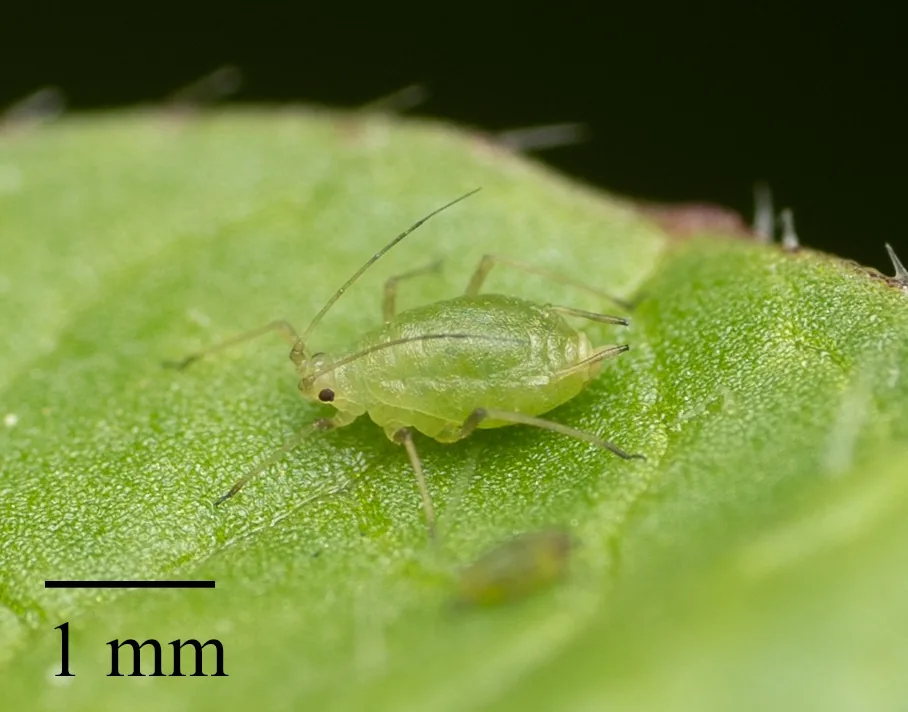
- Wingless adults are light to dark green, yellowish green or pink, with red eyes and three dark green lines down the back. UF/IFAS gives wingless adults as about 1.7 to 2.0 mm long.[2][1][4][5]
- Its cornicles (the two tailpipes at the rear) are long. UF/IFAS says they are moderately long, unevenly swollen and the same color as the body.[3][5]
- Adults may or may not have wings; nymphs are wingless and look like small adults.[2]
- Winged adults have a black head and thorax and a yellowish-green abdomen with a large dark patch on top, and measure 1.8 to 2.1 mm.[5]
- Eggs, laid on Prunus trees, are elliptical, about 0.6 mm long and 0.3 mm wide, and turn from yellow or green to black. Nymphs start greenish and soon turn yellowish; those that will become winged females may be pinkish.[5]
Look-alikes
| Look-alike | How to tell them apart |
|---|---|
| Other aphids | Many aphids look alike. Wisconsin separates the common vegetable aphids by color and markings, such as the pale green, black-legged pea aphid; the three dark lines on the back point to green peach aphid.[4][2] |
| Melon aphid | Pale yellow to brown or nearly black with black cornicles, rather than pale green with three dark stripes.[4] |
Where it lives
Found around the world, in fields, gardens and greenhouses; in the northern United States it overwinters on peach and other Prunus, while in the Southeast it breeds without eggs. Penn State calls it a common peach and nectarine pest in Pennsylvania, Minnesota and Wisconsin extension list it among the common aphids in those states, and NC State covers it in North Carolina.[2][6][1][3][4]
Biology and life cycle
In cold-winter areas it overwinters as eggs or wingless females under peach buds and on other Prunus such as cherry. In spring the young become stem mothers that give birth to live young, and winged forms appear in June and leave for summer hosts.[1][2][4]
In the Southeast no eggs are laid; females give birth to young females all season. UF/IFAS says populations in Florida cycle continuously on annual plants, and beet, Brussels sprout, cabbage, kale, potato and many winter weeds carry aphids through winter.[2][5]
A generation can take as little as 12 days, with up to 30 generations a year. UF/IFAS says a generation often takes 10 to 12 days, with over 20 generations a year in mild climates.[2][5]
In fall, winged aphids return to peach trees to overwinter. UF/IFAS says egg-laying females deposit four to 13 eggs, usually in crevices in and near the buds.[1][5]
Up to 8 generations may develop on Prunus in spring. Each wingless female produces 30 to 80 young, and winged dispersers about 20; reproduction speeds up with temperature above a threshold of about 4.3 °C (39.7 °F).[5]
Damage and signs
- It feeds on hundreds of plants, over 400 species by one count, including peach and nectarine, potato, pepper, cabbage, spinach, lettuce, tomato, ornamentals such as aster, dahlia and chrysanthemum, and weeds. UF/IFAS counts hosts in over 40 plant families; it is sometimes called the peach-potato aphid.[6][3][4][1][2][5]
- Aphids suck sap and leave honeydew and cast skins, where sooty mold can grow; damage per aphid is small, but they multiply so fast that serious harm can build quickly.[2]
- The bigger problem is viruses: it carries mosaic viruses of tobacco, tomato, lettuce, dahlia and other plants, potato leafroll and other potato diseases, and plum pox of stone fruit. UF/IFAS cites a list of over 100 viruses it transmits, including potato virus Y, beet western yellows, lettuce mosaic, turnip and cauliflower mosaic, and cucumber and watermelon mosaic; potato leafroll can cause net necrosis in tubers.[2][1][5]
- University of Minnesota says it is commonly found on cabbage but doesn't cause serious damage there.[3]
- Dense colonies on young growth cause water stress, wilting and slower growth. Early-season infestations are especially damaging to potato, and aphids or honeydew contaminating harvested greens such as spinach also cause losses.[5]
Health risk
A plant feeder; none of the sources describes any risk to people or pets.[2][1]
Control
Prevention
Avoid unnecessary broad-spectrum sprays: Penn State attributes outbreaks on peach after such sprays to the loss of natural enemies and to insecticide resistance.[1][3]
UF/IFAS says row covers can hold populations down, aluminum or white plastic mulch and mineral oil reduce virus spread, heavy nitrogen fertilizer favors aphids, infested crops should be destroyed right after harvest, and infested seedlings from greenhouses are a common source of spring outbreaks.[5]
Sanitation
Large numbers can build up on weeds in orchard ground covers, so keep weeds down around susceptible plants. UF/IFAS names field bindweed, lambsquarters and redroot pigweed as important hosts and cites an estimate of three to 16 million aphids per acre on weeds in Washington peach orchards.[1][5]
Biological control
Lady beetles, lacewings, syrphid (flower) fly larvae, leatherwing beetles and parasitic wasps attack it; predators can take time to catch up with fast-growing colonies. UF/IFAS adds insect-killing fungi, and says parasitoids, the fungus Verticillium lecanii and the predatory midge Aphidoletes aphidimyza have worked well in greenhouse vegetables.[1][3][5]
Pesticides
Sprays must reach the undersides of leaves. Resistance is a real problem: populations resist several classes of insecticide, including organophosphates. On peach and nectarine, Penn State uses a threshold of one colony per nectarine tree or five per peach tree, with weekly checks from petal fall. UF/IFAS says cold weather below about 20 °C (68 °F) makes sprays work worse, spotty early infestations are worth treating promptly, and insecticides do little to stop passing winged aphids from spreading nonpersistent viruses.[1][4][6][2][5]
Insecticide resistance
Over 40 years of research have described at least seven separate resistance mechanisms in this aphid, after years of heavy insecticide use.[6]
NC State says its high reproductive rate and pesticide resistance make it a formidable greenhouse pest, and a lesser one in landscapes, gardens and field crops.[2]
Where the sources disagree
Generations a year: NC State says up to 30; UF/IFAS says over 20 in mild climates and cites a Pennsylvania study that found at most 20 to 21.[2][5]
Cornicles: University of Minnesota calls them long; UF/IFAS calls them moderately long.[3][5]
Common questions
- What are the small green aphids on my peppers and spinach?
- Often green peach aphids, which feed on pepper, spinach and hundreds of other plants; look for three dark lines on the back.[3][4][2]
- Why is it a bigger problem than other aphids?
- It spreads many plant viruses, breeds very fast and resists several insecticides.[2][1][6]
- What eats green peach aphids?
- Lady beetles, lacewings, syrphid fly larvae, leatherwing beetles and parasitic wasps.[1][3]
- Can aphids on transplants cause problems later?
- Yes. UF/IFAS says infested greenhouse transplants carry aphids into the field and may bring insecticide resistance with them, so check seedlings before planting.[5]
Sources
- Penn State Extension, “Tree Fruit Insect Pest - Green Peach Aphid.” extension.psu.edu/tree-fruit-insect-pest-green-peach-aphid/ (accessed 2026-11-14)
- NC State Extension, “Green Peach Aphid (PDIC Factsheets).” content.ces.ncsu.edu/green-peach-aphid (accessed 2026-11-14)
- University of Minnesota Extension, “Aphids in home yards and gardens.” extension.umn.edu/yard-and-garden-insects/aphids (accessed 2026-11-14)
- University of Wisconsin-Madison Extension, “Aphids (Wisconsin Horticulture).” hort.extension.wisc.edu/articles/aphids/ (accessed 2026-11-14)
- University of Florida/IFAS Extension (Featured Creatures), “Green Peach Aphid, Myzus persicae (Sulzer), EENY-222/IN379.” ask.ifas.ufl.edu/publication/IN379 (accessed 2026-11-14)
- Insect Biochemistry and Molecular Biology, via PubMed, “The evolution of insecticide resistance in the peach potato aphid, Myzus persicae (Bass et al. 2014).” pubmed.ncbi.nlm.nih.gov/24855024/ (accessed 2026-11-14)
- iNaturalist, “Myzus persicae taxon page (order and family).” www.inaturalist.org/taxa/243745 (accessed 2026-11-14)