On this page
How to identify it
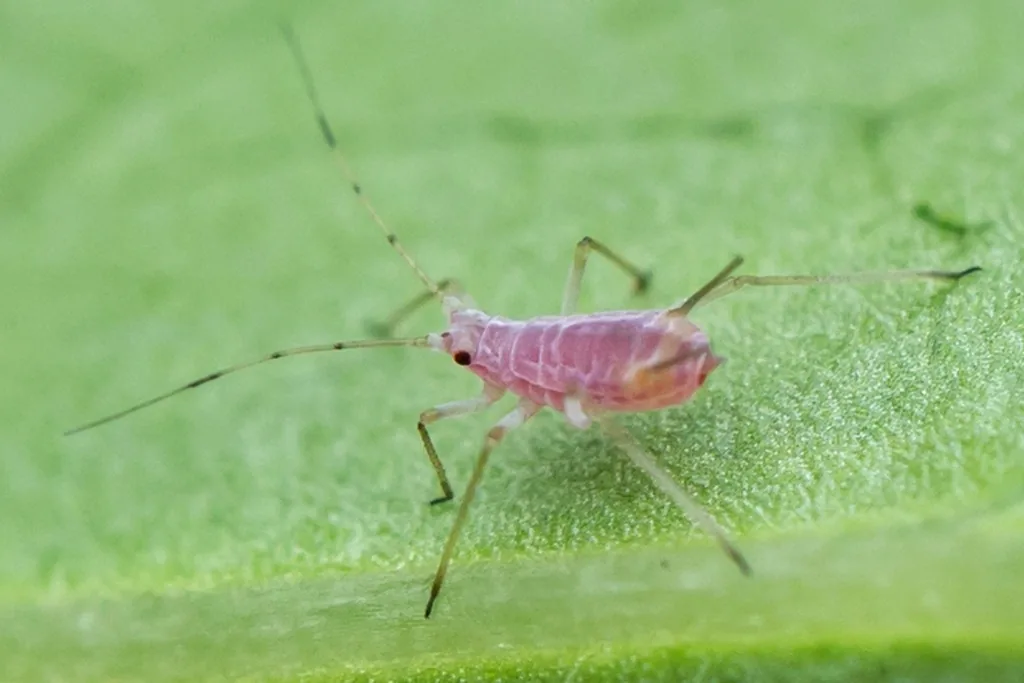
- They're soft, pear-shaped and almost 1/8 inch long, solid pink, pink-and-green mottled, or light green with a dark stripe; NC State calls them fairly large, long-bodied aphids with long legs and antennae, and UC IPM says they are much bigger and more elongate than green peach aphids.[1][2][3]
- They have a pair of long, slender tailpipe-like cornicles sticking out to the rear.[1][2]
- Pink and green forms can live together in the same colony, and winged adults appear when a colony gets crowded.[2]
- On tomatoes they usually show up on the tips of the plants later in the season than green peach aphids.[3]
Where it lives
Potato aphids occur throughout North America. GBIF holds 477 U.S. records since 1990, most from Illinois (153), California (83) and Alaska (45).[1][5]
Biology and life cycle
In South Carolina and North Carolina no eggs or males occur; wingless females feed and reproduce year-round and each bears about 50 live young without mating.[1][2]
In warm weather nymphs mature in two or three weeks; when colonies get crowded or food runs short, winged forms develop and fly to new plants. In cold weather feeding and reproduction slow down.[1][2]
NC State says rose is the only plant on which potato aphids lay their overwintering eggs; in North Carolina, as in South Carolina, no eggs or males are produced.[2][1]
They feed on a long list of plants: potato, tomato, eggplant, pepper, pea, bean, sunflower, apple, corn and rose, flowers such as lilies, iris, tulips and freesia, and weeds such as ragweed, lambsquarters, jimsonweed, pigweed, shepherd's purse and wild lettuce.[1][2]
UC IPM says that in California's mild climate most aphids reproduce without mating for most or all of the year, with females giving birth to live young, often as many as 12 a day.[4]
Damage and signs
- Feeding makes blossoms drop and new growth stunt and curl; heavily infested plants turn brown and die from the top down, although Clemson says infestations are rarely that severe.[1]
- High numbers on tomatoes distort leaves and stems, stunt plants and leave dead spots on leaves, and the honeydew they excrete grows sooty mold on leaves and fruit. UC IPM considers it more damaging than the green peach aphid.[3]
- They spread plant viruses, including mosaics and leaf roll in vegetables and, on ornamentals, viruses of freesia, iris, lily, narcissus and tulip (tulip breaking virus among them).[1][2]
Health risk
It feeds only on plants. Clemson, NC State and UC IPM describe it only as a plant pest; none of them mentions bites, stings or any effect on people or pets.[1][2][3]
Control
Prevention
Some tomato varieties tolerate potato aphids better. Varieties carrying the Mi gene (bred for nematode resistance) have been reported to be more tolerant, and laboratory work shows Mi-1 gives tomatoes resistance to the potato aphid, but UC IPM says this resistance no longer seems as effective as it once was, especially against the pink form.[3][6]
Traps and physical control
Knock aphids off with a strong stream of water or by shaking the plant; established plants can usually tolerate some aphid feeding and outgrow it.[4]
Biological control
Lady beetles and their larvae, lacewing larvae and syrphid fly larvae eat potato aphids, and parasites leave behind aphid mummies. If mummies are increasing or predators are gaining, hold off spraying. Keep ants off plants, because ants protect aphids from their enemies.[2][3][4]
Pesticides
If you need a spray, NC State suggests insecticidal soap, neem seed extracts or horticultural oil, which are much less harmful to natural enemies; it notes that most pyrethroids sold for aphids badly disrupt natural enemies. UC IPM's tomato guidelines list herbal oils, pyrethrin and insecticidal soap as acceptable on organic crops, but say soaps give less than 50% control of potato aphid and are best used to reduce numbers when parasites are active. Soaps and oils work only on contact, so cover the aphids thoroughly, repeat as needed, and don't spray drought-stressed plants or in very hot weather.[2][3][4]
More from NC State Extension
Rose is the only plant on which potato aphids lay overwintering eggs; in North Carolina females reproduce year-round with no eggs or males, each wingless female bearing about 50 live nymphs.[2]
Where the sources disagree
Color: Clemson describes solid pink, pink-and-green mottled, or light green with a dark stripe; NC State says grayish-green or pink; UC IPM describes pink and green color biotypes.[1][2][3]
Eggs: Clemson says the egg stage does not occur in South Carolina; NC State says no eggs are produced in North Carolina but that rose is the only plant on which overwintering eggs are laid.[1][2]
How damaging: Clemson says infestations are sporadic and rarely severe enough to kill plants; UC IPM considers it more damaging on tomato than the green peach aphid.[1][3]
Soap sprays: UC IPM's home aphid guide says soaps and oils, properly used, solve most aphid problems; its tomato guidelines say soaps give less than 50% control of potato aphid.[4][3]
Resistant tomatoes: UC IPM says Mi-gene resistance no longer appears as effective as it once was, especially against the pink form; a 2012 laboratory study still found Mi-1-mediated resistance to potato aphid in tomato.[3][6]
Common questions
- What are the pink aphids on my tomatoes?
- They're likely potato aphids, which can be solid pink, green or mottled. UC IPM notes the species has both a pink and a green form.[1][3]
- Can potato aphids kill tomato plants?
- Infestations are rarely that severe, but heavily infested plants can die from the top down. In tomatoes UC IPM says plants are most at risk of yield loss from heavy infestations 6 to 8 weeks before harvest.[1][3]
- Why are there aphids on my roses and my tomatoes?
- Potato aphids feed on both. NC State says rose is the only plant they lay overwintering eggs on, and Clemson lists rose among their cultivated hosts along with potato, tomato and pepper.[2][1]
Sources
- Clemson Cooperative Extension, Home & Garden Information Center, “Tomato Insect Pests (HGIC 2218).” hgic.clemson.edu/factsheet/tomato-insect-pests/ (accessed 2026-11-13)
- NC State Extension, “Potato Aphid on Ornamental Plants.” content.ces.ncsu.edu/potato-aphid-on-ornamental-plants (accessed 2026-11-13)
- University of California Statewide IPM Program, “Tomato Pest Management Guidelines: Potato Aphid.” ipm.ucanr.edu/agriculture/tomato/potato-aphid/ (accessed 2026-11-13)
- University of California Statewide IPM Program, “Aphids (Pest Notes, Home and Landscape).” ipm.ucanr.edu/home-and-landscape/aphids/ (accessed 2026-11-13)
- Global Biodiversity Information Facility (GBIF), “Macrosiphum euphorbiae: U.S. occurrence records since 1990 by state (GBIF occurrence search).” api.gbif.org/v1/occurrence/search?taxonKey=2077747&country=US&hasGeospatialIssue=false&occurrenceStatus=PRESENT&year=1990%2C2026&facet=stateProvince&facetLimit=400&limit=0 (accessed 2026-11-13)
- Planta 2012;235(2):299-309, via PubMed, “SlWRKY70 is required for Mi-1-mediated resistance to aphids and nematodes in tomato.” pubmed.ncbi.nlm.nih.gov/21898085/ (accessed 2026-11-13)
- Global Biodiversity Information Facility (GBIF), “Macrosiphum euphorbiae (Thomas, 1878) (GBIF Backbone Taxonomy).” api.gbif.org/v1/species/2077747 (accessed 2026-11-13)
- iNaturalist, “Macrosiphum euphorbiae taxon page (order and family).” www.inaturalist.org/taxa/53859 (accessed 2026-10-06)