On this page
How to identify it
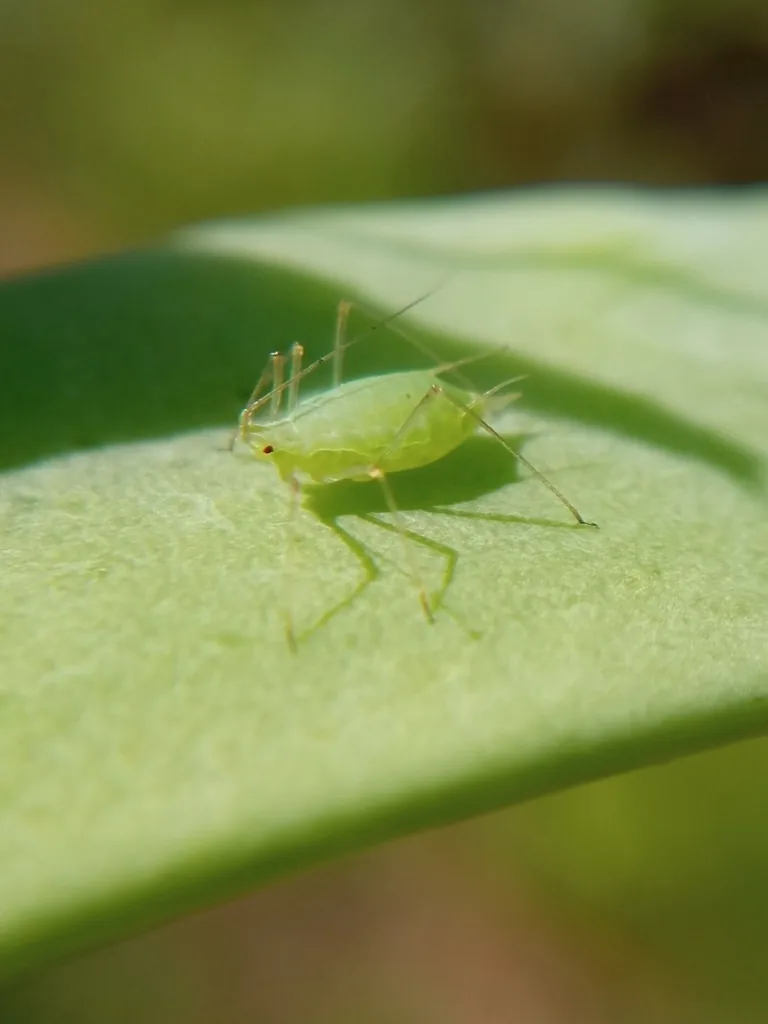
- It's light to dark green, sometimes pink, with unusually long legs and long cornicles, the tailpipe-like tubes at the rear. Manitoba Agriculture adds prominent red eyes, cornicles darker at the tips, and narrow dark bands on the antennae.[1][2][3]
- Large colonies leave sticky honeydew on the plants.[1]
Look-alikes
| Look-alike | How to tell them apart |
|---|---|
| Other aphids | The pea aphid stands out by its green color and unusually long legs and cornicles. The University of Idaho says it's larger than many aphids and is the only aphid found in significant numbers in most Pacific Northwest legume crops.[1][2] |
Where it lives
Introduced to North America from Europe and first reported in Illinois in 1878, it's now widespread across temperate Canada from coast to coast, Manitoba Agriculture says; the University of Idaho covers it as the main aphid on Pacific Northwest legumes.[3][2]
Biology and life cycle
It overwinters as eggs on perennial legumes such as alfalfa, vetch and clover. In spring, wingless stem mothers hatch and reproduce without mating, and winged offspring move to peas and other hosts.[1][3][2]
All are female through spring and summer; in fall, winged males and egg-laying females appear. See where the sources disagree on how fast they breed.[3][2]
The University of Idaho says spring migrants ride prevailing winds from central Washington and northern Oregon into eastern Washington and northern Idaho, and in some dry Pacific Northwest falls most die before eggs can overwinter, so new infestations come from warmer regions.[2]
Damage and signs
- Infestations during bloom and early pod reduce yield by removing sap, cutting seed fill and seed size, impairing nitrogen fixation and coating pods with honeydew. Manitoba says protein content doesn't appear to suffer and hot, dry summers make injury worse; severe infestations can kill plants.[1][3][2]
- It spreads legume viruses, including pea seed-borne mosaic, pea enation mosaic, bean leafroll and pea streak viruses; the University of Idaho says yield losses of 50% or more have been documented in heavy aphid years.[2]
Health risk
It feeds on legumes. UMass, the University of Idaho and Manitoba Agriculture describe crop damage only and don't mention any risk to people or pets.[1][2][3]
Control
Prevention
Pea varieties differ in how badly pea aphids damage them, so choose less susceptible ones. Early sowing can let plants grow past the vulnerable stages before aphids build up.[1][2][3]
UMass suggests harvesting or treating nearby alfalfa, vetch or clover in spring before winged adults form.[1]
Biological control
Lady beetles, lacewings, flower fly larvae and other predators, and parasitic wasps, especially Aphidius ervi, reduce aphid numbers. Fungal disease knocks down large populations in warm, humid or wet weather, and rain and wind knock aphids off plants.[1][2][3]
Pesticides
UMass says a single systemic insecticide application will control it. The University of Idaho says spraying after pea enation mosaic or bean leafroll symptoms appear is ineffective, and viruses aphids spread non-persistently, such as pea seed-borne mosaic, are harder to stop with insecticides.[1][2]
Where the sources disagree
Size: the University of Idaho says adults are about 1/8 inch (3 mm) long; Manitoba Agriculture says about 4.5 to 5 mm.[2][3]
Breeding: UMass says females take 12 days to mature and produce up to 150 young, with 13 to 20 generations a year. Manitoba says females start producing young 7 to 15 days after birth and produce 50 to 150 in a lifetime, with 7 to 15 generations a year.[1][3]
Common questions
- What are the long-legged green aphids on my peas?
- Green aphids with unusually long legs on peas, fava beans or lentils are most likely pea aphids.[1][2]
- Can pea aphids spread disease in my garden?
- Yes. The University of Idaho says pea aphids spread several legume viruses, including pea enation mosaic and bean leafroll virus, and spraying after symptoms appear is ineffective.[2]
Sources
- UMass Extension Vegetable Program, “Pea Aphid (Vegetable Program fact sheet).” www.umass.edu/agriculture-food-environment/vegetable/fact-sheets/pea-aphid (accessed 2026-11-13)
- University of Idaho Extension, “Pea aphids (D. Wickwar and S. Eigenbrode, 2023).” www.uidaho.edu/extension/food/ipm/ag-pests/pea-aphid (accessed 2026-11-13)
- Manitoba Agriculture, “Pea Aphids on Peas, Faba Beans and Lentils (J. Gavloski, revised May 2025).” www.gov.mb.ca/agriculture/crops/insects/pubs/aphids-on-peas-factsheet.pdf (accessed 2026-11-13)
- Global Biodiversity Information Facility (GBIF), “Acyrthosiphon pisum (Harris, 1776) (GBIF Backbone Taxonomy).” api.gbif.org/v1/species/2077503 (accessed 2026-11-13)
- iNaturalist, “Acyrthosiphon pisum taxon page (order and family).” www.inaturalist.org/taxa/132882 (accessed 2026-10-06)