On this page
How to identify it
- Larvae are legless and green with black heads, a distinct white line down the middle of the back and fainter white lines along the sides; newly hatched larvae are tiny and yellowish green. K-State says full-grown larvae reach a quarter inch.[2][3]
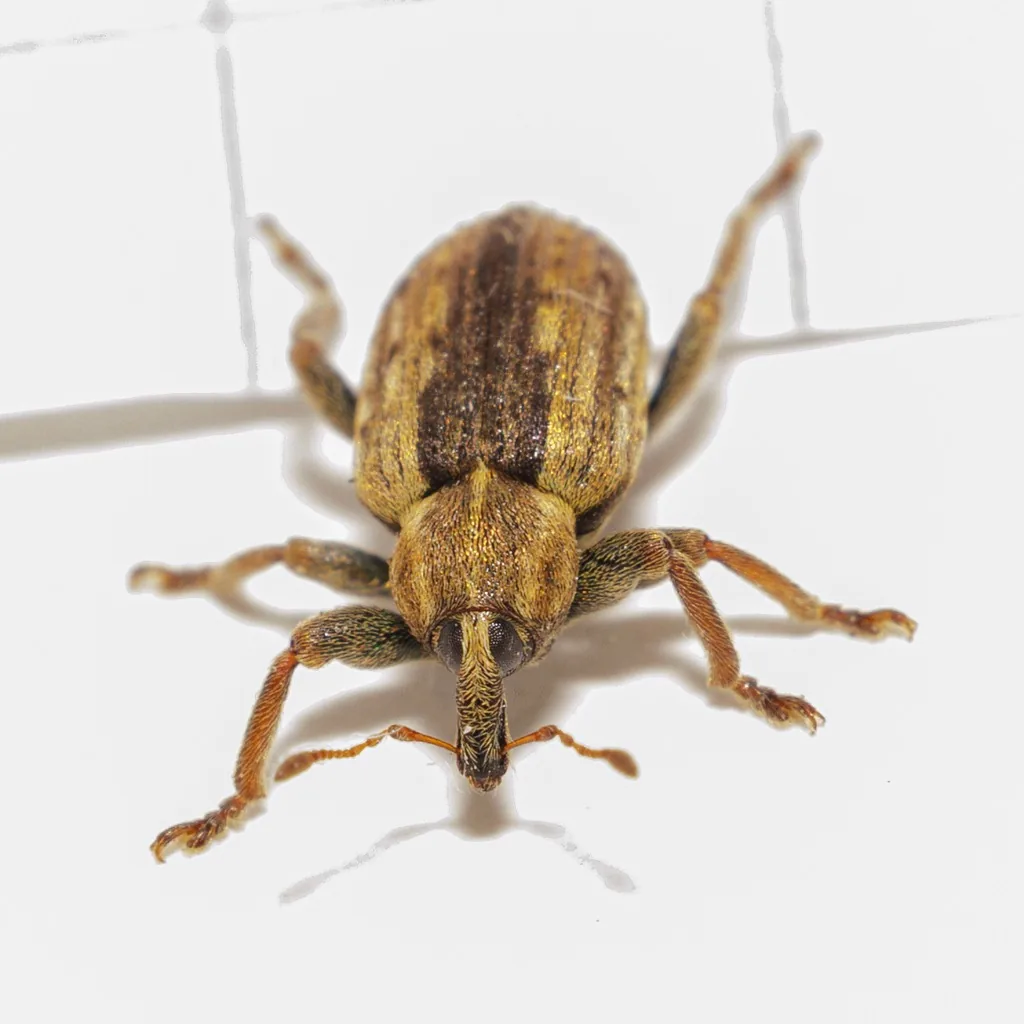
- Adults are light brown with a broad, darker stripe down the middle of the back and a narrow snout with chewing mouthparts at the tip; see where the sources disagree on size. K-State says adults readily drop to the ground when disturbed.[2][3]
- Feeding shows on the leaves, growing tips, buds and new shoots: young larvae chew small holes in the terminal leaves, leaves end up skeletonized, and a badly damaged field takes on a bleached look resembling frost damage.[1][2]
Where it lives
An exotic species that likely evolved in Asia, it was introduced to the United States at least three times. Kentucky calls it an important first-cutting pest, and Penn State ranks it one of the two most damaging insects of alfalfa in Pennsylvania.[2][1]
Biology and life cycle
Eggs are laid inside alfalfa stems; see where the sources disagree on which stage spends the winter.[2][3]
Eggs hatch after about 200 to 250 degree days (Fahrenheit). Young larvae feed in the terminal leaves and older ones on unfurled leaves, and the larval stage lasts about three weeks.[2]
Most mature larvae drop to the leaf litter, spin silken cocoons and emerge as adults 7 to 10 days later. The adults feed on alfalfa without doing much damage, then leave the fields as summer heats up and spend the warm months in a kind of hibernation.[2]
Kentucky times its field checks by degree days, with the first check at 190 degree days above a base of 48 degrees F.[1]
Damage and signs
- Larvae defoliate the plants, reducing yield, quality and stand health. Damage falls mostly on the first cutting, since larvae are usually gone by mid-June in Pennsylvania, but it can weaken the second cutting, and K-State says larvae and adults can suppress yields by delaying regrowth.[2][1][3]
- The damage often comes while farmers are busy planting corn, so it is easy to overlook.[2]
- Taller plants tolerate feeding better: Penn State estimates one larva per 30 twelve-inch stems costs about 3 pounds of hay per acre, but only about 0.75 pound per acre at sixteen inches.[2]
Health risk
Kentucky, Penn State and K-State describe crop damage only and don't mention any risk to people or pets.[1][2][3]
Control
Prevention
The weevil does not reach damaging numbers every year, so growers rely on scouting. Collect whole stems across the field, break them off gently and shake or beat them into a bucket, count the larvae, and measure plant height; Kentucky samples at least every 7 days. See where the sources disagree on how many stems to take.[1][2][3]
Treatment thresholds combine larvae per 30 stems with plant height, and Penn State's also weigh hay value and treatment cost. Use your state's tables; a sweep net shows whether larvae are present but not whether they are over threshold.[1][2]
Traps and physical control
Early harvest is often the best control when the crop is tall enough: once plants reach 16 inches, Penn State usually prefers cutting to spraying, and cutting spares beneficial insects a spray would kill.[2][1]
K-State says fall or winter grazing, or crushing the stems with a heavy roller, can destroy overwintering eggs and reduce spring larvae, but the suppression is not reliable.[3]
Biological control
Parasitic wasps brought in from the weevil's native range kill the larvae; see where the sources disagree on how much they help.[2][3]
Pesticides
When a treatment is justified, many insecticides are labeled for alfalfa weevil. Kentucky notes that an early spray, at 190 to 225 degree days, protects the alfalfa weevil parasites that emerge later.[2][1]
Where the sources disagree
Adult size: Penn State says about 1/4 inch (5 to 7 mm); K-State says 3/16 inch.[2][3]
Winter stage: Penn State says adults overwinter and lay eggs in spring; K-State says eggs are laid in fall or spring and that overwintering eggs can be destroyed by grazing or rolling.[2][3]
Parasitic wasps: Penn State says they have controlled the weevil well enough in parts of the eastern United States that sprays are rarely needed, though their role in Pennsylvania is unassessed; K-State says wasps and fungal diseases do not usually give enough control in Kansas.[2][3]
Sample size: Kentucky and Penn State count larvae on 30 stems; K-State says 30 to 50 stems.[1][2][3]
Common questions
- Why does my alfalfa look frost-damaged in spring?
- Alfalfa weevil larvae are one possible cause: they skeletonize leaves and growing tips until the field looks bleached. Shake some stems into a bucket and look for green larvae with black heads and a white stripe down the back.[1][2]
- Should I spray or cut early?
- If the alfalfa is about 16 inches or taller, Penn State says harvesting is usually preferable to spraying, and it conserves beneficial insects.[2]
- When are alfalfa weevils done for the year?
- In Pennsylvania the larvae are usually out of fields by mid-June, and the adults leave the fields as summer heats up.[2]
Sources
- University of Kentucky Entomology, “Alfalfa Weevil Field Sampling Program, ENTFACT-127 (L. Townsend).” entomology.ca.uky.edu/ef127 (accessed 2026-11-13)
- Penn State Extension, “Alfalfa Weevil (J. Tooker, updated March 23, 2026).” extension.psu.edu/alfalfa-weevil (accessed 2026-11-13)
- Kansas State University, Department of Entomology (K-State Research and Extension), “Alfalfa Weevil (Hypera postica) (J. P. Michaud; updated 4/1/26).” entomology.k-state.edu/extension/insect-information/crop-pests/alfalfa/alfalfa-weevil.html (accessed 2026-11-13)
- Global Biodiversity Information Facility (GBIF), “Hypera postica (Gyllenhal, 1813) (GBIF Backbone Taxonomy).” api.gbif.org/v1/species/1191191 (accessed 2026-11-13)
- iNaturalist, “Hypera postica taxon page (order and family).” www.inaturalist.org/taxa/196616 (accessed 2026-11-08)