On this page
How to identify it
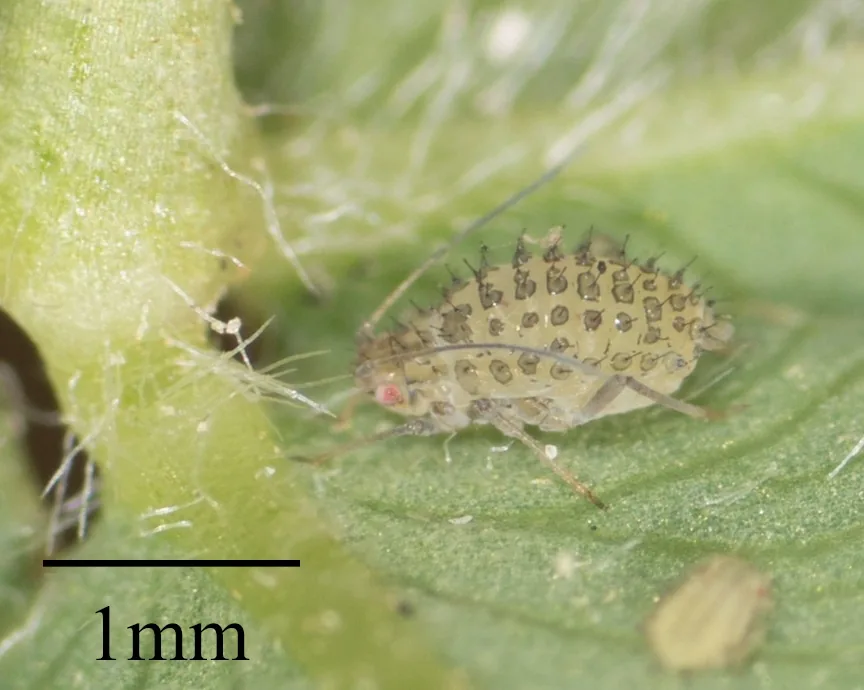
- It is small and pale yellow or grayish, with four to six rows of black spots on its back, each spot tipped with a short spine. Mature aphids are only about 1/16 inch long, and on small nymphs the spots can be hard to see without magnification.[2][1]
- Winged adults have smoky areas along the wing veins.[2][1]
- It usually feeds on the undersides of the lower leaves and moves higher on the plant as the lower leaves die. The aphids drop off easily when a stem is picked.[1]
Look-alikes
| Look-alike | How to tell them apart |
|---|---|
| Cowpea aphid | The cowpea aphid is shiny black as an adult and slate gray as a nymph, and it is the only black aphid in alfalfa, while the spotted alfalfa aphid is pale yellow or grayish with rows of black spots.[3][2] |
Where it lives
It was accidentally introduced into central New Mexico in 1954 and quickly spread through the alfalfa-growing areas of the United States. It prefers warm weather and is generally found in summer, though in California's southern desert high numbers may continue into fall and winter.[1][2]
Biology and life cycle
Wingless females each give birth to 100 or more live young without mating. The young pass through four instars in as little as five days in warm weather, and the whole life cycle can take less than a week.[1]
In fall, males and egg-laying females are produced, and the eggs overwinter in the crop.[1]
It prefers alfalfa but also infests some clovers.[1]
Damage and signs
- Its toxic saliva yellows the leaf at the feeding site and along the veins, and severe infestations stunt plants, reduce yield and may kill them.[1][2]
- Uncontrolled populations can destroy new stands and cut yield and protein content in half on established stands. Seedlings of susceptible varieties can be damaged by little more than one aphid per plant.[1]
- It secretes large amounts of honeydew, so plants become very sticky even at fairly low aphid numbers, and the sooty mold that grows on it lowers hay quality and palatability to livestock and makes harvesting difficult.[2][1]
Health risk
An alfalfa pest; no cited source describes any risk to people or pets. The livestock concern is that sooty mold on its honeydew makes hay less palatable.[1][2]
Control
Prevention
Resistant varieties have been the most effective control, and many modern varieties resist this aphid and suffer less damage. New biotypes able to infest previously resistant varieties keep evolving, though, so check resistant fields often too.[2][1]
Border-strip cutting at harvest helps keep natural enemies in the field. Sample fields from June until fall: pick whole stems at random in several parts of the field, at least 20 to 30 per spot, count aphids per stem without counting mummies, and measure stem length.[2][1]
Biological control
Lady beetles such as the convergent lady beetle, green lacewings, bigeyed bugs, damsel bugs and syrphid flies feed on it, and an introduced parasite, Trioxys complanatus, is established; its brown aphid mummies on leaves and stems are a reason for caution about spraying. Abundant mummies and lady beetles suggest the population may be coming under natural control.[2][1]
Pesticides
Kansas State advises treating seedling stands at two to three healthy aphids per seedling; plants 2 to 3 inches tall can tolerate four to five per plant, and established alfalfa takes higher numbers before treatment is justified. For organically certified crops, UC IPM lists azadirachtin, neem oil and pyrethrin insecticides for aphids on alfalfa but says no studies in California have tested how well they work.[1][2]
Where the sources disagree
Thresholds: Kansas State treats seedlings at two to three healthy aphids per seedling and established alfalfa at 50 or more aphids per stem on 10-inch plants and 100 or more on 20-inch plants; UC IPM's thresholds are 40 aphids per stem in spring, 20 in summer, 50 to 70 after the last fall cutting and 20 for newly seeded alfalfa in the lower desert, with no spray where lady beetles are numerous relative to aphids.[1][2]
Name: Kansas State gives Therioaphis trifolii (= Therioaphis maculata); GBIF's backbone accepts T. trifolii and treats T. maculata as a synonym of the subspecies T. trifolii trifolii.[1][4][5]
Common questions
- What are the tiny yellow aphids with black spots under my alfalfa leaves?
- Most likely spotted alfalfa aphids: small, pale yellow or grayish aphids with rows of spined black spots that feed on the undersides of the lower leaves in warm weather.[2][1]
- Will a resistant alfalfa variety stop spotted alfalfa aphid?
- Resistant varieties have been the most effective control, but biotypes that can infest previously resistant varieties keep evolving, so UC IPM advises checking resistant fields frequently as well.[2]
Sources
- Kansas State University Department of Entomology, “Spotted Alfalfa Aphid (J. P. Michaud, Facts and Information on Alfalfa Pests).” entomology.k-state.edu/extension/crop-protection/alfalfa/spotted-alfalfa-aphid.html (accessed 2026-11-13)
- University of California Statewide IPM Program, “Spotted Alfalfa Aphid (Pest Management Guidelines: Alfalfa).” ipm.ucanr.edu/agriculture/alfalfa/spotted-alfalfa-aphid/ (accessed 2026-11-13)
- University of California Statewide IPM Program, “Cowpea Aphid (Pest Management Guidelines: Alfalfa).” ipm.ucanr.edu/agriculture/alfalfa/cowpea-aphid/ (accessed 2026-11-13)
- Global Biodiversity Information Facility (GBIF), “Therioaphis trifolii (Monell, 1882) (GBIF Backbone Taxonomy).” api.gbif.org/v1/species/2071624 (accessed 2026-11-13)
- Global Biodiversity Information Facility (GBIF), “Therioaphis maculata (synonym) (GBIF Backbone Taxonomy).” api.gbif.org/v1/species/4290214 (accessed 2026-11-13)