On this page
How to identify it
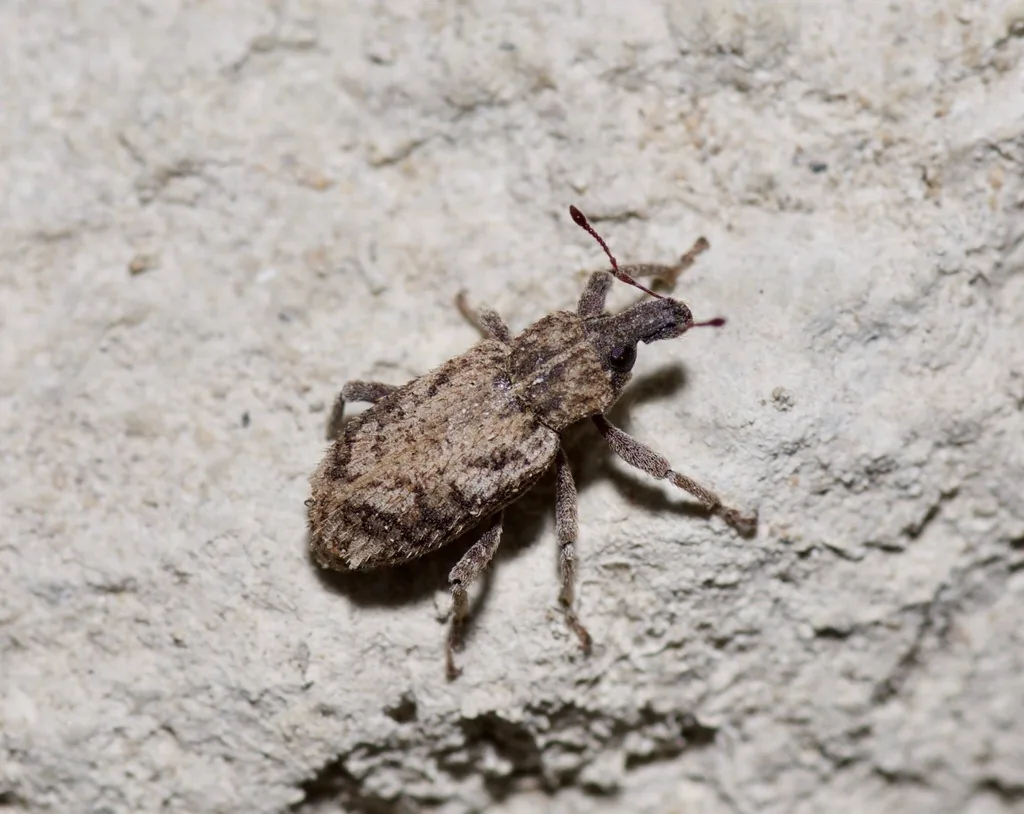
- UC IPM describes adults as small brown or gray snout beetles about 0.38 inch long with a V-shaped spot at the wing tips; they can't fly.[1]
- Texas A&M describes them as grayish, about 1/3 inch long, with a lighter V-shaped marking near the hind end of the wing covers.[4]
- Larvae are light green, legless grubs, about 0.38 inch long when grown according to UC IPM.[1][4]
Look-alikes
| Look-alike | How to tell them apart |
|---|---|
| Black vine weevil | UC IPM names the black vine weevil as California's most common pest weevil; the vegetable weevil is a separate species with a V-shaped wing mark.[1] |
| Carrot weevil | Carrot weevil adults are tannish gray and about 1/4 inch long, and their larvae are white, C-shaped grubs that burrow into carrot roots near the top; vegetable weevil larvae are green and feed on leaves, buds and roots from outside.[4][1] |
Where it lives
UC IPM lists it among the important pest weevils of California gardens.[1]
Biology and life cycle
It has one generation a year, but adults may live two years or more.[1]
Adults and larvae are most active at night and hard to find by day.[1]
Eggs are laid on plants or in nearby soil and take 2 weeks or more to hatch. Larvae need 3 to 6 weeks to finish growing, then pupate in the soil for a few days to 2 weeks, depending on temperature.[4]
Fun fact: only females of this species are known, so every vegetable weevil you find is a female that lays eggs without mating.[4]
Damage and signs
Health risk
It feeds on plants; neither UC IPM nor Texas A&M AgriLife lists any risk to people or pets.[1][4]
Control
Keep them out
Protect young plants with fabric covers, and use sticky barriers to keep weevils from walking into new areas.[1]
Traps and physical control
Pick off weevils at night, and destroy infested rows to stop local spread.[1]
Check seedlings with a flashlight after dark, since both adults and larvae feed mainly at night and hide by day; cut-off stems can look like cutworm damage.[4][1]
Pesticides
Pyrethrin or azadirachtin mixtures may give some control; spot treatments may be enough.[1]
More from Clemson Extension
Clemson Extension has found vegetable weevil larvae feeding on the undersides of Napa cabbage leaves alongside yellowmargined leaf beetle larvae in South Carolina, with both causing the leaf damage.[2]
Where else it turns up
In Georgia sod farms, vegetable weevils turned up as a minor species in traps set for turf billbugs.[5]
In an Australian vegetable study of plant mixes grown to attract beneficial insects, niger hosted significantly more vegetable weevils than the other three plants tested.[6]
Where sources disagree
Adult size: UC IPM gives 0.38 inch; Texas A&M says about 1/3 inch.[1][4]
Common questions
- What's cutting my seedlings off at night?
- Vegetable weevils feed at night and can cut young plants at ground level.[1]
- Can vegetable weevils fly?
- No, so infestations spread slowly and damage is often patchy.[1]
- Are there male vegetable weevils?
- No males are known. Texas A&M notes that only females of this species exist, and there is one generation a year.[4]
- Is the vegetable weevil harmful to people?
- No. It feeds only on plants, and UC IPM and Texas A&M list no risk to people or pets.[1][4]
Sources
- University of California Statewide IPM Program, “Vegetable Weevil (Pests in Gardens and Landscapes).” ipm.ucanr.edu/PMG/GARDEN/VEGES/PESTS/vegeweevil.html (accessed 2026-11-12)
- Clemson Cooperative Extension, Home & Garden Information Center, “What Is It? Wednesday: Yellowmargin Leaf Beetle and Vegetable Weevil Damage.” hgic.clemson.edu/what-is-it-wednesday-yellowmargin-leaf-beetle-and-vegetable-weevil-damage/ (accessed 2026-11-12)
- iNaturalist, “Listroderes difficilis taxon page (order and family).” www.inaturalist.org/taxa/391814 (accessed 2026-11-12)
- Texas A&M AgriLife Extension, “Insects in Vegetables (EEE-00029).” williamson.agrilife.org/files/2011/07/eee00029_3.pdf (accessed 2026-11-12)
- Journal of Economic Entomology (2020), via PubMed, “Seasonal Occurrence and Abundance of Billbugs (Coleoptera: Curculionidae) in Georgia Sod Farms.” pubmed.ncbi.nlm.nih.gov/32556196/ (accessed 2026-11-12). Cited from the PubMed abstract.
- Bulletin of Entomological Research (2010), via PubMed, “A comparison of alternative plant mixes for conservation bio-control by native beneficial arthropods in vegetable cropping systems.” pubmed.ncbi.nlm.nih.gov/19323854/ (accessed 2026-11-12). Cited from the PubMed abstract.