On this page
How to identify it
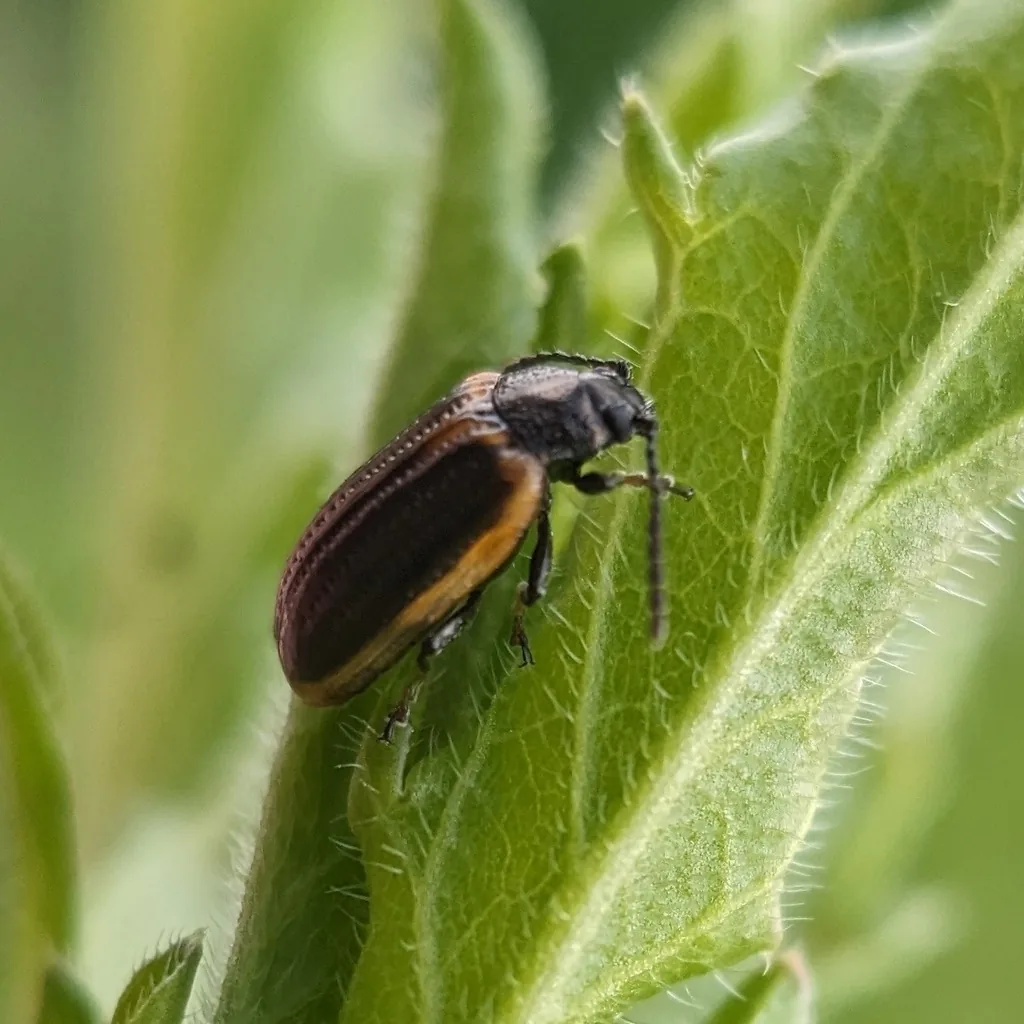
- Adults are just under 1/4 inch long and black or dark, with a dirty yellow or lighter band around the edge of the wing covers.[2][3]
- Larvae are dark, about the size of the adults, with soft bodies covered in fine hairs; UGA calls them alligator-shaped, with three pairs of stocky legs.[2][3]
- Pupae sit in round, white, loosely woven cocoons near the crown of the plant.[3]
Look-alikes
| Look-alike | How to tell them apart |
|---|---|
| Vegetable weevil | Its larvae feed on the same greens and can share a Napa cabbage leaf with yellowmargined leaf beetle larvae; Clemson notes the chewing on such a leaf can come from both, so look at the larvae themselves.[1] |
Where it lives
An introduced pest of crucifer crops in the southern United States, where it is a major pest of organic plantings in the Southeast. A 2024 niche-modeling study found suitable conditions for it widely across the Americas, including regions where it hasn't been reported.[6][4][10]
Biology and life cycle
The life cycle runs egg, four larval stages, prepupa, pupa and adult. In an LSU study, egg to adult took about 27 days (26.6 on turnip, 27.5 on cabbage). Around 25°C (77°F) it can finish a generation in less than a month, so numbers build fast.[5][4]
Females kept on turnip laid the most eggs, about 491 on average, and those on collards the fewest, about 199.[5]
Turnip and Napa cabbage are its favorite hosts, found mainly by their scent; cabbage and collards are less preferred. The LSU study also found a strong feeding preference for turnip and mustard.[6][5][1]
Adults and larvae gather in clumps rather than spreading evenly through a planting.[5]
Damage and signs
- Adults and larvae chew holes all over the leaves, leaving them lacy, and can strip plants. Turnip and mustard may be seriously damaged.[2][3][4]
- Other crops it feeds on include cabbage, cauliflower, collards, radish and Napa cabbage.[4][6][5]
- It is usually susceptible to synthetic insecticides, so it is mainly a problem in organic plantings, where without them it can build up fast enough to destroy a crop.[4][7]
Health risk
It feeds on plants; none of the sources describes any harm to people or pets.[2][3]
Control
Prevention
Plant turnip around a less attractive crop such as cabbage as a trap crop. In field trials this cut beetle numbers and damage on cabbage, but on mustard and Napa cabbage, which the beetle likes nearly as much, damage stayed high, so the trap needs other tactics with it.[8][1]
Sanitation
Cultivate and clean up the field right after harvest to remove the plant debris that shelters and feeds overwintering beetles.[4]
Biological control
The spined soldier bug preys on it. In field cages, releases of young soldier bugs reduced the beetle on turnip in one of two years.[4][9]
Pesticides
For organic plantings, spinosad applied weekly was the most consistent organic insecticide in four seasons of Alabama trials, with pyrethrum second, and the two worked in rotation. Scout often so you can act early, and follow the label.[7][4]
Where sources disagree
When to treat: UGA says to start controls when larvae and adults are causing noticeable damage and are still present; Auburn researchers suggest a level of one adult per plant, noting that no field-confirmed threshold exists yet.[3][4]
Common questions
- What's eating my turnip greens and mustard?
- Possibly yellowmargined leaf beetles: small dark beetles with pale-edged wing covers, and dark hairy larvae, chewing holes all over the leaves. They favor turnip.[2][3][6]
- Is there an organic option?
- Yes. A border of turnip as a trap crop, with an organic insecticide such as spinosad or pyrethrum applied to the trap plants, is the combination Auburn researchers recommend.[4][8][7]
Sources
- Clemson Cooperative Extension, Home & Garden Information Center, “What is It? Wednesday – Yellowmargin Leaf Beetle and Vegetable Weevil damage.” hgic.clemson.edu/what-is-it-wednesday-yellowmargin-leaf-beetle-and-vegetable-weevil-damage/ (accessed 2026-11-11)
- Clemson Cooperative Extension, Land-Grant Press, “Identification of Common Insect Pests of Brassica Crops (LGP 1122).” lgpress.clemson.edu/publication/identification-of-common-insect-pests-of-brassica-crops/ (accessed 2026-11-11)
- University of Georgia Cooperative Extension, “Commercial Production and Management of Cabbage and Leafy Greens (B1181).” openscholar.uga.edu/record/26351/files/B1181.pdf (accessed 2026-11-11)
- Entomological Society of America, Entomology Today, “Yellowmargined Leaf Beetle: New Guide Offers Pest Management Tips for Organic Growers (2017).” entomologytoday.org/2017/05/30/yellowmargined-leaf-beetle-new-guide-offers-pest-management-tips-for-organic-growers/ (accessed 2026-11-11)
- Louisiana State University, “The Biology and Ecology of the Yellowmargined Leaf Beetle, Microtheca ochroloma, on Crucifers (Ameen 1996, PhD dissertation).” repository.lsu.edu/gradschool_disstheses/6173/ (accessed 2026-11-11)
- Environmental Entomology, via PubMed, “Host finding and acceptance preference of the yellowmargined leaf beetle, Microtheca ochroloma, on cruciferous crops (Balusu and Fadamiro 2011).” pubmed.ncbi.nlm.nih.gov/22217763/ (accessed 2026-11-11)
- Pest Management Science, via PubMed, “Evaluation of organically acceptable insecticides as stand-alone treatments and in rotation for managing yellowmargined leaf beetle (Balusu and Fadamiro 2012).” pubmed.ncbi.nlm.nih.gov/22231993/ (accessed 2026-11-11)
- Journal of Economic Entomology, via PubMed, “Management of Yellowmargined Leaf Beetle Microtheca ochroloma Using Turnip as a Trap Crop (Balusu et al. 2015).” pubmed.ncbi.nlm.nih.gov/26470380/ (accessed 2026-11-11)
- Journal of Economic Entomology, via PubMed, “Evaluation of the predation capacity of Podisus maculiventris on Microtheca ochroloma in field cages (Montemayor and Cave 2012).” pubmed.ncbi.nlm.nih.gov/23156169/ (accessed 2026-11-11)
- International Journal of Biometeorology, via PubMed, “Ecological niche modeling of two Microtheca species in the Americas (Alencar et al. 2024).” pubmed.ncbi.nlm.nih.gov/38374294/ (accessed 2026-11-11)
- iNaturalist, “Microtheca ochroloma taxon page (order and family).” www.inaturalist.org/taxa/533267 (accessed 2026-11-11)