On this page
How to identify it
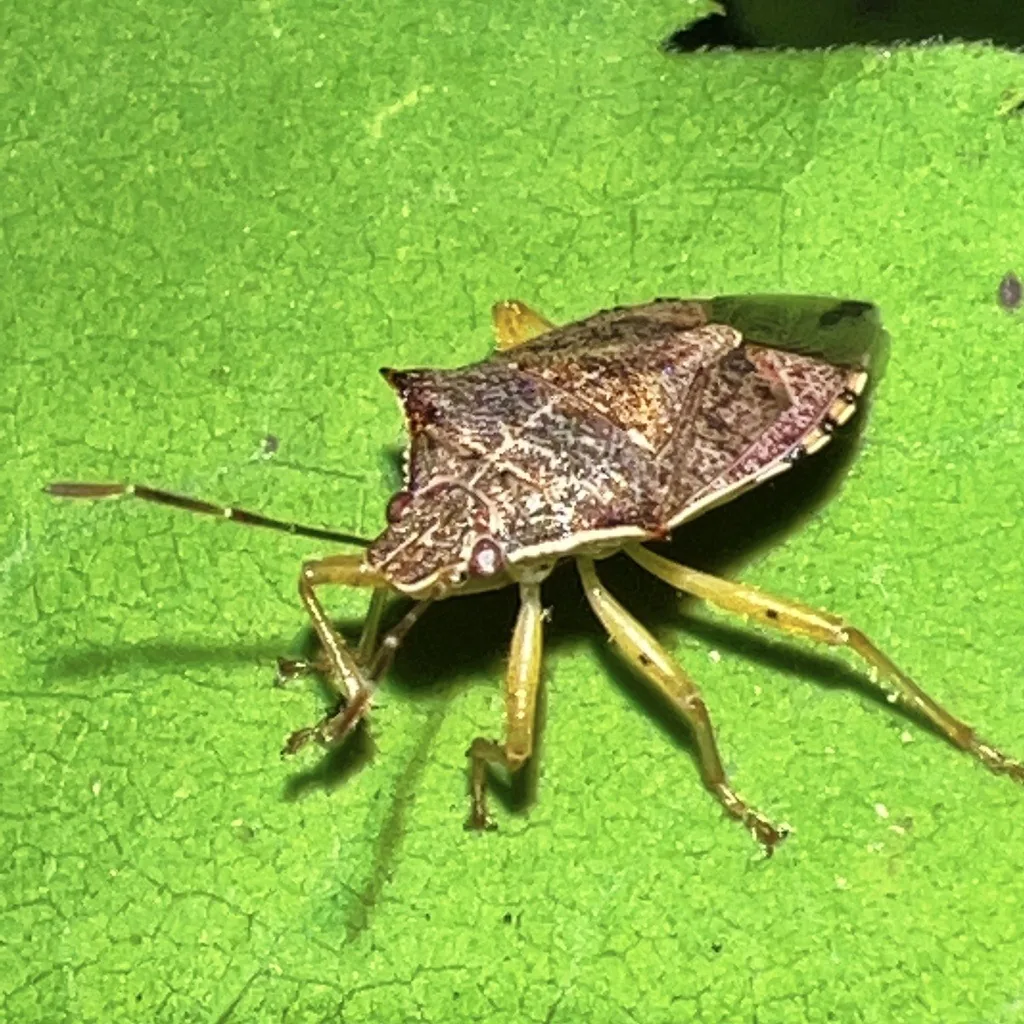
- Adults are shield-shaped, pale brown to grayish or tan, and about 2/5 inch (10 mm) long.[1]
- The shoulders end in sharp spines that point straight out. UC IPM says these set it apart from plant-feeding stink bugs, but Mississippi State notes that some plant feeders have similar spines, so check the beak and wing tips too.[1][2][3]
- Each forewing tip has a dark line on the membrane, and NC State notes alternating orange and black markings along the edges of the abdomen.[1][2]
- NC State says predatory stink bugs have a beak at least twice as thick as their antennae, while plant feeders' beaks are as thin as the antennae. UC IPM says it extends its beak forward in front of the body to feed; plant-feeding stink bugs point theirs downward.[2][1]
- Nymphs are wingless and round. UC IPM says the first, second and fourth stages have a black head and thorax and a mostly red abdomen, and the last stage is black, cream and tan with orange or red; they grow from about 1.5 to 9 mm.[1][2]
Look-alikes
| Look-alike | How to tell them apart |
|---|---|
| Plant-feeding stink bugs | Plant-feeding stink bugs have beaks as thin as their antennae (NC State) and lack the dark line on each wing tip (UC IPM). Shoulder spines alone aren't proof, since Mississippi State says some plant feeders have similar spines.[2][1][3] |
| Anchor stink bug | Mississippi State lists anchor bugs among the other predatory stink bugs found in the Southeast.[3] |
| Giant strong-nosed stink bug | Mississippi State lists giant strongnosed stink bugs among the other predatory stink bugs found in the Southeast.[3] |
Where it lives
NC State says it's native throughout eastern North America. UC IPM covers it in California and calls it important in alfalfa, beans, cole crops, cotton, potato, soybean and tomato, and Mississippi State finds it in home gardens, weedy roadsides and soybean fields.[2][1][3]
Biology and life cycle
Eggs are barrel-shaped, about 1 mm, with a ring of spines on top, laid in groups of one to three dozen. UC IPM says they range from blackish to cream; Mississippi State says they're white at first and turn metallic silver to gold.[1][3]
UC IPM says eggs hatch in about a week; Mississippi State says five to eight days.[1][3]
UC IPM says nymphs mature in about three weeks, for about a month from egg to adult; Mississippi State says they become adults about four weeks after hatching.[1][3]
Adults live 2 to 3 months, and a female can lay several hundred eggs.[1]
Adults overwinter in bark crevices or ground litter; in mild areas they stay active all year, with several generations.[1]
Its eggs are attacked by tiny parasitic wasps. Mississippi State names Telenomus podisii, and says another, Telenomus clavatus, attacks only spined soldier bug eggs and finds them by riding on adult soldier bugs.[3]
Damage and signs
Health risk
It's a predator of insects, and no cited source describes any risk to people or pets.[1][2][3]
Control
Prevention
This is a beneficial insect. Before spraying stink bugs, check for the thick beak, sharp shoulder spines and wing-tip lines so you don't kill it by mistake.[1][2][3]
Biological control
To help it and other natural enemies, UC IPM says to control ants, grow insectary plants, reduce dust, and avoid broad-spectrum, persistent insecticides.[1]
UC IPM and NC State say spined soldier bugs are sold commercially, and UC IPM says they've been released in large numbers against caterpillars in greenhouses. Mississippi State says wild populations sometimes contribute significantly to control of loopers in crops.[1][2][3]
In a 2025 potato field study, plots baited with synthetic spined soldier bug pheromone had 13% more tuber yield and fewer Colorado potato beetle larvae. The authors found too few predators to explain it and credited plant and prey responses to the pheromone.[6]
Common questions
- Is this stink bug good or bad?
- If its beak is thicker than its antennae, its shoulders end in sharp spines and each wing tip has a dark line, it's likely the predatory spined soldier bug.[2][1]
- What does it eat?
- Caterpillars, beetle and sawfly larvae, and other true bugs. UC IPM says it has been recorded on more than 100 pest species, and NC State says it can subdue prey many times its own size.[1][2]
- Are insecticides hard on them?
- Some are. In lab tests, spinosad and chlorantraniliprole on contact were more toxic to beet armyworm than to the spined soldier bug, pyrethrin products were the reverse, and spinosad was the most toxic to the bug when eaten. Another study found imidacloprid soil drenches on cabbage cut nymph survival and adult emergence.[4][5]
Sources
- University of California Statewide IPM Program, “Spined Soldier Bug (Natural Enemies Gallery).” ipm.ucanr.edu/natural-enemies/spined-soldier-bug/ (accessed 2026-11-13)
- NC State Extension (Department of Entomology and Plant Pathology), “Spined Soldier Bug (Biological Control Information Center: Beneficial Predators).” entomology.ces.ncsu.edu/biological-control-information-center/beneficial-predators/spined-soldier-bug/ (accessed 2026-11-13)
- Mississippi State University Extension Service, “Spined Soldier Bug (Bug's Eye View, Vol. 9, No. 26).” extension.msstate.edu/newsletters/bugs-eye-view/2023/spined-soldier-bug-vol-9-no-26 (accessed 2026-11-13)
- PLoS One (via PubMed), “Lethal and behavioral effects of synthetic and organic insecticides on Spodoptera exigua and its predator Podisus maculiventris. de Castro et al. 2018 (abstract).” pubmed.ncbi.nlm.nih.gov/30408828/ (accessed 2026-11-13)
- Journal of Economic Entomology (via PubMed), “Impact of imidacloprid soil drenching on survival, longevity, and reproduction of the zoophytophagous predator Podisus maculiventris. Resende-Silva et al. 2020 (abstract).” pubmed.ncbi.nlm.nih.gov/31675095/ (accessed 2026-11-13)
- Journal of Economic Entomology (via PubMed), “A predator pheromone increases potato yield through multiple mechanisms. Martinez et al. 2025 (abstract).” pubmed.ncbi.nlm.nih.gov/40353822/ (accessed 2026-11-13)
- Global Biodiversity Information Facility (GBIF), “Podisus maculiventris (Say, 1832) (GBIF Backbone Taxonomy).” api.gbif.org/v1/species/2079037 (accessed 2026-11-13)