On this page
How to identify it
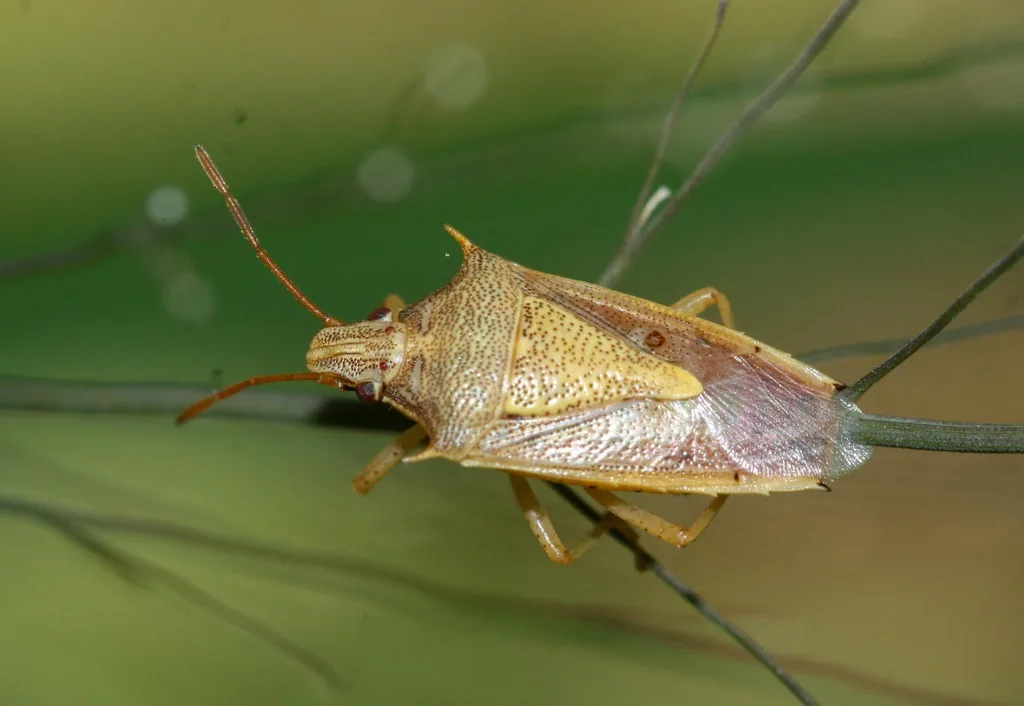
- Adults are narrower than most stink bugs, with a spine on each 'shoulder'. Texas A&M describes them as yellowish brown with spines that face out and slightly forward; Virginia Tech's field guide describes a tan, narrow body with forward-pointing shoulder spines and a yellow scutellum.[1][4]
- Like other stink bugs, adults are shield shaped with a large triangular plate (the scutellum) on the back. Nymphs lack that plate, so use adults to confirm the species.[1]
- Nymphs have a white to brown head and thorax and a light-colored abdomen with red speckles and dark spots in the center. Eggs are laid in two rows of up to 45 and turn from green to red as they mature.[4]
- A disturbed bug gives off an unpleasant smell.[1]
- UF/IFAS notes that nymphs of most stink bugs in rice fields are more colorful than the adults, and they grow larger, with more prominent wing pads, at each molt.[3]
Look-alikes
| Look-alike | How to tell them apart |
|---|---|
| Spined soldier bug | The spined soldier bug is a brown predator of other insects that does not harm sorghum heads. It has a dark spot on the center of its clear wings, and its strong shoulder spines point outward rather than forward.[1] |
| Conchuela bug | The conchuela, another stink bug that feeds on sorghum heads in Texas, has an orange tip on its scutellum and often an orange edge around the body.[1] |
Where it lives
Extension services in Arkansas and Texas treat it as a pest of rice and grain sorghum, and the Virginia Tech field guide lists it among the stink bugs of agricultural importance in the United States. Arkansas Extension says it has concerned Arkansas rice producers for many years, and that populations rose substantially in 2000 and 2001 compared with earlier years. In Florida a 1986 study found it made up more than 95% of the stink bugs in rice, but UF/IFAS now reports that Oebalus insularis, first found in Florida rice in 2010, has become the most abundant species there; a third, Oebalus ypsilongriseus, was first reported in 1988.[2][1][4][3]
Biology and life cycle
Adults spend the winter in grassy areas, ground litter and debris around fields, and in Arkansas they start moving to these sites in early October.[2]
In spring they feed almost entirely on the developing seeds of wild grasses, especially vasey grass and barnyardgrass, along with bearded sprangletop, broadleaf signalgrass, dallisgrass and crabgrass, and they begin reproducing soon after.[2]
Rice is the preferred host, but the bugs also feed on oats, wheat and grain sorghum. Breeding on early wild grasses lets their numbers climb before crops are available.[2]
Females lay an average of 500 to 600 eggs and up to 1,100. Eggs hatch in 4 to 11 days depending on temperature, and the nymphs pass through five stages, so egg to adult takes 14 to 30 days.[2]
Adults can live up to 3 months. Arkansas normally sees three generations a year, and four are possible when spring temperatures are moderate.[2]
They usually enter rice once it begins heading, moving in from wild grasses as those decline, and harvest pushes them from cut fields into later-maturing ones.[2]
In UF/IFAS monthly flight data from Florida, rice stink bug catches peaked sharply in July, with very few from October through April.[3]
Damage and signs
- Adults and nymphs pierce developing seeds and inject saliva, which hardens into a feeding sheath on the outside of the grain.[2]
- Feeding from before pollination through the early milk stage makes heads blank or abort, and feeding from the milk to soft dough stages shrinks or discolors kernels. UF/IFAS adds that feeding in the milk stage can remove a grain's contents completely.[2][3]
- Later feeding seldom shrinks kernels but opens an entry site for fungi and bacteria. Pecky rice forms from the bug's saliva and the feeding hole: fungi that get in cause discolored, dark-spotted kernels that break easily, lowering yield and grade. UF/IFAS describes pecky kernels, from dough-stage feeding, as shriveled with spots from light yellow to black, and says this does the most harm to rice quality and marketability.[2][3]
- In grain sorghum, stink bugs feed directly on the developing seeds, and damaged seed is more likely to be infected by fungi or other diseases.[1]
Health risk
It feeds on grasses and grain. Arkansas Extension, Texas A&M and Virginia Tech describe it only as a crop pest; none of them mentions bites or any effect on people or pets. Texas A&M notes that, like other stink bugs, it gives off an unpleasant odor when agitated. UF/IFAS notes that all these stink bugs can give off an ill-smelling substance.[2][1][4][3]
Control
Prevention
Planting so that rice heads outside the main flight period can reduce stink bug numbers, but UF/IFAS notes that frost risk and rotations with crops such as corn and sugarcane often make shifting the planting date difficult or impossible.[3]
In Florida sweep-net sampling, time of day made little difference except in rainy, stormy or very windy weather, and counts from the ends of fields predicted the population of the whole field.[3]
Sanitation
Watch grassy weeds in and around fields. Arkansas links barnyardgrass in fields to higher counts, but warns that mowing grass along highway ditches can cause a sudden jump in bug numbers in adjoining fields. In Florida, weedy patches of fall panicum in rice fields held significantly more rice stink bugs, and unmowed roadsides with heading weeds such as coast cockspur held large numbers, while mowed roadsides held few.[2][3]
Biological control
Telenomus wasps parasitize rice stink bug eggs. UF/IFAS adds that an assassin bug (Zelus bilobus), a jumping spider (Phidippus audax) and a wasp that stocks its nest with stink bugs (Bicyrtes quadrifasciata) prey on them. Birds eat them too, but a Florida study that kept blackbirds out of plots found no difference in stink bug numbers or pecky rice.[2][3]
Pesticides
Scout with a 15-inch sweep net from 75 percent panicle emergence through the fourth week of heading, ideally between about 7 and 11 a.m. Arkansas treats when counts reach 5 or more bugs (adults plus nymphs) per 10 sweeps in the first two weeks after 75 percent panicle emergence, or 10 per 10 sweeps during the milk and soft dough stages, and sprays in the morning.[2]
UF/IFAS says the insecticides Florida growers use are effective but the drop in numbers may be only temporary, and growers should get currently labeled products from their local UF/IFAS Extension agent. Five insecticides recommended against rice stink bug in Florida also worked well against the two invasive Oebalus species.[3]
Where the sources disagree
Adult color: Texas A&M says yellowish brown; Virginia Tech's field guide says tan, with a yellow scutellum.[1][4]
Shoulder spines: Virginia Tech describes them as forward-pointing; Texas A&M says they face out and slightly forward.[4][1]
Sampling time: Arkansas recommends sweeping between about 7 and 11 a.m., while UF/IFAS found time of day made little difference in Florida rice except in bad weather.[2][3]
Treatment thresholds: Arkansas's are given above; UF/IFAS, citing LSU, gives 30 stink bugs per 100 sweeps during the first two weeks of heading and 100 per 100 sweeps from then until two weeks before harvest.[2][3]
Common questions
- What is pecky rice?
- Rice kernels marked with dark spots. The bug's saliva and feeding hole let fungi into the grain, and the spotted kernels break easily, which cuts grade and yield. UF/IFAS describes the spots as ranging from light yellow to black.[2][3]
- Why do rice stink bugs suddenly show up in a rice field?
- They build up on wild grasses in spring and move into rice as those grasses decline or get mowed. Harvest also drives them from cut fields into later ones.[2]
- Does the rice stink bug attack crops besides rice?
- Yes. Rice is its preferred host, but it also feeds on oats, wheat and grain sorghum, attacking the developing seed.[2][1]
- Are there other stink bugs in Florida rice?
- Yes. UF/IFAS says Florida rice has the most diverse stink bug complex in U.S. rice. Two other Oebalus species, O. ypsilongriseus and O. insularis, arrived in recent decades, and O. insularis is now the most abundant there.[3]
Sources
- Texas A&M AgriLife Extension, “Stink Bugs (sorghum head pests), South Texas Field Crop Entomology.” agrilife.org/sca/stink-bugs-sorghum-head/ (accessed 2026-11-13)
- University of Arkansas System Division of Agriculture, Cooperative Extension Service, “Rice Stink Bug in Arkansas, FSA-7057 (D. R. Johnson, J. Bernhardt, J. Greene, G. Lorenz and G. Studebaker).” www.uaex.uada.edu/publications/PDF/FSA-7057.pdf (accessed 2026-11-14)
- University of Florida IFAS Extension (EDIS), “Stink Bugs in Florida Rice, IG479/IN1009 (R. Cherry).” ask.ifas.ufl.edu/publication/IN1009 (accessed 2026-11-14)
- Virginia Cooperative Extension (Virginia Tech), “Field Guide to Stink Bugs of Agricultural Importance in the United States, Second Edition (Herbert, Kamminga, Malone, Kuhar and others; publication 444-356).” accomack.ext.vt.edu/content/dam/pubs_ext_vt_edu/444/444-356/444-356_pdf.pdf (accessed 2026-11-13)
- Global Biodiversity Information Facility (GBIF), “Oebalus pugnax (Fabricius, 1775) (GBIF Backbone Taxonomy).” api.gbif.org/v1/species/2078986 (accessed 2026-11-13)
- iNaturalist, “Oebalus pugnax taxon page (order and family).” www.inaturalist.org/taxa/295792 (accessed 2026-11-08)