On this page
How to identify it
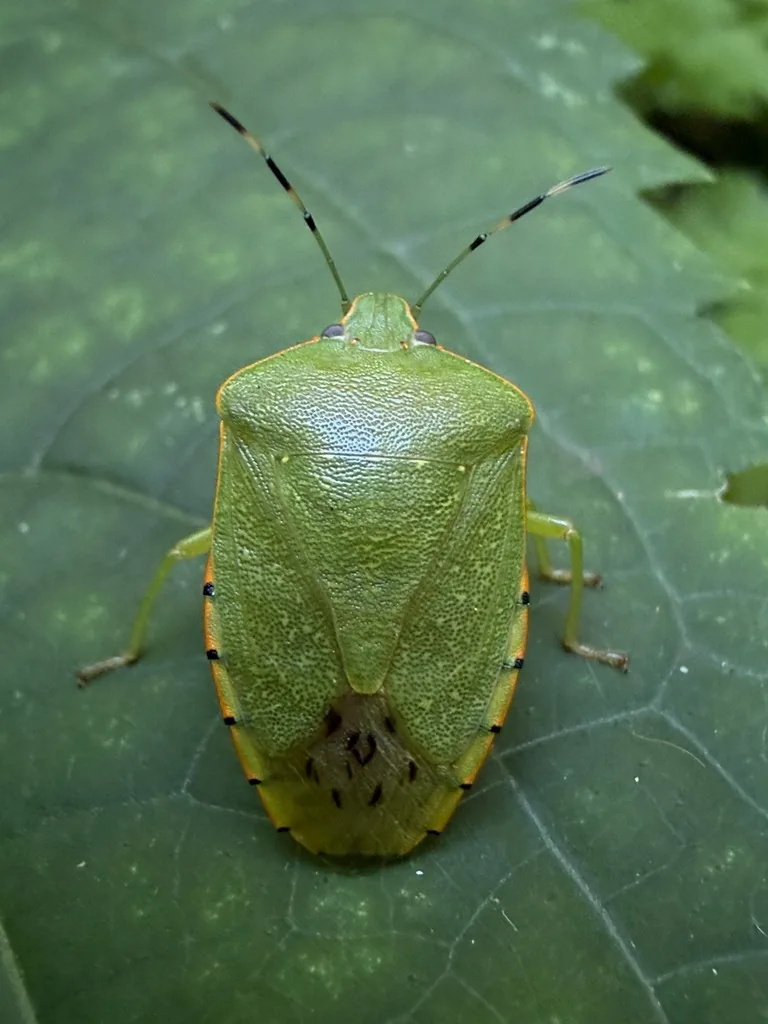
- Adults are shield-shaped and green, with a large triangle (the scutellum) on the back and folded wings that form an X; they give off a foul odor when handled or crushed.[6][2]
- The green stink bug is light green and 1/2 to 3/4 inch (13 to 19 mm) long. UF/IFAS gives 14 to 19 mm and says the head and pronotum are often bordered by a narrow orange-yellow line.[1][5]
- The southern green stink bug is bright green and about 1/2 inch long. UF/IFAS describes it as dull green with dark red or black eyes and small black dots along the sides of the abdomen; males average 12.1 mm and females 13.15 mm.[6][7]
- Eggs are barrel-shaped and laid in tight clusters, usually on the undersides of leaves. Green stink bug eggs start yellow-green and turn pink to gray; southern green stink bug eggs are white to pale yellow. UF/IFAS says green stink bug eggs sit in double rows and measure 1.4 by 1.2 mm, while southern green stink bug eggs are flat-topped, with a disc-shaped lid ringed by 28 to 32 tiny projections, and turn pinkish as they develop.[1][6][2][5][7]
- Nymphs are rounder than adults and change color as they grow. Green stink bug nymphs hatch orange, then develop a black abdomen with white stripes, and older nymphs are green; southern green stink bug nymphs start pale yellow and turn green.[1][2][6]
Look-alikes
| Look-alike | How to tell them apart |
|---|---|
| Brown marmorated stink bug | Mottled brown or gray rather than green, about 5/8 inch long, with alternating dark and pale markings along the abdomen edge and white bands on the dark antennae.[6][8] |
| Green stink bug vs. southern green stink bug | Adult sizes overlap and both are green, so color alone won't separate them reliably; the young are easier, since young green stink bug nymphs have a black abdomen with white stripes while early southern green stink bug nymphs are pale yellow. UF/IFAS gives a reliable check on the underside: the scent gland opening between the second and third legs is long and curved in the green stink bug but short and broad in the southern green stink bug.[1][6][7][5] |
Where it lives
The green stink bug is native to North America. The southern green stink bug was among the most abundant stink bugs on both tomato and sorghum in a North Florida study, feeds on sorghum heads in South Texas, and in California it occurs in parts of the Sacramento and northern San Joaquin valleys, where an imported parasite keeps it at low levels. GBIF's public U.S. records since 1990 for the two species (about 29,000, over nine tenths of them green stink bugs) come from 44 states on the map, most from Texas, Pennsylvania and Ohio. UF/IFAS says the green stink bug occurs across most of eastern North America, from Quebec and New England west through southern Canada and the northern U.S. to the Pacific Coast and southwest from Florida through California. The southern green stink bug, believed to have originated in Ethiopia, is limited in North America mainly to the Southeast, from Virginia to Florida, Ohio and Arkansas, and Texas, and is established in Hawaii and California.[1][4][9][3][10][5][7]
Biology and life cycle
Both overwinter as adults in leaf litter, plant debris or under bark and become active in spring; K-State says green stink bugs start feeding on young leaves when temperatures rise above 70 F.[1][6][2]
Green stink bug egg clusters hold about 30 to 40 eggs, and nymphs hatch after about seven days. UF/IFAS says southern green stink bug masses hold 30 to 130 eggs, laid on the undersides of upper leaves, which hatch in five days in summer and two to three weeks in early spring and late fall; a female may lay as many as 260 eggs in her life.[1][7]
Newly hatched nymphs cluster around the empty egg shells and don't feed at first. UF/IFAS says southern green stink bug nymphs start feeding at the second stage and pass through five stages, with wing pads marking the fifth.[1][6][7]
The green stink bug takes 30 to 45 days from egg to adult and has one generation a year in Kansas; adults live up to two months. UF/IFAS adds that it can have a second generation in the South. The southern green stink bug completes its life cycle in 65 to 70 days and can have up to four generations a year in warm climates.[1][5][7]
Infestations often start when adults fly in from weedy areas. Green stink bugs move between woods and fields: a three-year trapping study across a farm landscape caught them most often in forest, then in crops.[6][11]
When disturbed, green stink bugs may play dead.[2]
UF/IFAS says green stink bugs need a sequence of host plants with overlapping seed and fruit production to build large populations; favorite wild hosts include black cherry, elderberry, flowering dogwood, blackberry, basswood and pine.[5]
Damage and signs
- Feeding on green tomatoes leaves dark pinpricks surrounded by a light spot that stays green or turns yellow as the fruit ripens, and the tissue below turns pithy and firm.[6][3]
- On peaches the fed-on fruit turns brown and corky, and fruit fed on early can become distorted as it grows; on apples, catfacing points to early-season feeding, and corky spots just under the skin can be mistaken for bitter pit. UF/IFAS describes catfacing on peach as sunken, rough, corky areas surrounded by distorted tissue, with later feeding causing shallow dimples, and says the most severe damage occurs near woodlands.[6][8][5]
- On grapes, feeding collapses berries and can shrivel whole clusters, and the wounds let in plant-disease bacteria and fungi.[1]
- On sorghum heads, southern green stink bugs feed on the developing seed, which then is more likely to be attacked by fungi.[9]
- Hosts include tomato, beans, corn, peach, apple, pear, grape, soybean, cotton and sorghum. UF/IFAS adds apricot, asparagus, cherries, eggplant, peas and tobacco.[1][6][9][5]
- Southern green stink bug feeding leaves hard brown or black spots on fruit; young fruit may stop growing, wither and drop, attacked shoots usually wither, and feeding can mechanically spread tomato bacterial spot, UF/IFAS says.[7]
Health risk
Green stink bugs feed on plants, not people; their nuisance is the bad-smelling fluid they release when disturbed or crushed.[6][2]
Control
Prevention
On grapes, check leaf undersides for egg masses weekly in May and June, then look for nymphs and adults on leaves and clusters.[1]
UF/IFAS says trap crops are not widely used against the southern green stink bug but show potential: legumes such as cowpeas and beans in summer and cruciferous plants in late fall and early spring, sprayed or plowed under before the bugs become adults so they don't move to the main crop.[7]
Sanitation
Remove weeds and groundcovers in early spring, before stink bugs build up there and move to crops, and clear the leaf debris where adults overwinter.[6][1]
Traps and physical control
Handpick bugs and egg clusters from small plants; K-State suggests dropping hand-picked bugs into a container of soapy water, which is practical only in small plantings.[6][1]
Biological control
Egg parasites and predators attack these stink bugs, and UC IPM says they help when persistent broad-spectrum insecticides don't kill them off, while K-State finds they don't kill enough green stink bugs to prevent damage on grapes. In Florida, UF/IFAS says, a tachinid fly, Trichopoda pennipes, parasitizes southern green stink bug adults and nymphs and the wasp Trissolcus basalis parasitizes its eggs; both have been introduced elsewhere to control it. Birds, toads and spiders also eat green stink bugs.[6][3][1][7][5]
Pesticides
UC IPM generally doesn't recommend insecticides for stink bugs in gardens and landscapes, since the damage often shows only after the bugs have left; K-State notes horticultural oil kills eggs and young nymphs by suffocation.[6][1]
Where the sources disagree
Trap crops: UF/IFAS calls trap cropping promising for the southern green stink bug, but a two-year North Florida trial found sorghum border rows did not reduce stink bugs on tomatoes.[7][4]
Green stink bug size: Kansas State gives 13 to 19 mm, UF/IFAS 14 to 19 mm.[1][5]
Common questions
- What are the cloudy spots on my tomatoes?
- Light, cloudy spots around dark pinpricks are a sign of stink bug feeding. A Florida study found that tomatoes covered with probing sites were still fit to eat.[6][4]
- Are green stink bugs the same as brown marmorated stink bugs?
- No. Green stink bugs are green, while the brown marmorated stink bug is mottled brown or gray with banded antennae and abdomen edges.[6][8]
- Does planting sorghum around tomatoes pull stink bugs away?
- Not in a two-year North Florida trial: sorghum border rows caught many stink bugs but did not reduce their numbers in the tomatoes, and fruit next to the sorghum had more punctures.[4]
- When do southern green stink bugs lay eggs?
- UF/IFAS reports eggs from as early as the second week of April to as late as December 12, laid in masses on the undersides of leaves high in crops and weeds.[7]
Sources
- Kansas State University Research and Extension, “MF3606: Green Stink Bug, Insect Pest of Grapes (June 2022).” bookstore.ksre.ksu.edu/pubs/MF3606.pdf (accessed 2026-11-11)
- Missouri Department of Conservation, “Stink Bugs (Field Guide).” mdc.mo.gov/discover-nature/field-guide/stink-bugs (accessed 2026-11-11)
- UC Statewide IPM Program (UC IPM), “Stink Bugs, Tomato: Agriculture Pest Management Guidelines.” ipm.ucanr.edu/agriculture/tomato/stink-bugs/ (accessed 2026-11-11)
- Journal of Economic Entomology, via PubMed, “Stink bug occurrence, reproduction, and injury to fruit in an organic tomato crop bordered by sorghum (Leppla et al. 2023).” pubmed.ncbi.nlm.nih.gov/36511782/ (accessed 2026-11-11). Cited from the PubMed abstract.
- University of Florida IFAS Extension (EDIS), “Green Stink Bug, Chinavia hilaris (Say), EENY-431/IN794 (Featured Creatures; C. Gómez and R. Mizell III).” ask.ifas.ufl.edu/publication/IN794 (accessed 2026-11-14)
- University of California Statewide IPM Program, “Stink Bugs (Pest Notes, Home and Landscape).” ipm.ucanr.edu/home-and-landscape/stink-bugs/ (accessed 2026-11-11)
- University of Florida IFAS Extension (EDIS), “Southern Green Stink Bug, Nezara viridula (Linnaeus), EENY016/IN142 (Featured Creatures; J. Squitier).” ask.ifas.ufl.edu/publication/IN142 (accessed 2026-11-14)
- Pacific Northwest Pest Management Handbooks (Oregon State University, Washington State University and University of Idaho Extension), “Apple-Stink bug, Pacific Northwest Insect Management Handbook.” pnwhandbooks.org/insect/tree-fruit/apple/apple-stink-bug (accessed 2026-11-11)
- Texas A&M AgriLife Extension, “Stink Bugs (sorghum head pests), South Texas Field Crop Entomology.” agrilife.org/sca/stink-bugs-sorghum-head/ (accessed 2026-11-11)
- Insects, via PubMed, “Characterizing the spatiotemporal distribution of three native stink bugs across an agricultural landscape (Grabarczyk, Cottrell & Tillman 2021).” pubmed.ncbi.nlm.nih.gov/34680623/ (accessed 2026-11-11). Cited from the PubMed abstract (PMC8540503).
- iNaturalist, “Chinavia hilaris taxon page (order and family).” www.inaturalist.org/taxa/485010 (accessed 2026-11-11)