On this page
How to identify it
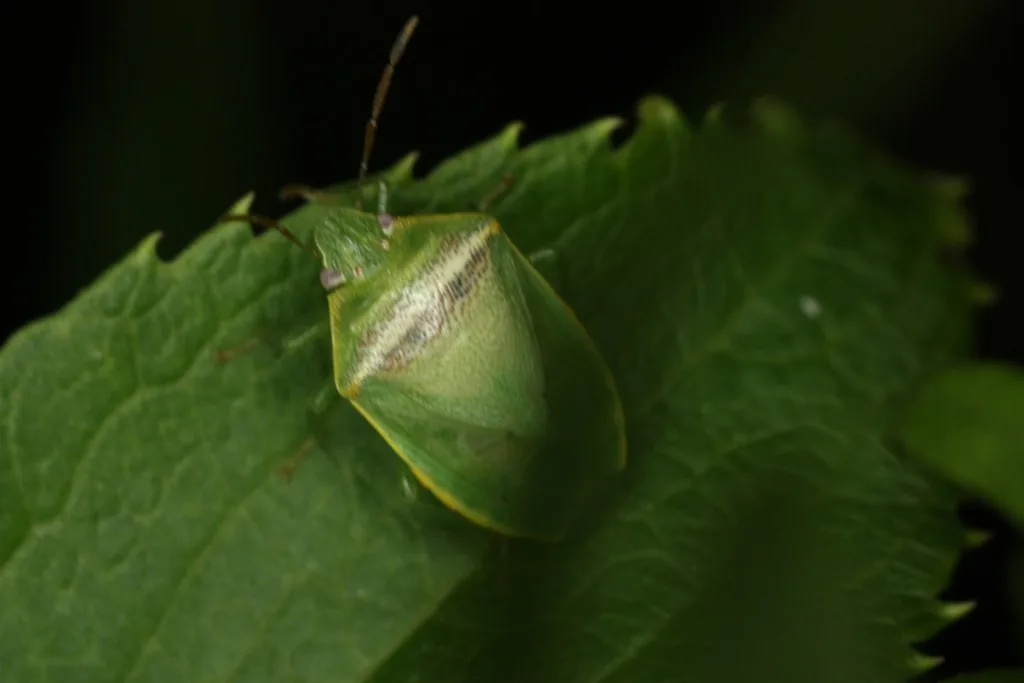
- Adults are shiny green to yellow-green and about half the size of the common stink bugs in soybeans, and they look more slender for their width.[1][2]
- Two stripes cross the pronotum behind the head, the front one yellow and the back one dark red, though the color of the band varies between individuals.[2][1]
- The surest mark is a long, fixed spine on the underside of the abdomen, between the hind legs. No other economically important stink bug in Arkansas soybeans has it, though it can be hard to see.[1][2]
- Later-stage nymphs are mostly green with brown to red stripes on the sides and top of the abdomen.[2]
- Eggs are laid in two side-by-side rows. The Virginia Tech field guide describes them as usually dark red to brown with a white band and about 30 to a cluster; in Louisiana soybean fields clusters averaged about 17 eggs.[1][2][4]
- UF/IFAS gives adults as 8–11 mm long and 4–6 mm wide across the pronotum. The band is usually cream or red but sometimes orange to deep purple, and the outer edge of the abdomen (the connexivum) often shows the same color.[10]
- Young nymphs often have a black head and pronotum with a red abdomen marked in black.[10]
Look-alikes
| Look-alike | How to tell them apart |
|---|---|
| Green stink bug and southern green stink bug | Both are about twice the size of the redbanded stink bug, have a flatter finish and lack the spine under the abdomen.[1] |
| Redshouldered stink bugs (Thyanta) | Also green and of similar size, often with a red or purple stripe across the pronotum, but shield-shaped with a flatter finish and no belly spine. Their nymphs have thinner stripes across the abdomen.[1][2] |
Where it lives
A key soybean pest throughout South America. It was first found in southern Louisiana in 2000 and had reached all of the state's soybean regions by 2006. By 2017 it had moved into southern Arkansas as far north as Marianna. Its northern limit shifts from year to year with winter cold. It was first described from the Caribbean island of St. Vincent and occurs from Argentina to the southern United States. UF/IFAS reports it was first noted in the United States in the early 1970s and became a major economic pest here from 2002; as of 2016 it had been recorded in Alabama, Arkansas, Florida, Georgia, Louisiana, Mississippi, New Mexico, South Carolina and Texas.[1][8][3][7][10]
Biology and life cycle
Adults that overwinter come out in spring to feed on other legumes such as clover while soybeans are still growing leaves. Later in the season they move into soybeans that have set pods.[1]
Arkansas Extension cites an estimate of four to eight generations a year in Louisiana, where generations can overlap by mid-July. Once they overlap, eggs, nymphs and adults are in a field at the same time.[1]
Soybean is its main crop host. In spring it builds up on other legumes: in Louisiana field studies, adults and nymphs were found most often on crimson clover and white clover, its main spring breeding hosts.[1][5]
In Arkansas it has been seen in July but has usually not reached treatable numbers until August or September. It is highly mobile and quickly moves into isolated fields that still have green pods, such as soybeans planted after wheat.[1]
Nymphs go through five instars of 3–13 days each, the third being the longest, and in laboratory colonies can reach adulthood in as little as 20 days; development and survival are best around 27°C. The first instar does not feed on plants.[10]
Egg-laying begins about 16 days after the final molt and mating. The eggs are black and cylindrical, laid in two side-by-side rows of generally 13–17, mostly on pods, and hatch in about 7.5 days under optimal conditions.[10]
Besides soybeans it feeds on beans, peas, lentils, alfalfa and other forage legumes, and on weedy legumes such as Crotalaria and Indigofera.[10]
Damage and signs
- Nymphs and adults can feed on stems, leaves and blooms, but they prefer the pods and the seeds inside. Feeding punctures show as small brown or black spots, and seed quality and quantity can drop.[1]
- Heavy feeding delays plant maturity and causes abnormal leaflet and pod growth. In Louisiana tests, high numbers of adults during pod development left plants holding green leaves at maturity.[1][6]
- University of Arkansas data suggest it does more damage per insect than other stink bugs, and the longer it stays in a field the more damage it does.[1][7]
- Like other stink bugs it injects salivary enzymes that break down plant tissue. Damaged seeds can shrivel, the wounds can let in fungi, and because it feeds for longer it appears to cause more seed damage than other stink bugs.[10]
Health risk
It is a crop pest of soybeans and other legumes; none of the sources describe any risk to people or pets.[1][2]
Control
Prevention
It tends to arrive late in the season, so planting earlier-maturing varieties in early planting windows gives fields a chance to mature before populations build.[1]
UF/IFAS notes it may be manageable with insect-resistant soybean varieties, and that mixing active ingredients and rotating insecticides is essential to avoid resistance.[10]
Traps and physical control
Scout at least weekly with a 15-inch sweep net. Sweep deeper in the canopy in hot weather, or sample in the early morning or late evening. The threshold used in Louisiana and Arkansas is 6 redbanded stink bugs in 25 sweeps, lower than for other stink bugs, so correct identification matters.[1]
UF/IFAS recommends checking fields weekly for eggs, nymphs and adults, because infestations can build quickly. No trap lure has been developed for this species, though it responds to the pheromone lure of another South American stink bug, Euschistus heros.[10]
Pesticides
Pyrethroids that control green and southern green stink bugs usually only suppress this species when used alone. Arkansas Extension found bifenthrin the most consistent pyrethroid and higher rates of acephate generally effective, and it recommends combining two modes of action, such as acephate with bifenthrin or a premix of lambda-cyhalothrin and thiamethoxam, for control and resistance management.[1]
Few soybean insecticides last more than a few days, and new bugs fly in after the residual wears off. This is often mistaken for insecticide failure, and repeat applications are typically needed.[1]
Where the sources disagree
Eggs: UF/IFAS describes them as black, generally 13–17 per clutch; the Virginia Tech field guide gives usually dark red to brown with a white band, approximately 30 eggs.[10][2]
Pronotal band: UF/IFAS says the adult usually has a single band, cream or red; the Virginia Tech field guide describes two stripes, the front yellow and the back dark red.[10][2]
Arrival: UF/IFAS reports it was first noted in the United States in the early 1970s; a Louisiana survey says it was first identified in southern Louisiana in 2000.[10][8]
Common questions
- How do I tell a redbanded stink bug from a green stink bug?
- Look for its smaller size (about half as big), shinier, more slender body, the colored band across the shoulders and a spine under the abdomen.[1][2]
- Why does it seem to come back after spraying?
- It is highly mobile, and most soybean insecticides only last a few days, so new bugs can move in after the treatment wears off.[1]
- Does it only feed on soybeans?
- No. Soybean is its main crop host, but it also feeds on other legumes; in spring it breeds mainly on clovers such as crimson and white clover.[1][5]
- How fast can redbanded stink bugs build up?
- UF/IFAS reports four to eight generations a year that begin to overlap in July, and nymphs can reach adulthood in as little as 20 days in the laboratory.[10]
Sources
- University of Arkansas System Division of Agriculture, Cooperative Extension Service, “Biology, Identification and Management of the Redbanded Stink Bug (FSA7078).” www.uaex.uada.edu/publications/PDF/FSA-7078.pdf (accessed 2026-11-14)
- Virginia Cooperative Extension (Virginia Tech), “Field Guide to Stink Bugs of Agricultural Importance in the United States, Second Edition (Herbert, Kamminga, Malone, Kuhar and others; publication 444-356).” accomack.ext.vt.edu/content/dam/pubs_ext_vt_edu/444/444-356/444-356_pdf.pdf (accessed 2026-11-14)
- Journal of Economic Entomology 2024;117(3):887-898, via PubMed, “Cold temperatures drive the latitudinal range limits and inhibit overwintering survival of the redbanded stink bug (2024).” pubmed.ncbi.nlm.nih.gov/38567742/ (accessed 2026-11-12)
- Insects 2016;7(2):27, via PubMed, “Oviposition and Sex Ratio of the Redbanded Stink Bug, Piezodorus guildinii, in Soybean (2016).” pubmed.ncbi.nlm.nih.gov/27322333/ (accessed 2026-11-12)
- Journal of Economic Entomology 2018;111(4):1716-1723, via PubMed, “Preference of the Redbanded Stink Bug (Hemiptera: Pentatomidae) for Selected Spring Host Plants (2018).” pubmed.ncbi.nlm.nih.gov/29684159/ (accessed 2026-11-12)
- Journal of Economic Entomology 2015;108(4):1516-1525, via PubMed, “Redbanded Stink Bug (Hemiptera: Pentatomidae) Infestation and Occurrence of Delayed Maturity in Soybean (2015).” pubmed.ncbi.nlm.nih.gov/26470290/ (accessed 2026-11-12)
- University of Arkansas System Division of Agriculture, “Emergency forum on redbanded stink bug set for Aug. 17 (news release, August 14, 2017).” www.uaex.uada.edu/media-resources/news/2017/august2017/08-14-2017-Ark-red-banded-stink-bugs.aspx (accessed 2026-11-12)
- Environmental Entomology 2013;42(4):648-657, via PubMed, “Species composition and seasonal abundance of stink bugs (Hemiptera: Pentatomidae) in Louisiana soybean (2013).” pubmed.ncbi.nlm.nih.gov/23905727/ (accessed 2026-11-14)
- iNaturalist, “Piezodorus guildinii taxon page (order and family).” www.inaturalist.org/taxa/330167 (accessed 2026-11-09)
- University of Florida IFAS Extension (EDIS), “Redbanded Stink Bug, Piezodorus guildinii (Westwood), EENY-682 (D. Pinkerton and A. Hodges).” ask.ifas.ufl.edu/publication/IN1176 (accessed 2026-11-14)