On this page
How to identify it
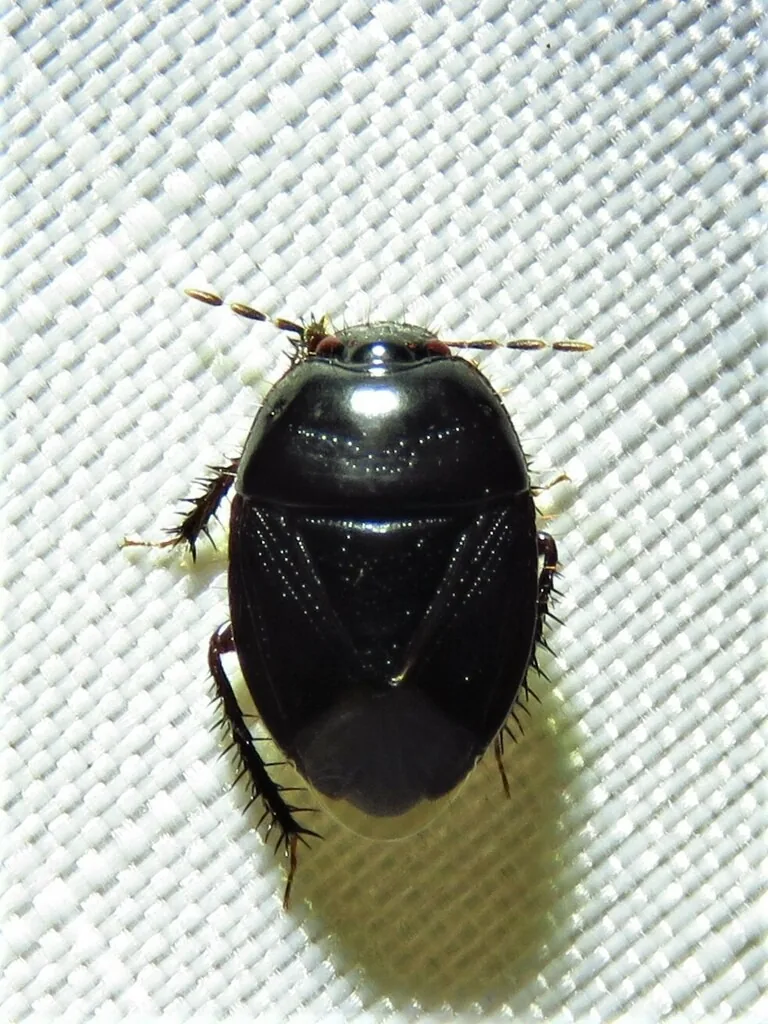
- Adults are somewhat oval, shiny black when fully hardened, and average about 5 mm long, though size varies considerably. Their legs are strong and covered in spines.[3]
- A sharp, deeply cut line running parallel to the front and side edges of the pronotum, the plate behind the head, is the main identifying feature; UF/IFAS names that line, together with body size, as what sets this species apart.[3][5]
- Nymphs have a light brown to black head and thorax and a creamy-white to gray abdomen; the fifth and last nymphal stage has wing pads.[3]
- Eggs are oval and about 1 mm long, creamy white (University of Georgia) or light yellow to white (UF/IFAS); two small red eyespots appear as the nymph inside develops.[3][5]
- UF/IFAS describes adults as oval, light brown to black and 5.85 to 7.6 mm (0.23 to 0.30 inch) long, among the larger burrower bugs found in peanut.[5]
- Other features UF/IFAS lists: four antenna segments, many spines on the shins angled at about 45 degrees, no tubercles under the hind thighs, and a scutellum (the triangular plate on the back) that does not reach the tip of the abdomen.[5]
- Nymphs look much like adults but lighter brown. UF/IFAS gives pronotum widths of about 0.66 mm for the beige first instar, then 0.9 mm (light brown), 1.27 mm (dark brown), 1.8 mm, and 2.6 mm for the darker fifth instar with distinct wing pads.[5]
Look-alikes
| Look-alike | How to tell them apart |
|---|---|
| White-margined burrower bug | Another burrower bug found in peanut fields. In South Carolina its nymphs showed up in May and June, probably drawn by henbit seeds, and none were present during pod formation; only the peanut burrower bug was tied to kernel feeding.[1] |
| Other burrower bugs (Cydnidae) | In the U.S., 27 burrower bug species are pests of crops such as cotton, spinach, peppers and strawberries, but UF/IFAS says that of those found in peanut fields, the peanut burrower bug is the only economically important one. Pitfall traps in South Carolina peanut fields caught three burrower bug species, and this one was the most abundant and the only one tied to kernel-feeding injury.[5][1] |
Where it lives
Native to North and Central America. UF/IFAS records it along the Atlantic coast from New York to Florida, west through Ohio, southern Wisconsin and Kansas, and southwest across New Mexico and Arizona into California's Imperial Valley, and south through Mexico to Guatemala; in the main southeastern peanut region it has been reported in 27 counties across Alabama, Florida and Georgia. It was not recognized as a peanut pest in Georgia until 2010 and is now one of the primary insect pests in Georgia peanut fields.[5][4][3]
Biology and life cycle
Adults overwinter in the soil. A Texas study found them 6 to 8 inches deep from December, becoming active again in late February to early March and moving toward the surface as it warms. UF/IFAS cites Georgia observations of active nymphs from December to February, and University of Georgia IPM reports nymphs as late as mid-November; in south Georgia adults are readily caught in light traps from May through September.[5][3]
Overwintering adults can already be in a field before peanuts are planted. After mating, females lay eggs in the soil near roots and pods in early spring; UF/IFAS gives an average of 130 eggs per female, about two a day. In laboratory colonies the eggs hatch within 7 days, and a generation takes about 30 days at 29 °C (84 °F); similar generation times appear to occur in Georgia fields from May to August.[1][3][5]
There are five nymphal stages, spent mostly below the soil surface. Adults and nymphs feed mainly on seeds but also on roots and stems; even the smallest nymphs can pierce the hull, though they feed more readily once pods fill, and their mouthparts grow by about 1.44 mm with each molt. Two to three generations followed the overwintering adults in South Carolina fields, and UF/IFAS says there are thought to be at least three a year.[1][3][5]
Few nymphs turn up before the full-seed stage. Populations peak as the kernels reach full size and often stay high until harvest.[1]
Strip-tilling peanuts into corn or wheat residue led to more burrower bugs and more kernel feeding than conventional tillage or strip-tilling into rye, and overwintering adults were found in a conservation-tillage field before planting. UF/IFAS says cover crops likely give the bugs winter habitat that is still occupied when peanuts go in.[1][5]
Adults and nymphs also spend the winter near field edges, just under the soil surface and near other host plants or grasses.[5]
Damage and signs
- Adults and nymphs feed directly on the developing seed through the hull, leaving sunken yellowish, brown or black lesions; UF/IFAS says scarred kernels are unmarketable. Fed-on kernels weigh about 10 percent less, and the injury lowers the grade more than the yield.[1][3][5]
- In South Carolina, each 10 percent rise in fed-on kernels went with a 1.7 percent drop in sound mature kernels, and feeding on more than 30 percent of kernels raised the risk of damaged-kernel grade penalties.[1]
- Puncture wounds in the hull can let in pathogens and aflatoxin. Georgia surveys found preharvest aflatoxin across all the fields studied, particularly in counties where this bug was common, and UF/IFAS says grade reductions and contamination can cut a crop's value by 50 percent.[4][2][5]
- Infestations are sporadic but can be serious, and because the bug stays underground the injury is often not noticed until the peanuts are harvested and sent for processing.[3][5]
Health risk
The sources describe it only as a crop pest. The health concern is indirect: UF/IFAS says its feeding wounds can be a pathway for aflatoxin contamination, and Georgia surveys found preharvest aflatoxin in peanuts especially where this bug was common.[4][5]
Control
Prevention
Conventional tillage reduced burrower bug numbers and kernel feeding compared with strip-tillage into corn or wheat residue, and fall tillage before a wheat cover crop also reduced feeding. Deep tillage and irrigation are the cultural tactics in use, but neither gives complete control, and because infestations are sporadic and cover crops and conservation tillage have their own benefits, UF/IFAS does not recommend changing tillage just for this pest.[1][3][5]
Traps and physical control
There are no economic thresholds, economic injury levels or standard sampling plans for this pest, and no cost-effective way to monitor it. UF/IFAS lists light traps, pitfall traps, inspecting pods and sampling soil as the only known sampling methods, but trap catches are not yet reliable enough to base decisions on.[3][5]
Biological control
Little is known about its natural predators or parasites. In laboratory tests, the insect-killing nematode Steinernema carpocapsae was the most virulent of six nematode strains against adults, and combining it with imidacloprid gave significant mortality starting three days after treatment; this is still research rather than an established control.[2][5]
Pesticides
Foliar sprays don't reach a pest that attacks pods underground, and UF/IFAS reports no currently labeled insecticide that gives adequate control. The only insecticide that gave consistent field control was granular chlorpyrifos, and all its food-use tolerances were revoked in early 2022.[2][3][5]
Where the sources disagree
Adult size and color: University of Georgia IPM describes fully hardened adults as shiny black and averaging about 5 mm long, with size varying considerably; UF/IFAS describes them as light brown to black and 5.85 to 7.6 mm long.[3][5]
Egg color: University of Georgia IPM calls the eggs creamy white; UF/IFAS calls them light yellow to white, with red eyespots appearing before hatch.[3][5]
Common questions
- What causes brown, scarred spots on peanut kernels when the shells look fine?
- Peanut burrower bugs feed through the hull from the soil, leaving sunken yellowish, brown or black lesions on the kernels inside, and UF/IFAS says those kernels are unmarketable. The damage is often found only after harvest.[3][5]
- Can I spray for burrower bugs in peanuts?
- Not effectively. Foliar sprays don't reach the bugs underground, UF/IFAS reports no labeled insecticide that gives adequate control, and the one insecticide that gave consistent field control, granular chlorpyrifos, lost its food-use tolerances in 2022.[2][3][5]
- Why is it a concern for aflatoxin?
- Its feeding wounds can serve as a pathway for aflatoxin contamination, and Georgia surveys found preharvest aflatoxin in peanuts especially in counties where the bug was common.[4][5]
- How big is a peanut burrower bug?
- Small. University of Georgia IPM says adults average about 5 mm long, while UF/IFAS gives 5.85 to 7.6 mm (0.23 to 0.30 inch). Eggs are about 1 mm long.[3][5]
Sources
- Entomological Society of America (Journal of Economic Entomology), “Chapin JW, Thomas JS. Burrower bugs (Heteroptera: Cydnidae) in peanut: seasonal species abundance, tillage effects, grade reduction effects, insecticide efficacy, and management. Journal of Economic Entomology 96(4):1142-1152 (2003) (abstract).” doi.org/10.1093/jee/96.4.1142 (accessed 2026-11-12)
- Society of Chemical Industry / Wiley (Pest Management Science), “Mbata GN, Li Y, Shapiro-Ilan D. Evaluation of chemical and microbial control options for Pangaeus bilineatus (Say) (Hemiptera: Cydnidae) infesting peanut crop. Pest Management Science 78(11):4719-4727 (2022) (abstract).” doi.org/10.1002/ps.7092 (accessed 2026-11-12)
- University of Georgia Integrated Pest Management, “Pangaeus bilineatus (Say), pest profile (M. Abney and B. Aigner, 2022).” ipm.uga.edu/2022/12/06/pangaeus-bilineatus-say/ (accessed 2026-11-12)
- Entomological Society of America (Journal of Economic Entomology), “Danso JK, Mbata GN, Holton RL. Preharvest insect pests of peanuts and associated aflatoxin contaminants in Georgia, USA. Journal of Economic Entomology 117(3):993-1000 (2024) (abstract).” doi.org/10.1093/jee/toae074 (accessed 2026-11-12)
- University of Florida IFAS Extension (EDIS), “The Peanut Burrower Bug, Pangaeus bilineatus (Say), EENY-821/IN1456 (K. Malfa, E. Carter, X. Martini and I. Esquivel; Featured Creatures).” ask.ifas.ufl.edu/publication/IN1456 (accessed 2026-11-14)
- iNaturalist, “Pangaeus bilineatus taxon page (order and family).” www.inaturalist.org/taxa/152126 (accessed 2026-11-09)