On this page
How to identify it
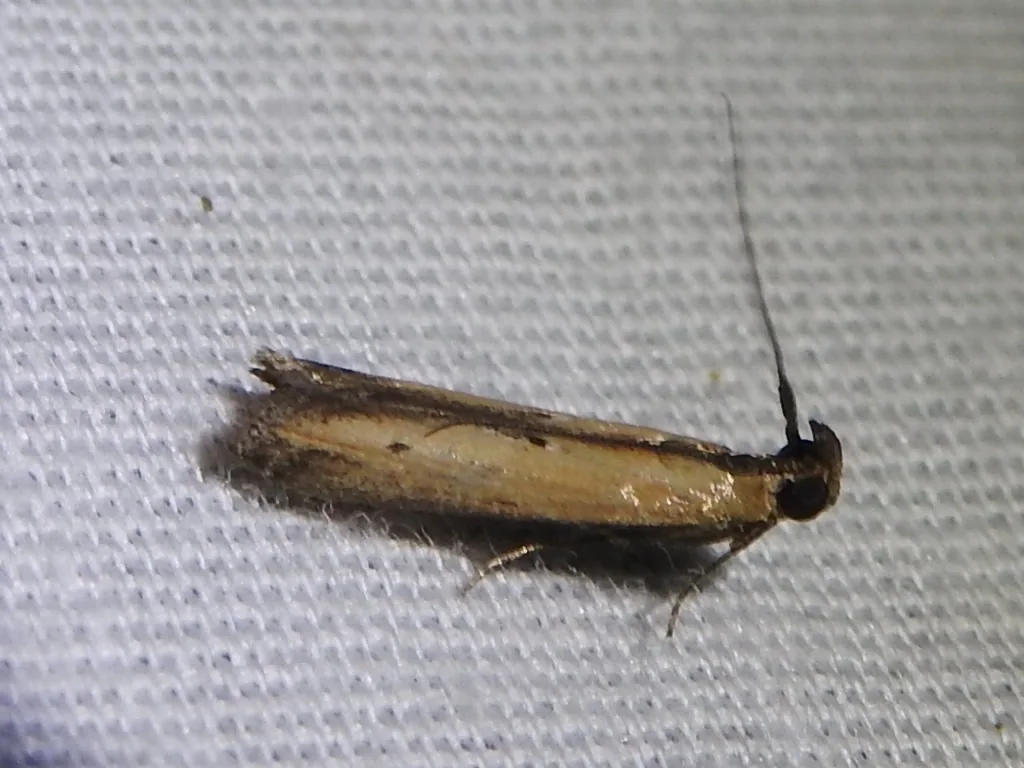
- Moths are about 1/2 inch long at rest with the wings wrapped tightly, and the forewings are 6 to 9 mm long. Females are dark brown to almost black and males are lighter tan with various markings, though color varies a great deal.[1][3]
- Grown caterpillars are slender and bluish green with brown rings or brownish lines, a narrow white line down the back and a dark brown shield behind the head. NC State gives a length of up to 7/8 inch; the EFSA plant health panel gives up to 13 mm. UF gives a final length of about 16.2 mm (5/8 inch).[1][2][3][4]
- Caterpillars move forward and backward very rapidly inside their silken tubes. UF says they wiggle violently when disturbed, which is why it is called the jumping borer in some countries.[2][4]
- The telltale sign is a small silk tube coated with sand at the base of the stem. Tunnels often radiate out from the stem just below the soil surface.[1][3]
- Pupae are slender, about 7/16 inch long, pale at first and darker just before the moth emerges, inside silken cocoons in the soil or under plant debris. UF gives sand-and-silk cocoons about 16 mm long and pupae about 8 mm long that turn from yellowish to brown to almost black.[1][4]
- UF says moths have a wingspan of 17 to 22 mm. The male's forewing is yellowish in the center, bordered by a broad dark band, while the female's is dark, sometimes almost black; both have transparent hind wings with a silvery tint.[4]
- Eggs are tiny, oval and greenish when laid, turning pinkish and then reddish, and UF says they look like grains of sand.[4]
Look-alikes
| Look-alike | How to tell them apart |
|---|---|
| Cutworms | Cutworms also attack seedlings at or just below the soil, but they are dull brown caterpillars 1 to 2 inches long that curl into a C-shape when disturbed and clip stems off; lesser cornstalk borer larvae are slender, bluish green and bore into the stem from sand-covered silk tubes.[5][1] |
Where it lives
The lesser cornstalk borer lives across tropical and some temperate parts of the Americas. In the U.S. it is found most often in the southeastern states; moths migrate north, sometimes as far as Canada, and the EFSA panel notes that records from northern states may be migrants rather than settled populations, since it has no winter diapause and cold winters probably keep it from establishing there. GBIF has 1990-2026 records from 32 states, with the most from Texas, California, Florida, Mississippi and Oklahoma. The University of Florida says damage occurs mainly in the sandy soils of the coastal plain from South Carolina to Texas, with sporadic records from Maine to southern California; it was first found outside the continental US in July 1986, on sugarcane in Kauai, Hawaii.[3][6][4]
Biology and life cycle
NC State says moths fly from June to November. The EFSA panel says adults shelter in shady areas under plants by day and fly on warm nights above 27 °C with high relative humidity.[1][3]
Eggs are laid mostly singly just below the soil surface near a host, with a few on stems and leaves; they hatch in 2 to 7 days by the EFSA panel's account, or 3 to 7 days by NC State's. EFSA says females lay about 30 eggs a day for about 6 days.[3][1]
Young caterpillars feed on roots, buds or leaves touching the soil, then build silk-lined tunnels and bore into the stem near the ground line. They leave the tube to feed and build new tunnels as they grow, reaching full size in 2 to 3 weeks.[1][3]
NC State says a complete life cycle usually takes 30 to 60 days and generations overlap considerably; the EFSA panel says egg to adult takes 25 days under favourable conditions.[1][3]
NC State reports at least two generations a year in North Carolina; the EFSA panel says 3 to 4 are possible in the southern U.S., such as South Carolina and Georgia.[1][3]
It has no diapause. Larvae and pupae carry it through winter, with development simply slowed by the cold.[1][3]
UF counts three to four generations a year in the Southeast and three in the Southwest. A female lays about 200 eggs, with up to 420 reported, and UF sees heavy egg-laying in Florida in spring and early summer, versus late summer and fall in Kentucky.[4]
Larvae usually pass through six instars (five to nine depending on conditions), the pupal stage lasts about nine to 10 days, and UF estimates adults live about 10 days in the field.[4]
Temperature matters: a UF lab study on sugarcane found egg-to-adult development ranged from 22.8 days at 33 °C to 120.7 days at 13 °C.[7]
In the northwest Florida Panhandle, a UF study using pheromone traps from 2017 to 2021 caught moths from April to December, most in August, with catches rising as temperatures rose.[8]
Damage and signs
- Larvae feed on more than 70 plant species in 27 families. Hosts include corn, sorghum, beans, peas, cowpeas, peanuts, soybeans and sugarcane, grasses such as crabgrass and Johnson grass, ornamental grasses such as Miscanthus, and seedlings of trees such as pines.[1][3]
- Feeding at or just below the soil surface damages the growing point and can kill young plants. Stem and root feeding make plants wilt and stunt, and larvae can girdle the main stem so plants die or fall over.[3][2][1]
- Outbreaks follow hot, dry weather. NC State says dry soils favor egg and larval survival, and the EFSA panel says irrigation causes significant larval mortality; NC State says ornamental grasses in sandy soil or in highway medians that are not irrigated in dry weather are likely to become infested.[2][3][1]
- EFSA says that despite its name it is regarded as a sporadic pest of corn, that U.S. economic damage is generally confined to the southeastern states from South Carolina to Texas, and that in Alabama it can become a significant pest of peanuts in hot, dry years. A 2023 UF study calls it an economic pest of peanuts in the southeastern US, with economic damage possible during the seedling and pegging stages.[3][8]
- UF says legume and grass crops are damaged most; in north Florida, soybeans, peanuts and grain sorghum are at risk. Weed hosts include nutsedge, Johnsongrass, crabgrass and goosegrass.[4]
- Boring kills the growing point, causing "dead heart" symptoms similar to wireworm damage, and UF notes the tunnels can also let plant pathogens in.[4]
Health risk
It feeds on plants. NC State and the EFSA plant health panel don't mention any risk to people or pets.[1][2][3]
Control
Prevention
Water frequently in dry weather: NC State says moist soils discourage female moths from laying eggs and encourage soil fungi that attack the caterpillars, and EFSA says irrigation causes significant larval mortality. NC State adds that mulching may reduce attacks.[1][3]
In soybeans, NC State advises against planting into burned stubble, planting late into droughty soil, or planting into fields burned down with a herbicide less than two weeks earlier; burning dries the soil, and the moths can sense smoke.[2]
UF says early planting avoids some damage, since populations build over the season; tilling and destroying weeds before planting kills larvae in the soil; and conservation tillage that leaves crop residue on the surface reduces injury because larvae feed on the residue. Frequent irrigation and Bt corn varieties also help.[4]
Traps and physical control
To check a field, UF suggests pulling up small plants in 10 locations; treatment is recommended if live larvae or pupae turn up in 10% of plants. Pheromone traps can monitor moths. UF also describes a "borer-days" forecast: hot, dry days (35 °C or more with under 2.5 mm of rain) minus cooler, wetter days; 10 or more means damage is likely, and 5 to 9 means fields should be scouted.[4]
Biological control
Big-eyed bugs, ground beetles, robber flies and earwigs eat the larvae, and viruses and the fungus Beauveria kill larvae and pupae; these diseases are favored by moisture. UF says parasitoids rarely cause more than 10% mortality and a granulosis virus appears to be the most important disease.[2][4]
Pesticides
Getting insecticide down to where the borers feed is hard, and NC State gives no economic threshold in soybean because remedial control is difficult. For landscapes, NC State says systemic insecticides labeled for residential use, such as imidacloprid granules watered into the soil, should be toxic to the borers; follow the label.[1][2]
Where the sources disagree
Corn: NC State calls it a fairly common pest of corn and sorghum; EFSA says it is regarded as a sporadic pest of corn.[1][3]
Caterpillar size: NC State says up to 7/8 inch; EFSA says up to 13 mm.[1][3]
Egg hatch: NC State says three to seven days; EFSA says 2 to 7 days, depending on temperature. UF says eggs hatch in two to three days.[1][3][4]
Generation time: NC State says a complete life cycle usually takes 30 to 60 days; EFSA says egg to adult takes 25 days under favourable conditions.[1][3]
Generations a year: NC State says at least two in North Carolina; EFSA says 3 to 4 are possible in the southern U.S., such as South Carolina and Georgia. UF says three to four in the Southeast.[1][3][4]
Eggs per female: UF says about 200, with up to 420 reported; a 2023 UF study cites up to 120; EFSA says about 30 a day for about 6 days.[4][8][3]
Common questions
- Why are my plants wilting in sandy soil during a drought?
- Lesser cornstalk borer is one possible cause: NC State says infested plants usually wilt and that ornamental grasses in sandy soil not irrigated in dry weather are likely to become infested. EFSA says larvae can be found by searching the soil and the silken tunnels attached to the underground stem or roots; look for a sand-covered silk tube and a slender bluish-green caterpillar.[1][3]
- How do I prevent it?
- Keep sandy soil irrigated through hot, dry spells, consider mulch, and avoid planting into dry, burned or freshly killed ground.[1][2]
- Does it attack ornamental grasses?
- Yes. NC State says ornamental grasses such as Miscanthus growing in sandy soil, or in highway medians that aren't watered in dry weather, are likely to become infested.[1]
- When do the moths fly in Florida?
- In the northwest Florida Panhandle, a UF study caught moths in pheromone traps from April to December, with the peak in August.[8]
- How do I check a field for lesser cornstalk borer?
- UF suggests pulling up small plants in 10 locations and looking for larvae and their sand-covered silk tubes; treatment is recommended if live larvae or pupae are found in 10% of plants.[4]
Sources
- NC State Extension, “Lesser Cornstalk Borer in Ornamental Plants (PDIC Factsheet).” content.ces.ncsu.edu/lesser-cornstalk-borer-in-ornamental-plants (accessed 2026-11-14)
- NC State Extension, “Lesser Cornstalk Borer in Soybean (D. Reisig).” content.ces.ncsu.edu/lesser-cornstalk-borer-in-soybean (accessed 2026-11-14)
- European Food Safety Authority (EFSA Journal), via PubMed Central, “EFSA Panel on Plant Health (2021), Pest categorisation of Elasmopalpus lignosellus, EFSA Journal 19(6):6663.” pmc.ncbi.nlm.nih.gov/articles/PMC8227406/ (accessed 2026-11-14). Cited from the open-access full text (PubMed 34194573).
- University of Florida/IFAS Extension (Featured Creatures), “Lesser Cornstalk Borer, Elasmopalpus lignosellus (Zeller), EENY-155/IN312.” ask.ifas.ufl.edu/publication/IN312 (accessed 2026-11-14)
- University of California Statewide IPM Program (UC IPM), “Cutworms (Home and Landscape).” ipm.ucanr.edu/home-and-landscape/cutworms/ (accessed 2026-11-14)
- Global Biodiversity Information Facility (GBIF), “Elasmopalpus lignosella (lesser cornstalk borer): occurrence records, 1990-2026 (GBIF occurrence search).” api.gbif.org/v1/occurrence/search?taxonKey=1877282&hasGeospatialIssue=false&occurrenceStatus=PRESENT&year=1990%2C2026&facet=stateProvince&facet=country&facetLimit=400&limit=0 (accessed 2026-11-14). Counts are records reported (iNaturalist research-grade, museum specimens, surveys), not abundance; the U.S. state split uses the same query with country=US.
- Entomological Society of America (Environmental Entomology), via PubMed, “Temperature-dependent development of Elasmopalpus lignosellus (Lepidoptera: Pyralidae) on sugarcane under laboratory conditions (Sandhu et al. 2010, Environmental Entomology 39:1012-1020).” pubmed.ncbi.nlm.nih.gov/20550817/ (accessed 2026-11-14). Abstract read through NCBI E-utilities.
- Insects (MDPI), via PubMed Central, “Flight Phenology of Elasmopalpus lignosellus (Lepidoptera: Pyralidae) in the Northwest Florida Panhandle (Santos et al. 2023, Insects 14:354).” pmc.ncbi.nlm.nih.gov/articles/PMC10146345/ (accessed 2026-11-14). Full text read through NCBI E-utilities (PMC).
- Global Biodiversity Information Facility (GBIF), “Elasmopalpus lignosella Zeller, 1848 (GBIF Backbone Taxonomy).” api.gbif.org/v1/species/1877282 (accessed 2026-11-14). GBIF spells the species name lignosella
- iNaturalist, “Elasmopalpus lignosella taxon page (order and family).” www.inaturalist.org/taxa/1252809 (accessed 2026-11-14)