On this page
How to identify it
- Full-grown caterpillars are smooth, plump and nearly hairless, about 1 to 2 inches long.[2][1][4]
- They curl into a tight C shape when disturbed.[1][2][4]
- Colors range from dingy white, tan or brown to gray, pink, green or black, and many have markings that blend in with soil.[2][1][4]
- UC IPM describes the black cutworm as greasy gray with several black bumps on each segment, and says it may tunnel into soil, dragging plant parts with it. Utah State describes the larva as reddish-brown.[1][6]
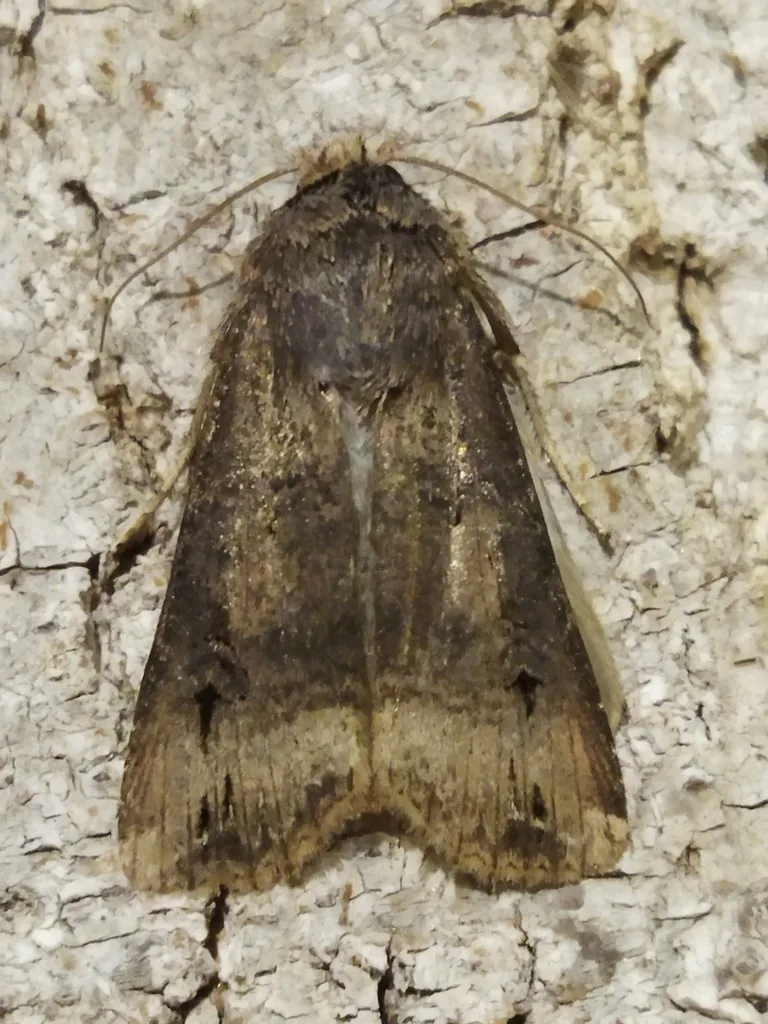
- Adults are night-flying, dull gray-brown moths about 1 inch long with patterned forewings darker than the hind wings. Wingspan figures differ: up to about 1 1/2 inches in Minnesota's account, 1.5 to 3 inches in UNH's.[2][4]
Look-alikes
| Look-alike | How to tell them apart |
|---|---|
| Variegated cutworm | Pale gray to mottled brown with red and yellow dots along the back; it climbs trees, shrubs, vines and garden plants to eat leaves, buds and fruit.[1][2] |
| Armyworms | Close relatives, but armyworms typically feed during the day, and in lawns they feed and travel in large groups that leave broad brown patches, while cutworms clip blades and leave small scattered pockets.[5][6] |
Where it lives
Which species you see depends on region. In Minnesota, black and variegated cutworms fly in from the south each spring, while dingy, bronzed and glassy cutworms are native and overwinter there.[2]
Biology and life cycle
Females lay hundreds of eggs, singly or in small clusters, on or near low plants, grasses, weeds and plant residue; a few species lay on bare ground. Utah State reports variegated cutworm females laying more than 1,200 eggs in under 10 days.[2][4][6]
Young larvae feed on leaves or small roots until about 1/2 inch long, then start cutting through seedling stems.[2]
They feed in the evening and at night and hide in soil or debris by day, so it's common to find clipped plants but no caterpillars.[2][1][4][5]
UNH says most species overwinter in the soil or under debris as partly or fully grown larvae, feed from early spring into early summer, then pupate in the soil and emerge as moths one to eight weeks later. Utah State says its black and variegated cutworms overwinter as pupae.[4][6]
Black and variegated cutworms fly into Minnesota from the south each spring on weather fronts, while dingy, bronzed and glassy cutworms live there year-round. A 2023 genome study describes the black cutworm as a serious pest worldwide with the ability to migrate long distances.[2][7]
Some species have up to three generations a year in Minnesota and up to four in Utah, but they are rarely a problem after spring. Numbers swing a lot from year to year, and Minnesota says rainfall especially controls them.[2][6][1]
Damage and signs
- Cutworms curl around a stem and chew through it just above the soil, often eating just enough to topple the plant; partly cut plants wilt.[2][4]
- They attack most garden crops, including asparagus, beans, cabbage, carrots, lettuce, peppers, potatoes and tomatoes.[2][1]
- Feeding habits differ by group: surface cutworms cut stems, climbing cutworms eat buds, leaves and fruit on plants, shrubs, vines and trees, army cutworms move across land in large numbers, and soil-dwelling species such as the glassy cutworm eat roots and underground stems.[4][2]
- Some species chew holes in leaves, bore into lettuce or cabbage heads, or eat into young fruit.[1]
- In lawns, and especially on golf greens, cutworms clip blades near the crown and leave small pockets that look like ball marks. Utah State considers them minor turf pests, and grass usually recovers because roots and crowns aren't eaten.[6]
Health risk
Cutworms are plant pests. The adult moths sip flower nectar and don't damage plants, and the caterpillars feed only on plants.[2][4][1]
Control
Prevention
Check in the morning for freshly cut or wilting plants and droppings on the ground, then search at dusk or with a flashlight at night. Run your hand through the soil within a foot of damaged plants; black cutworms may leave a hole nearby.[2][4][5]
Plant a few extra seedlings to allow for losses, use sturdy transplants, and till before planting and again in fall to expose larvae and pupae in the soil.[1][2]
Keep them out
Put a collar of cardboard, foil, plastic or a cut-down carton or bottle around each transplant. Recommended sizes differ: UNH says at least 1 inch into the soil and 2 inches above, WSU 2 inches each way, and Minnesota a few inches down and several inches up.[2][4][5][1]
Sanitation
Remove crop residue and weeds, especially over winter, and keep nearby grass mowed short; UNH notes many moths lay eggs in fall. Minnesota suggests compost rather than green manure, which may encourage egg-laying, and a 3- to 4-foot strip of dry, bare soil around the garden edge.[1][2][4][5]
Traps and physical control
Hand-pick caterpillars at night or dig them from the soil at the base of damaged plants by day, then crush them or drop them into soapy water.[1][2][4][5]
Biological control
Birds and spiders eat cutworms, so encourage them.[5]
Pesticides
Pesticides are usually not needed in home gardens. Bacillus thuringiensis or spinosad sprays can protect larger plants, though WSU notes Bt works only if caterpillars eat enough of it, and UC IPM says pesticides are not very effective and not recommended on ornamentals.[2][1][5]
Common questions
- What is cutting my seedlings off at the ground overnight?
- Most likely cutworms. Check the soil around damaged plants in the evening for C-shaped caterpillars; black cutworms may leave a small hole nearby.[2][1][4]
- Why do I find cut plants but no caterpillars?
- Cutworms feed at night and spend the day hidden in the soil or under debris near the plant. Scratch through the top layer of soil at the base of the damage, or come back after dark with a flashlight.[2][5][4]
- Do cutworm collars really work?
- Yes, for most species. A collar pushed into the soil and standing a couple of inches or more above it keeps cutworms from reaching the stem.[2][4][5]
Sources
- University of California Statewide IPM Program, “Cutworms (Pest Notes, Home and Landscape).” ipm.ucanr.edu/home-and-landscape/cutworms/ (accessed 2026-11-11)
- University of Minnesota Extension, “Cutworms (Yard and Garden Insects).” extension.umn.edu/yard-and-garden-insects/cutworms (accessed 2026-11-11)
- iNaturalist, “Agrotis ipsilon taxon page (order and family).” www.inaturalist.org/taxa/126276 (accessed 2026-11-11)
- University of New Hampshire Cooperative Extension, “Cutworms [fact sheet] (Eaton and Maccini, updated August 2016).” extension.unh.edu/resource/cutworms-fact-sheet (accessed 2026-11-11)
- Washington State University Extension, “Corn: Cutworms and armyworms (Hortsense).” hortsense.cahnrs.wsu.edu/fact-sheet/corn-cutworms-and-armyworms/ (accessed 2026-11-11)
- Utah State University Extension, “Armyworms and Cutworms in Turfgrass (Hodgson, June 2007).” extension.usu.edu/planthealth/research/armyworms-and-cutworms-in-turfgrass (accessed 2026-11-11)
- BMC Biology, via PubMed, “Jin M, Liu B, Zheng W, et al. (2023), Chromosome-level genome of black cutworm provides novel insights into polyphagy and seasonal migration in insects, BMC Biology 21:2.” pubmed.ncbi.nlm.nih.gov/36600240/ (accessed 2026-11-11). Cited from the PubMed abstract.