On this page
How to identify it
- Descriptions of the caterpillar's color differ. Missouri describes a yellow-green to green body with a yellow-brown head and a pale-green stripe down the middle of the back; the Crop Protection Network says pale green to yellow-green with a tan to orange mottled head; UC IPM says yellowish to green with a pale double stripe along the back and a lighter line on each side; and Texas A&M calls it buff colored. Nebraska Extension describes pale green or yellow-green caterpillars with a whitish-tan, brown-speckled head marked by a distinct black spot on each side near the thorax, and rows of lighter gray spots on the lower half of the body.[1][2][4][3][5]
- All four describe rows of distinct black spots; Missouri and the Crop Protection Network count six on each segment, and the Crop Protection Network notes that each spot bears stiff hairs.[1][2][4][3]
- Missouri gives the full-grown length as 0.5 to 0.75 inch; the Crop Protection Network says about 1 inch.[1][2]
- Look for leaves tied together with silk, or a single leaf folded into a tube, with the caterpillar feeding inside and hiding there when disturbed.[2][4][3]
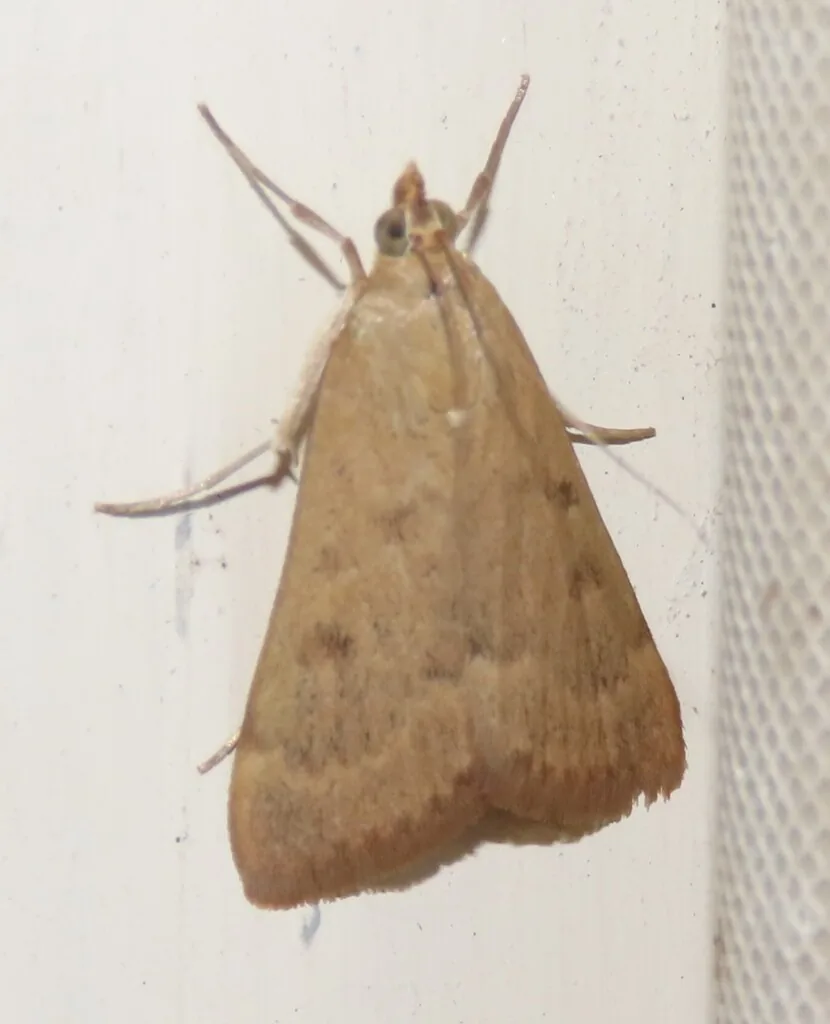
- The adult is a small tan to brown moth with a distinct snout. UC IPM adds that webworm moths are active at night but often fly up out of the foliage when you walk through a field by day.[2][4]
Look-alikes
| Look-alike | How to tell them apart |
|---|---|
| Alfalfa webworm | A very similar webbing caterpillar on alfalfa and soybeans, light to dark brown or green with a brown-tan stripe down the back; its six spots per segment are less distinct, and the moth has a prominent cream band near the base of the forewing.[2] |
| Beet webworm | Larger, about 1.5 inches when grown, olive to dark green with a dark stripe down the back and lighter stripes on the sides; its six spots per segment are large.[2][4] |
Where it lives
The Crop Protection Network describes webworms as occasional pests whose activity varies by region across the United States, Canada and Mexico, and a long-term study followed garden webworms on small islands in the Bahamas. GBIF holds about 14,000 U.S. records since 1990, most of them from Texas, with Oklahoma and Florida next. Nebraska Extension calls them uncommon pests of Nebraska field crops.[2][6][7][5]
Biology and life cycle
Caterpillars are present from late spring to fall, with two to three generations a year in Missouri. Nebraska Extension says several generations develop each season and the last may spend the winter in the soil as pupae.[1][5]
UC IPM, writing about the three webworms found in sugarbeets, says they spend the winter as caterpillars or pupae and emerge in early spring. Their small yellow or green eggs are laid in groups of 2 to 20 on the undersides of leaves.[4]
Early in the season moths lay eggs at the base of soybean seedlings, and the young caterpillars wrap themselves in the emerging leaves. Later in the season caterpillars feed on weeds such as pigweed and ragweed before moving into crops, and they move from alfalfa into soybeans when the alfalfa is cut.[2]
The caterpillar feeds mainly on the undersides of leaves, pulling the leaf in and curling it with silk.[3]
In Kansas, K-State Extension noted in early August 2022 that garden webworms had nearly finished feeding on soybeans and alfalfa and would pupate in the soil for 4 to 7 days before the moths emerged to lay eggs.[8]
Damage and signs
- Host plants include many vegetables, field crops such as alfalfa, soybeans and sugarbeets, and weeds. Nebraska Extension adds clover, beans and corn to the list.[1][2][3][4][5]
- Feeding skeletonizes the leaves, which turn brown and net-like once the green tissue is eaten, and severely damaged plants are covered with silken webbing. Nebraska Extension says only the network of veins is left, drying and curling inside the webbing.[2][1][4][5]
- Heavy infestations can strip foliage fast: UC IPM says webworms can defoliate a sugarbeet field in a very short time, and the Crop Protection Network says severe early-season feeding in soybeans can thin the stand enough to need replanting.[4][2]
Health risk
It feeds only on plants; none of the sources reports any harm to people or pets.[1][2][4]
Control
Prevention
Scout late-planted soybeans, field edges and areas next to weedy ground or recently cut alfalfa, where webworms are most likely to move in.[2]
Sanitation
Keep weeds down. UC IPM reports worse injury in weedy fields, especially those with pigweed and lambsquarters.[4][2]
Traps and physical control
In alfalfa, Nebraska Extension says the best control is to harvest the crop if possible. In early August 2022 K-State Extension expected little effect on most soybeans because the plants were far enough along, but said very late-planted or moisture-stressed fields still deserved monitoring.[5][8]
Biological control
Many parasites and predators attack webworms, and plants tolerate a lot of leaf loss, so UC IPM favors materials with low impact on natural enemies, such as Bacillus thuringiensis or spinosad, when treatment is needed.[4]
Pesticides
Thresholds differ by crop. In soybeans the Crop Protection Network uses 30 percent defoliation during vegetative stages and 20 percent during reproductive stages and says spot treatments may be warranted; in sugarbeets UC IPM says no thresholds exist and to treat only if defoliation keeps progressing. The Crop Protection Network refers growers to local extension specialists for current recommendations, and Texas A&M points vegetable growers to its vegetable IPM recommendations.[2][4][3]
What keeps webworms in check
UC IPM notes that many parasites and predators have been reported on webworms, though it doubts any of them can regulate webworm numbers on their own.[4]
Predators can matter, though. On small Bahamian islands where garden webworm caterpillars feed on sea purslane, a 10-year study found webworms 4.6 times more abundant on islands without a ground-foraging anole lizard than on islands with it, and the plant recovered faster after hurricanes where lizards were present.[6]
Night-flying bats eat the moths: DNA from garden webworm moths turned up in the stomachs of eastern red bats found dead at a north Texas wind farm.[9]
Common questions
- What is webbing the leaves of my beans together?
- Small green caterpillars with rows of black spots feeding inside silk-tied leaves are likely garden webworms.[1][2][3]
- Where do garden webworms come from?
- They often move in from weedy areas and nearby alfalfa, especially after the alfalfa is cut.[2][4]
- Do I need to spray garden webworms?
- Often not. They are occasional pests, plants tolerate considerable leaf loss, and weed control helps. If defoliation keeps climbing, low-impact options such as Bacillus thuringiensis or spinosad spare natural enemies; check with local extension for products labeled for your crop.[2][4]
Sources
- University of Missouri Extension, “Caterpillars in Your Yard and Garden (IPM1019), page 18: garden webworm.” extension.missouri.edu/publications/ipm1019/18 (accessed 2026-11-14)
- Crop Protection Network (multi-state university extension collaboration), “Webworms in Soybean.” cropprotectionnetwork.org/encyclopedia/webworms-in-soybean (accessed 2026-11-14)
- Texas A&M AgriLife Extension, Aggie Horticulture, “Garden Webworm (Cucurbit Problem Solver).” aggie-horticulture.tamu.edu/vegetable/problem-solvers/cucurbit-problem-solver/cucurbit-insects/garden-webworm/ (accessed 2026-11-14)
- University of California Statewide IPM Program, “Sugarbeet Pest Management Guidelines: Webworms.” ipm.ucanr.edu/agriculture/sugarbeet/webworms/ (accessed 2026-11-14)
- University of Nebraska-Lincoln Extension (CropWatch), “Webworms Damaging Alfalfa and Soybeans (Bob Wright, August 24, 2007).” cropwatch.unl.edu/webworms-damaging-alfalfa-and-soybeans/ (accessed 2026-11-14). Its insecticide lines are not used.
- Ecology, via PubMed, “Predators suppress herbivore outbreaks and enhance plant recovery following hurricanes (Spiller, Schoener and Piovia-Scott 2016).” pubmed.ncbi.nlm.nih.gov/27859131/ (accessed 2026-11-14)
- Global Biodiversity Information Facility (GBIF), “Achyra rantalis: U.S. occurrence records since 1990 by state (GBIF occurrence search).” api.gbif.org/v1/occurrence/search?taxonKey=1892488&country=US&hasGeospatialIssue=false&occurrenceStatus=PRESENT&year=1990%2C2026&facet=stateProvince&facetLimit=400&limit=0 (accessed 2026-11-14)
- Kansas State University Extension Entomology, “Garden Webworms (Jeff Whitworth, August 4, 2022).” www.k-state.edu/news/kansasbugs/articles/2022/08/garden-webworms.html (accessed 2026-11-14)
- PeerJ, via PubMed, “Increasing evidence that bats actively forage at wind turbines (Foo et al. 2017).” pubmed.ncbi.nlm.nih.gov/29114441/ (accessed 2026-11-14)
- iNaturalist, “Achyra rantalis taxon page (order and family).” www.inaturalist.org/taxa/204077 (accessed 2026-11-14)