On this page
How to identify it
- Unlike other caterpillars on cole crops in Kentucky, the larva has a black head; NC State adds a well-defined V-shaped mark on it. Grown larvae are about 1/2 to 5/8 inch long, tan or yellowish gray with dark lengthwise stripes.[1][2][3]
- Larvae hide in webbed pockets along leaf margins or in webs along veins on the leaf undersides.[1][2]
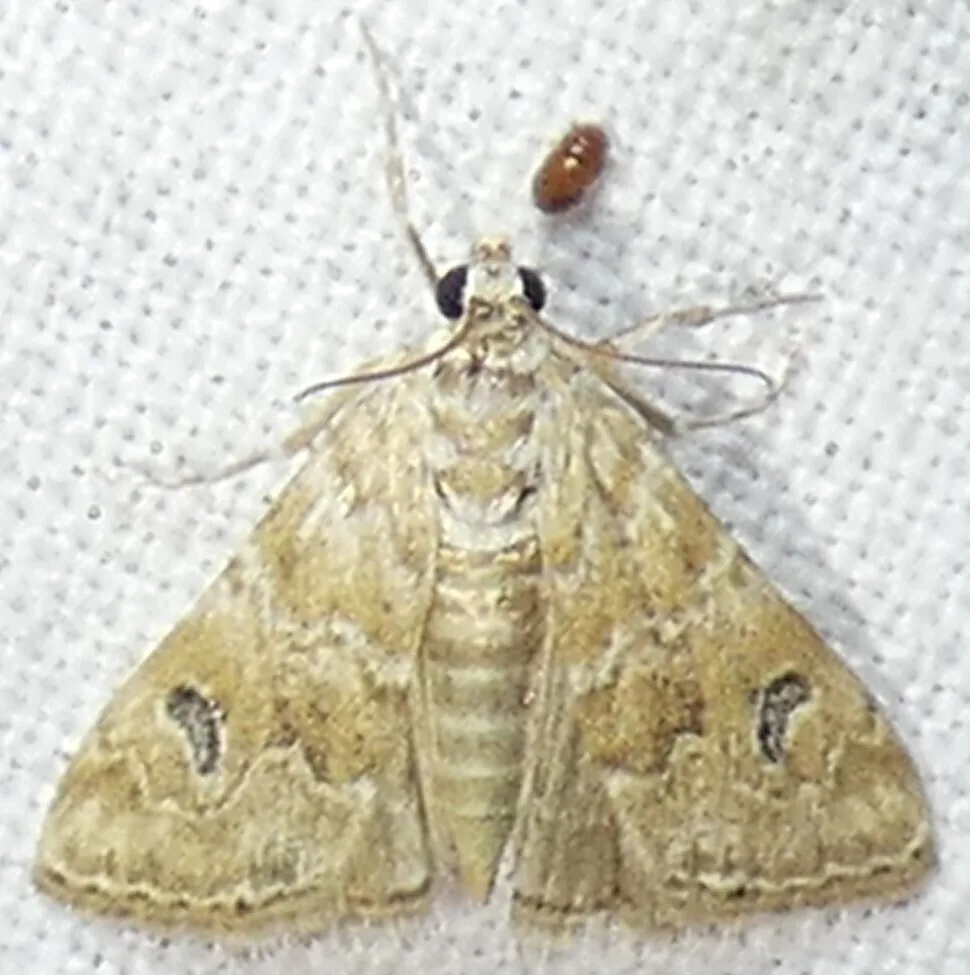
- The moth has brownish-yellow, darker-mottled forewings and pale gray hind wings, with a wingspan a little over 1/2 inch. It rests on the ground, well camouflaged, and makes short, erratic flights when disturbed. UF describes the forewings as yellowish-brown with white bands and a dark kidney-shaped spot, and the hind wings as grayish.[1][2][7]
- Eggs are flat with a distinct nipple at one end; they are gray or yellowish-green and turn pink as they age.[7]
Look-alikes
| Look-alike | How to tell them apart |
|---|---|
| Imported cabbageworm | Another cole crop caterpillar; the cabbage webworm's black head sets it apart.[1] |
| Diamondback moth | Another cabbage caterpillar; in Florida, UF/IFAS calls diamondback moth the greatest insect problem for cabbage growers, and cabbage webworm is now only an occasional pest there.[8] |
Where it lives
NC State says it occurs from North Carolina south to Florida and west into California. UKY says it's common along the Gulf Coast and southern Atlantic states and only rarely reaches Kentucky in fall. A University of Florida pest page calls it an American insect found in the southern states from Virginia to California.[2][1][7]
Biology and life cycle
Moths lay about 300 to 350 eggs on plant buds; larvae hatch in about three days and feed in the buds before moving to outer leaves.[1][2]
UGA says development from egg to adult takes about a month in warm weather, with about two weeks as a larva. NC State says the number of generations a year in North Carolina hasn't been determined. UF says the life cycle generally takes about 30 days and that the cabbage webworm can reproduce throughout the year.[3][2][7]
Hosts include cabbage, broccoli, cauliflower, collards, kale, turnip, rutabaga, radish, kohlrabi, mustard and horseradish, plus weeds such as shepherd's-purse. UF adds purslane as a weed host.[1][2][7]
Damage and signs
- Damage begins as quarter-sized brown, dried areas on leaf edges. Boring into the bud and stem kills the bud, causing side shoots that won't make marketable heads, and sometimes kills the plant; UKY says it's more destructive than other cabbage caterpillars, especially on small plants.[1][2][3]
- In Florida cabbage, UF/IFAS says eggs are usually laid in plant buds and the young larvae feed on the undersides of leaves in the bud area, making small holes. They cover themselves with webs that become coated with dirt and excrement; larger larvae can burrow into buds, stems and leaves.[8]
- Feeding on the growing point prevents head formation, and the plant may look lopsided. UF/IFAS says it can attack cabbage both in seedbeds and in the field, and that larvae mine the leaves before webbing them, leaving rolled foliage.[8][7]
Health risk
It feeds on cabbage-family plants. UKY, NC State, UGA and Clemson describe crop damage only and don't mention any risk to people or pets.[1][2][3][4]
Control
Prevention
Start checking when fall plants are set out; UKY and NC State say it isn't a problem on spring crops.[1][2]
UF suggests choosing early-maturing varieties to avoid the heavy infestations that build late in the season.[7]
Biological control
Clemson says the webs shield the caterpillars from natural enemies and give some protection from sprays.[4]
Pesticides
Controls used for other cabbage caterpillars work if applied while larvae are small, before they spin protective webs; UKY says to direct sprays under the leaves and down into the bud.[1][3]
UF says insecticide control is difficult because the larvae feed hidden. In Florida commercial cabbage, UF/IFAS describes it as a sporadic pest, more of a problem in southern Florida, that is usually controlled by treatments aimed at diamondback moth.[7][8]
Where the sources disagree
Stripes: UKY describes four brown stripes on a tan body; NC State describes five dark stripes, and UGA five brownish-purplish bands.[1][2][3]
Pupation: UKY and NC State say larvae pupate among shed leaves or other refuse on the ground; Clemson and UGA say they pupate in the soil, UGA in a webbed cocoon. UF's vegetable pest page also says the soil, while UF/IFAS's cabbage profile says larvae pupate in the buds, on the sides of stems or on the soil surface.[1][2][4][3][7][8]
Season: UKY and NC State say it's a fall pest only; UGA has seen damaging levels in summer and fall in Georgia. UF says it can reproduce throughout the year.[1][2][3][7]
When to treat: NC State says control on fall crops is mainly preventive, starting as plants come up or are set out; UGA says a spray is warranted if webworms appear before the five-leaf stage in cabbage, and that normal scouting and control for other caterpillars usually handles it.[2][3]
Natural enemies: UF's 2005 vegetable pest page says natural enemies of the cabbage webworm have not been identified, while Clemson says the webs shield the caterpillars from natural enemies.[7][4]
Common questions
- What caterpillar has a black head on my cabbage?
- Probably the cabbage webworm. UKY says its black head sets it apart from other cole crop caterpillars in Kentucky.[1][2]
- Why didn't my broccoli form a head?
- Cabbage webworms boring into the bud kill it, and the side buds that grow instead usually don't form marketable heads in time.[1][2]
Sources
- University of Kentucky Entomology (ENTFACT), “Cabbage Webworm (ENTFACT-315).” entomology.mgcafe.uky.edu/ef315 (accessed 2026-11-13)
- NC State Extension, “Pests of Crucifers (Insect and Related Pests of Vegetables; K. Sorensen).” content.ces.ncsu.edu/insect-and-related-pests-of-vegetables/pests-of-crucifers (accessed 2026-11-13)
- University of Georgia Extension, Vegetable IPM, “Cabbage Webworm (Lepidoptera, Pyralidae) (D. Riley and S. Sparks, 2018).” ipm.uga.edu/files/2020/02/Webworm_UGA_FeatureCreature.pdf (accessed 2026-11-13)
- Clemson Cooperative Extension, Home & Garden Information Center, “What Is It? Wednesday – Cabbage Webworm.” hgic.clemson.edu/what-is-it-wednesday-cabbage-webworm/ (accessed 2026-11-13)
- Global Biodiversity Information Facility (GBIF), “Hellula rogatalis Hulst, 1886 (GBIF Backbone Taxonomy).” api.gbif.org/v1/species/1879398 (accessed 2026-11-13)
- iNaturalist, “Hellula rogatalis taxon page (order and family).” www.inaturalist.org/taxa/210616 (accessed 2026-10-06)
- University of Florida, Department of Entomology and Nematology, “Cabbage Webworm, Hellula rogatalis (UF/IFAS Vegetable Arthropod Pest Photographs CD-ROM III).” entnemdept.ufl.edu/projex/gallery/dl/Vegetable_Pests_III/text/cabbage_webworm.htm (accessed 2026-11-14)
- University of Florida IFAS Extension, EDIS, “Florida Crop/Pest Management Profile: Cabbage, CIR1256/PI042 (W. M. Elwakil and M. Mossler; archival copy).” journals.flvc.org/edis/article/download/120874/119409 (accessed 2026-11-14). Archival copy on the EDIS journal site; the current EDIS address, ask.ifas.ufl.edu/publication/PI042, returns 410 (withdrawn).