On this page
How to identify it
- Mature caterpillars are pale green to green-yellow with scattered black hairs, slender and tapered at both ends. UC IPM puts them at 0.33 inch long and NC State at about 3/8 inch. UF/IFAS says the last of the four instars rarely exceeds 11.2 mm (0.44 in). The caterpillars are colorless in the first instar and green afterward, with few short hairs, and have five pairs of prolegs.[1][2][9]
- Two prolegs on the last segment form a distinctive V at the rear end.[1][5]
- When disturbed, the caterpillars wriggle or thrash rapidly and often drop from the plant on a silk thread.[5][2][3]
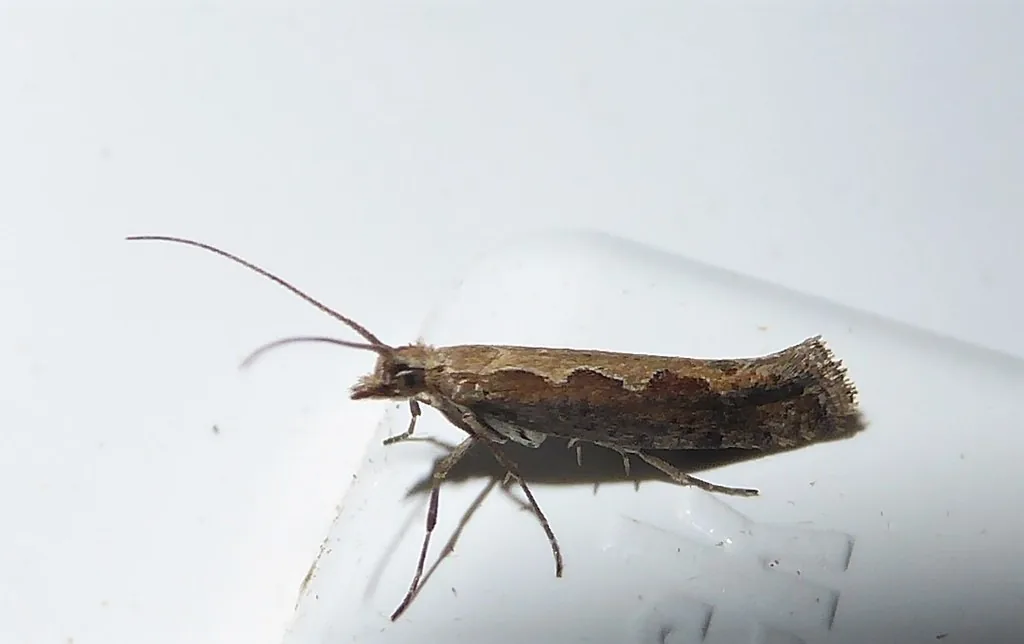
- The adult is the smallest of the moths that attack brassicas: slender, light brown, with narrow forewings, fringed hind wings and a wingspan of about ¾ inch. At rest the male's folded wings show a line of pale diamonds down the middle of the back. UF/IFAS gives about 6 mm (0.24 in) and says the cream or light brown band along the back is sometimes pinched into one or more light diamonds, the source of the name; from the side, the wing tips turn up slightly.[2][3][9]
- Pupae sit in loose, white, gauze-like cocoons attached to leaves or stems. UF/IFAS says the yellowish pupa is 7 to 9 mm long, and that in cauliflower and broccoli it may pupate in the florets.[1][2][9]
Look-alikes
| Look-alike | How to tell them apart |
|---|---|
| Imported cabbageworm | Imported cabbageworm concentrates its feeding in the head, while diamondback moth feeds across all the foliage.[3] |
| Cross-striped cabbageworm | A bluish-gray caterpillar with black bands across the back that grows to about 3/4 inch. Its eggs are laid in batches of 3 to 25, so many caterpillars feed together on one plant.[6] |
| Cabbage looper | A much bigger caterpillar, light green and smooth with wavy white or light yellow lines, that reaches 1½ to 2 inches.[7] |
Where it lives
UC IPM says it may be found year round in California and is most numerous in spring to early summer and again in fall. NC State reports five or six generations a year in North Carolina. In the Northeast it historically did not overwinter, but it blows in every year from farther south, and UMass says wind-borne populations reinvade areas well into Canada each year. A 2013 review notes that its worldwide distribution and relative abundance are still poorly known. UF/IFAS says it is probably of European origin and now occurs throughout the Americas and in Europe, Southeast Asia, Australia and New Zealand. It was first seen in North America in Illinois in 1854, had reached Florida and the Rocky Mountains by 1883 and British Columbia by 1905, and is now recorded wherever cabbage is grown, including places such as most of Canada where it can't overwinter.[1][5][2][3][4][9]
Biology and life cycle
Females lay tiny eggs on the undersides of leaves, singly or in small groups: UC IPM says groups of two or three, NC State groups of two to eight. NC State puts a female's lifetime total at about 150 eggs, with some laying as many as 300. UF/IFAS describes the eggs as oval and flattened, yellow or pale green and 0.44 mm long, hatching in about 5.6 days on average, and says females may lay 250 to 300 eggs but probably average about 150.[1][2][9]
Newly hatched caterpillars feed inside the leaf as leafminers for a few days, then move to the leaf undersides. NC State says they feed there for another 10 to 30 days; UC IPM says larvae mature in about 10 to 14 days, depending on temperature. UF/IFAS says first instars mine the leaf, then come out, molt under the leaf and feed on the lower surface.[2][1][5][9]
Caterpillars pass through four instars. A new generation of moths emerges about two weeks after pupation, and UC IPM counts four to six generations a year.[3][2][1]
NC State says the moths overwinter as adults among crucifer crop debris. They are weak fliers but can be carried long distances on the wind. UF/IFAS says the moths usually fly within 2 m (6.6 ft) of the ground; males live about 12 days and females 16. They don't survive cold winters such as most of Canada's and re-invade each spring, evidently helped by southerly winds.[2][3][9]
UF/IFAS gives 25 to 30 days on average from egg to pupa, with a range of about 17 to 51 days depending on weather, and says the cocoon stage averages about 8.5 days.[9]
Damage and signs
- Young caterpillars rasp the undersides of leaves and leave the upper surface intact, a see-through 'windowpane'; older ones chew small holes.[5][3]
- Holes in outer leaves are usually not serious, except on cabbage wrapper leaves. Chewed growing points stunt young plants, and some caterpillars bore into broccoli or cauliflower heads, contaminating them.[1][5]
- Besides broccoli, cabbage and kale, NC State lists alyssum, candytuft, watercress and stock as hosts, along with weeds such as shepherd's purse. UF/IFAS says it attacks only plants in the mustard family (Cruciferae), including Chinese cabbage, kohlrabi, mustard, radish and turnip; egg-laying moths usually choose collard over cabbage, and several cruciferous weeds are important hosts early in the season.[2][9]
- Heavy numbers can strip leaves down to the veins, which is especially damaging to seedlings and can disrupt head formation in cabbage, broccoli and cauliflower. UF/IFAS says larvae in florets can get produce rejected even when feeding is slight.[9]
- UF/IFAS says it was long a minor pest, began increasing in the 1950s, was troublesome in some areas by the 1970s, and became much harder to control once pyrethroids began to fail in the 1980s.[9]
Health risk
It feeds on plants; none of these sources reports any harm to people or pets.[1][2]
Control
Prevention
Don't grow cole crops in the same spot in back-to-back years, and plant a block all at once rather than staggering plantings, which lets the moth move from older to younger plants.[5]
Make sure transplants are free of insects before planting. UF/IFAS notes that many crucifer transplants are grown in the South and shipped north, sometimes carrying young, hard-to-see larvae, including insecticide-resistant ones.[9]
Rain kills many young larvae, and UF/IFAS says crops under overhead sprinklers tend to have fewer larvae than drip- or furrow-irrigated crops, with the best results from daily evening sprinkling.[9]
UF/IFAS says two or more border rows of preferred hosts such as collard and mustard can delay or prevent the moth's spread into cabbage, and that glossy varieties, which lack the normal waxy bloom, are somewhat resistant to the larvae.[9]
Sanitation
Destroy crop culls and mustard-type weeds several weeks before planting, and work crop residues into the soil soon after harvest.[1][3]
Biological control
Natural enemies often control it. The ichneumonid wasp Diadegma insularis is the most common parasite in Southern California, Trichogramma pretiosum may attack the eggs, and ground beetles, spiders and syrphid fly larvae also feed on it. Broad-spectrum sprays aimed at other pests can make outbreaks worse by killing these enemies. UF/IFAS names Diadegma insulare and Microplitis plutellae as the important larval parasitoids in North America and Oomyzus sokolowskii in warmer areas such as the Southeast, says wildflower nectar helps Diadegma, and says cutting back insecticide use, especially pyrethroids, can return the moth to minor pest status.[1][5][9]
UC IPM rates Bacillus thuringiensis and spinosad sprays as very effective. UMass says the aizawai strain of Bt usually works better than older products against resistant populations. UF/IFAS says Bt is especially important because it favors the survival of parasitoids, but that even Bt products should be rotated, alternating the kurstaki and aizawai strains.[1][3][9]
Pesticides
It has become resistant to many synthetic and microbial insecticides, including some Bt products. Rotate between modes of action; UC IPM advises no more than two applications with the same mode of action within 10 to 14 days. If caterpillars survive the garden insecticides on the label, NC State suggests switching to plants outside the cabbage family.[2][3][5]
Why it is hard to control
A 2013 review found that insecticides still form the basis of management, that their inappropriate use disrupts parasitic wasps, and that it has developed field resistance to all available products. Repeated return to calendar spraying has broken down integrated programs that once worked.[4]
UMass advises growers to use locally grown transplants so they don't bring in moths that are already resistant, and on farms to treat young plants only when at least 35% are infested, or 20% from the start of heading.[3]
Pheromone traps can track the moths and may predict caterpillar numbers 11 to 21 days later, but UF/IFAS says each field needs its own monitoring. It cites treatment thresholds of 0.3 larvae per plant in Texas and one hole per plant in Florida and Georgia, and recommends checking at least 40 to 50 plants.[9]
Where sources disagree
Caterpillar size: UC IPM gives 0.33 inch, NC State about 3/8 inch, and UMass under ½ inch.[1][2][3]
Larval feeding time: UC IPM says about 10 to 14 days, NC State another 10 to 30 days after a few days of leaf mining.[1][2]
Overwintering in the Northeast: UMass says it historically did not overwinter there, but caterpillars found by May in recent years suggest it may now survive in high tunnels or other warm spots; NC State says the moths overwinter as adults in crop debris in North Carolina.[3][2]
Generations: UC IPM counts four to six a year and NC State five or six in North Carolina, while UF/IFAS gives four in cold climates such as southern Canada and perhaps eight to 12 in the South.[1][2][9]
Egg parasites: UC IPM says Trichogramma pretiosum may attack the eggs, while UF/IFAS says egg parasites are unknown.[1][9]
Common questions
- What are the tiny green caterpillars that wriggle when touched on my broccoli?
- Likely diamondback moth caterpillars. They are small, pointed at both ends, have a V of rear prolegs and drop on a silk thread when disturbed.[1][5][2]
- Do I need to spray?
- Often not. Older plants usually aren't seriously harmed and natural enemies are effective. If you do spray, Bt or spinosad works well, but rotate products because this moth becomes resistant quickly.[1][5][2]
- Why do my cabbage leaves have see-through patches?
- Young diamondback moth caterpillars feed on the leaf underside and leave the clear upper surface, a pattern called windowpaning.[5][3]
- Where did the diamondback moth come from?
- Probably Europe. UF/IFAS says it was first seen in North America in Illinois in 1854 and had spread to Florida and the Rocky Mountains by 1883.[9]
Sources
- University of California Statewide IPM Program, “Diamondback Moth (Pests in Gardens and Landscapes).” ipm.ucanr.edu/PMG/GARDEN/VEGES/PESTS/diabackmth.html (accessed 2026-11-11)
- NC State Extension, “Diamondback Moth (PDIC factsheet, J. Baker).” content.ces.ncsu.edu/diamondback-moth (accessed 2026-11-11)
- UMass Amherst Extension Vegetable Program, “Diamondback Moth (vegetable fact sheet).” www.umass.edu/agriculture-food-environment/vegetable/fact-sheets/diamondback-moth (accessed 2026-11-11)
- Annual Review of Entomology, via PubMed, “Furlong, Wright and Dosdall (2013), Diamondback moth ecology and management: problems, progress, and prospects.” pubmed.ncbi.nlm.nih.gov/23020617/ (accessed 2026-11-11)
- University of California Statewide IPM Program, “Diamondback Moth (Cole Crops: Agriculture Pest Management Guidelines).” ipm.ucanr.edu/agriculture/cole-crops/diamondback-moth/ (accessed 2026-11-11)
- UMass Amherst Extension Vegetable Program, “Cross-Striped Cabbageworm (vegetable fact sheet).” www.umass.edu/agriculture-food-environment/vegetable/fact-sheets/cross-striped-cabbageworm (accessed 2026-11-11)
- UMass Amherst Extension Vegetable Program, “Caterpillars in Brassica Crops (vegetable fact sheet).” www.umass.edu/agriculture-food-environment/vegetable/fact-sheets/caterpillars-in-brassica-crops (accessed 2026-11-11)
- iNaturalist, “Plutella xylostella taxon page (order and family).” www.inaturalist.org/taxa/911325 (accessed 2026-10-06)
- University of Florida IFAS Extension, EDIS, “Diamondback Moth, Plutella xylostella (Linnaeus), EENY-119/IN276 (Featured Creatures).” ask.ifas.ufl.edu/publication/IN276 (accessed 2026-11-14)