On this page
How to identify it
- Caterpillars are green and covered in fine hairs that give them a velvety look, often with a faint yellow or yellow-orange stripe down the back.[1][2][3][4]
- Full-grown caterpillars reach about 1 inch long and move slowly; they are sluggish compared with other cabbage caterpillars.[1][2][3][5]
- Wet green or greenish-brown droppings on leaves and inside heads are a telltale sign.[5][1][2]
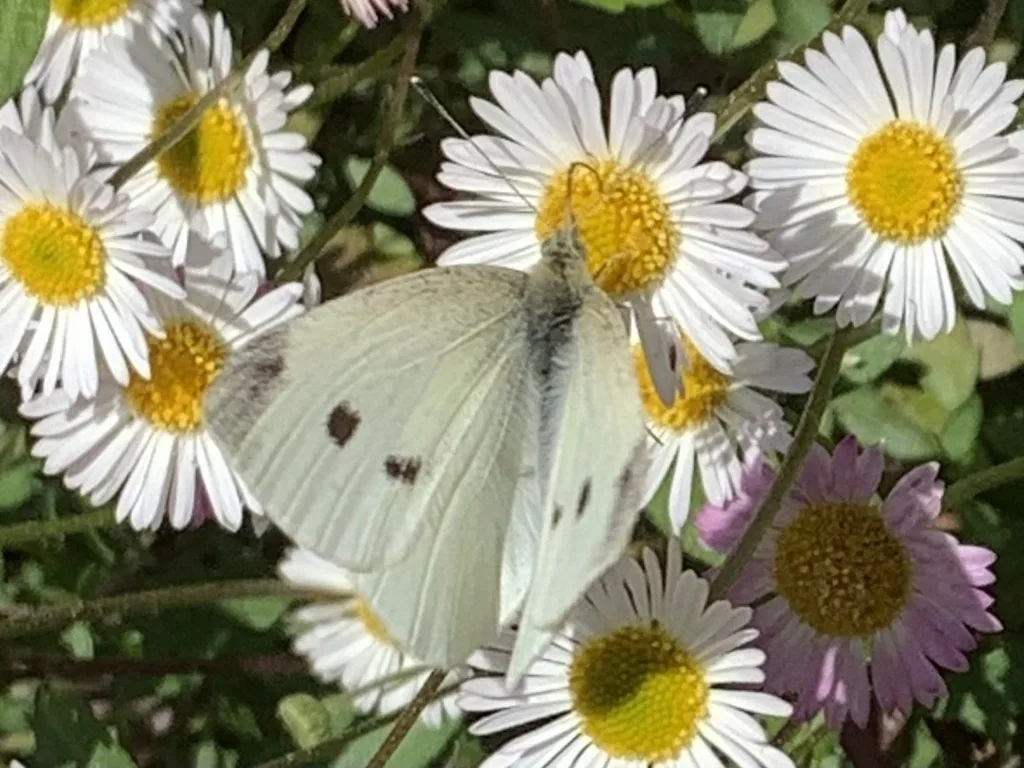
- The adult is a white to pale yellowish butterfly with a wingspan of about 1 1/4 to 1 3/4 inches, a dark border on each forewing and one or more black spots on each forewing (see below on how many).[4][1][5][2]
- Eggs are tiny, upright and bullet-shaped, laid one at a time, usually on the underside of leaves.[5][1][4]
Look-alikes
| Look-alike | How to tell them apart |
|---|---|
| Cabbage looper | Cabbage loopers are smooth rather than fuzzy, grow to 1 1/2 to 2 inches, and arch their backs like an inchworm as they crawl. They have only two pairs of prolegs in the middle of the body; other cabbage caterpillars have four.[5][3][6] |
| Diamondback moth caterpillar | Diamondback moth caterpillars stay under about half an inch, taper at both ends, and wriggle hard when touched instead of moving sluggishly.[5] |
| Cross-striped cabbageworm | Has alternating black and white bands across the back and a yellow stripe along each side, reaches about 0.75 inches, and hatches from egg masses of up to 25 rather than single eggs.[3] |
Where it lives
Believed native to Europe, it was first reported in North America in 1860 and has spread through most of the United States; people have carried it to every continent except South America and Antarctica. With several generations a year, it can be active year-round where hosts grow.[4][7][1]
Biology and life cycle
Female butterflies fly by day and start laying single eggs on host plants within a day or two of emerging. Lincoln University gives 400 to 1000 eggs per female over an adult life of 5 to 20 days.[4][5][1]
Eggs hatch within about a week; Lincoln gives 4 to 10 days depending on temperature.[2][4]
Caterpillars feed for about 2 to 3 weeks (Lincoln says 10 to 14 days through five stages), then form a green to brownish chrysalis attached to a leaf by a few silk threads, with no cocoon.[1][4][5][3]
Wisconsin usually sees three generations a season, with the second, from mid-July on, doing the most damage; central New England sees three to four.[2][5]
The insect passes the winter as a pupa on plant debris, so crop remains left in fall can carry it into the next season.[2][4]
A genetic study built on citizen-science samples from 32 countries found that over roughly the last 160 years the butterfly spread with human movement and trade, through at least four founding events.[7]
Damage and signs
- Caterpillars chew large, irregular holes in leaves, feed along the midrib and bore into cabbage heads; older larvae moving to the center of the plant can strip leaves to the main veins.[1][2]
- Seedlings can be damaged quickly. Severe feeding stunts cabbage and cauliflower heads, and damage to the buds of young cabbage can make heads abort.[1][2]
- Large amounts of greenish-brown droppings contaminate heads and foliage and can make produce unmarketable.[1][2][4]
- Before heads form, plants tolerate a fair amount of leaf feeding; once heading starts, even a few caterpillars matter.[1][5]
- Wisconsin calls it the most important pest of cole crops in the state, and Lincoln University found it the most abundant and severe pest of cabbage, Brussels sprouts and broccoli in central Missouri, warning of 80-100% crop loss if it isn't controlled.[2][4]
Health risk
Imported cabbageworms are plant feeders: the caterpillars eat cabbage-family crops and mustard-family weeds, and the harm is to the crop.[1][2][4]
Control
Prevention
Start clean: plants grown from seed indoors are low-risk, and bought transplants should be checked for caterpillars before planting.[2]
Lincoln University notes that red kale and purple cabbage give the green caterpillars poor camouflage, so predators find them more easily.[4]
Keep them out
Fine mesh netting or floating row cover keeps the butterflies from laying eggs on the crop; it works best in home gardens and small plantings.[2][3][4]
Sanitation
Pull mustard-family weeds around the garden, and clean up crop debris in fall to reduce overwintering pupae.[1][2][3]
Traps and physical control
Check leaf undersides and the center of each plant, especially as heads form, and pick off caterpillars or knock them into soapy water. The tiny, pale eggs can be crushed by hand too.[5][2][4]
Biological control
Parasitic wasps, tachinid flies, Trichogramma egg parasites, predators such as soldier bugs and paper wasps, and natural viral infections all attack cabbageworms; avoid broad-spectrum sprays that kill these allies.[1][4][2]
Pesticides
Bacillus thuringiensis (Bt) works very well on young caterpillars and spares natural enemies.[1][2][4]
Spinosad, insecticidal soap, horticultural oils such as neem, and pyrethrins are other options; target small caterpillars and cover the plant well.[1][2]
Spray botanical and other bio-insecticides from late afternoon into evening, when beneficial insects are less active, and follow the label for the crop.[4]
Where sources disagree
Egg color: UC IPM calls the eggs whitish, UMass light green, Lincoln University yellowish to cream, and Wisconsin yellow-orange.[1][5][4][2]
Wing spots: UMass says one or two black spots per forewing and UC IPM one to four, while Wisconsin says females have two and the smaller males one.[5][1][2]
Generations: Wisconsin usually sees three a season and UMass three to four in central New England, while UC IPM says it can stay active all year in California where hosts are present.[2][5][1]
Thresholds: UMass treats cabbage and broccoli when 35% of plants are infested before heads form and 15% from head formation on. Wisconsin and Lincoln use 10% in the seedbed, 30% between transplanting and cupping, 20% from cupping to early heading, and 10% from early heading to harvest.[5][2][4]
Common questions
- Are the white butterflies in my garden a problem?
- Yes, if you grow cabbage family crops. The white butterflies lay the eggs that become cabbageworms, so check plants for eggs and small caterpillars a few days after they appear.[1][2]
- What is the green slime and holes in my broccoli?
- Ragged holes plus wet green droppings point to imported cabbageworm; look for slow, velvety green caterpillars near the leaf midribs and center of the plant.[5][1]
- Is Bt safe to use on cabbageworms?
- Bt is the extension-preferred spray for cabbageworm because it targets caterpillars and spares natural enemies; apply it while larvae are small. NPIC says Bt toxins are not activated when people eat the spores, and no harm occurs.[1][2][8]
Sources
- University of California Statewide IPM Program, “Cole Crops Pest Management Guidelines: Imported Cabbageworm.” ipm.ucanr.edu/agriculture/cole-crops/imported-cabbageworm/ (accessed 2026-11-11)
- University of Wisconsin-Madison Extension, “Imported Cabbageworm (XHT1032).” hort.extension.wisc.edu/articles/imported-cabbageworm/ (accessed 2026-11-11)
- Clemson Cooperative Extension Home & Garden Information Center, “Cabbage, Broccoli & Other Cole Crop Insect Pests (HGIC 2203).” hgic.clemson.edu/factsheet/cabbage-broccoli-other-cole-crop-insect-pests/ (accessed 2026-11-11)
- Lincoln University Cooperative Extension, “Imported Cabbageworm: Lifecycle, Damage and Pest Management in Missouri (LUCE 2022-33-FS-A).” www.lincolnu.edu/cooperative-extension-and-research/publication-files/imported-cabbageworm-lifecycle-damage-and-pest-management-in-missouri-2022-33-fs-a.pdf (accessed 2026-11-11)
- UMass Amherst Center for Agriculture, Food, and the Environment, “Imported Cabbageworm (vegetable fact sheet).” www.umass.edu/agriculture-food-environment/vegetable/fact-sheets/imported-cabbageworm (accessed 2026-11-11)
- University of California Statewide IPM Program, “Cole Crops Pest Management Guidelines: Cabbage Looper.” ipm.ucanr.edu/agriculture/cole-crops/cabbage-looper/ (accessed 2026-11-11)
- Proceedings of the National Academy of Sciences, via PubMed, “Ryan et al. (2019), Global invasion history of the agricultural pest butterfly Pieris rapae revealed with genomics and citizen science.” pubmed.ncbi.nlm.nih.gov/31506352/ (accessed 2026-11-11)
- National Pesticide Information Center, “Bacillus thuringiensis (Bt) General Fact Sheet.” npic.orst.edu/factsheets/btgen.html (accessed 2026-11-11)
- iNaturalist, “Pieris rapae taxon page (order and family).” www.inaturalist.org/taxa/55626 (accessed 2026-10-06)