On this page
How to identify it
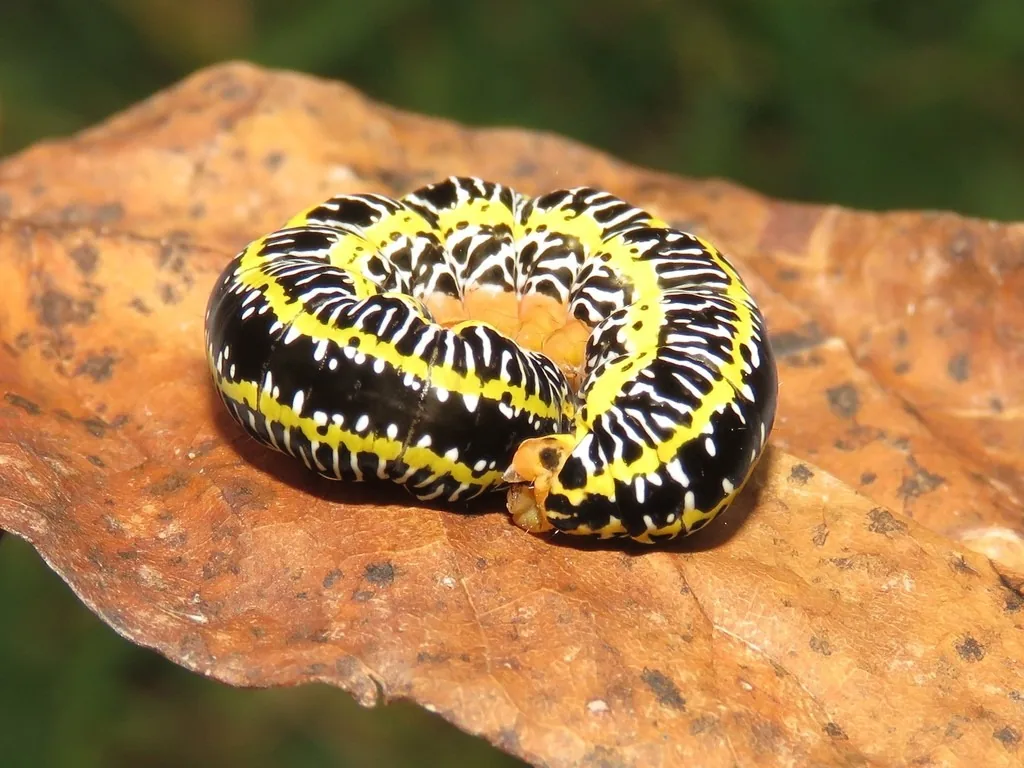
- Grown caterpillars have bold black and cream-to-bright-yellow stripes running the length of the body, a reddish-brown to orange head and brown to orange legs.[1][3]
- Colorado State, as quoted by Ohio State, separates it from other crop caterpillars by two bright yellow stripes along each side, with alternating black and white bands running around the body between them.[2]
- They reach about 1 1/2 inches long (35 to 40 mm).[2][3]
- Newly hatched caterpillars are whitish with black spots.[1]
- Alarmed caterpillars roll into a ball and drop off the leaf.[2]
- The adult moth is chestnut or reddish brown with whitish hind wings edged in light brown and a light gray abdomen, with a wingspan of 35 to 40 mm.[1][3]
Look-alikes
| Look-alike | How to tell them apart |
|---|---|
| Cutworms and armyworms | Oregon State notes that variegated cutworms and other leaf-feeding cutworms and armyworms often occur at the same time as zebra caterpillars.[3] |
| Sawfly larvae | An Ohio State educator first took zebra caterpillars on roses for sawfly larvae. Caterpillars have five or fewer pairs of prolegs with tiny hooks; sawfly larvae have six or more pairs and no hooks.[2] |
Where it lives
Reported by extension services from Utah and Oregon east to Ohio, and reported as a pest in British Columbia. GBIF US records since 1990 come from 31 states, most from Wisconsin, Ohio, Colorado and Michigan; Ohio State expects caterpillars in late May and June and again in late August and September.[1][3][2][4][6]
Biology and life cycle
Adults lay masses of up to 100 eggs on the foliage. Young caterpillars feed in groups, then disperse over the plant or to other plants and feed alone.[1][2]
Mature caterpillars drop and pupate in the soil, where the insect spends the winter.[1][2][3]
The moths have a long flight period, so adults and caterpillars can be found through summer into fall. Ohio State expects damage in late May and June and again in late August and September.[2]
A virus, the Melanchra picta nucleopolyhedrovirus, infects the caterpillars. USDA researchers who sequenced it found it belongs to the same virus species as the bertha armyworm's virus and likely jumped between the two caterpillars, which often occur together.[5]
Parasites attack the caterpillars: an ichneumon wasp has been reported from eastern Canada, a tachinid fly from British Columbia, and researchers reared a further larval parasitoid from zebra caterpillars in British Columbia blueberry fields.[4]
Damage and signs
- Young caterpillars skeletonize the foliage and larger ones can strip plants. Utah State rates the threat to hemp as low, and Ohio State says it is generally not considered a serious pest.[1][2]
- Hosts include cabbage, broccoli, asparagus, spinach, potato and tomato, flowers such as aster and hydrangea, field-grown hemp and some trees; Ohio State has seen them feeding heavily on roses and calls them a fairly common pest of cole crops.[2][1]
- In British Columbia it has been reported as a minor pest of corn and small fruits and also infests vegetables, blueberries and currants; researchers there reported it becoming more abundant in the Fraser Valley.[4]
Health risk
It feeds only on plants; none of the sources reports any harm to people or pets.[1][2]
Control
Prevention
Scout from late spring to the end of the season for egg clusters on or under leaves and for groups of young caterpillars skeletonizing leaves.[1]
Traps and physical control
Hand-pick and destroy the caterpillars, and remove weeds and plant debris around the crop.[1]
Biological control
Natural enemies typically keep numbers below damaging levels; parasitic wasps and flies and a virus all attack the caterpillars.[1][4][5]
Pesticides
Treatment is rarely needed; Utah State suggests considering it only where infestations are chronic or numbers are consistently large. Use a product labeled for caterpillars on that crop and follow the label.[1]
In peppermint, Oregon State manages zebra caterpillars together with variegated cutworm and other leaf-feeding cutworms and armyworms.[3]
Where it lives
Extension services report it from Utah and Oregon east to Ohio, and it has been reported as a pest in British Columbia.[1][3][2][4]
GBIF US records since 1990 come from 31 states, most from Wisconsin, Ohio, Colorado and Michigan.[6]
Where sources disagree
Generations: Utah State gives two to three generations a season, while Oregon State describes two a year.[1][3]
Winter stage: Utah State and Ohio State say it overwinters as a pupa in the soil, while Oregon State says it overwinters as a larva or pupa.[1][2][3]
Common questions
- What is the black-and-yellow striped caterpillar on my cabbage?
- A caterpillar up to about 1 1/2 inches long with bold black and yellow lengthwise stripes and a reddish-brown head is likely a zebra caterpillar, which Ohio State calls a fairly common pest of cole crops.[2][1][3]
- Is the zebra caterpillar harmful?
- It can strip leaves, especially when young caterpillars feed in groups, but it is generally not a serious pest and natural enemies usually keep it in check.[1][2]
- Do I need to spray zebra caterpillars?
- Usually not. Hand-pick them; Utah State reserves treatment for chronic infestations or consistently large numbers.[1]
Sources
- Utah State University Extension, “Zebra Caterpillar (hemp pest IPM).” extension.usu.edu/planthealth/ipm/notes_ag/hemp-zebra-caterpillar (accessed 2026-11-11)
- Ohio State University Extension (Buckeye Yard & Garden onLine), “Stripes of a Different Kind - The Zebra Caterpillar.” bygl.osu.edu/node/1704 (accessed 2026-11-11)
- Oregon State University, Integrated Plant Protection Center, “Zebra Caterpillar (IPM on Peppermint, IPMP3.0).” hopper.science.oregonstate.edu/mint/zebraid.htm (accessed 2026-11-11)
- The Canadian Entomologist (Entomological Society of Canada), via Crossref, “Larval parasitoid of the zebra caterpillar, Melanchra picta (Harris), on blueberry in British Columbia (Li, Henderson and Feng 1993).” doi.org/10.4039/ent125405-2 (accessed 2026-11-11)
- Journal of Invertebrate Pathology, via PubMed, “An alphabaculovirus from the zebra caterpillar, Melanchra picta Harris, is an isolate of species Alphabaculovirus maconfiguratae (Harrison et al. 2024, USDA Agricultural Research Service).” pubmed.ncbi.nlm.nih.gov/39401585/ (accessed 2026-11-11)
- Global Biodiversity Information Facility (GBIF), “Melanchra picta: US occurrence records since 1990 by state (GBIF occurrence search API).” api.gbif.org/v1/occurrence/search?taxonKey=1765779&country=US&hasGeospatialIssue=false&year=1990%2C2026&facet=stateProvince&facetLimit=400&limit=0 (accessed 2026-11-11)
- iNaturalist, “Melanchra picta taxon page (order and family).” www.inaturalist.org/taxa/224556 (accessed 2026-11-11)