On this page
How to identify it
- Caterpillars are smooth, hairless and plump, mottled brown-gray to gray-black on top. Missouri describes a conspicuous yellow spot on top of each of the first four abdominal segments and a less distinct black W near the tail; Iowa State describes a row of 4 or 5 yellowish-white dots, one per segment.[4][1][3]
- Below the dark breathing holes runs an orange-brown line, and the underside is light tan.[4]
- Full-grown caterpillars are about 1.5 to 2 inches long (see where the sources disagree), and they curl into a C when disturbed.[4][2][3][1]
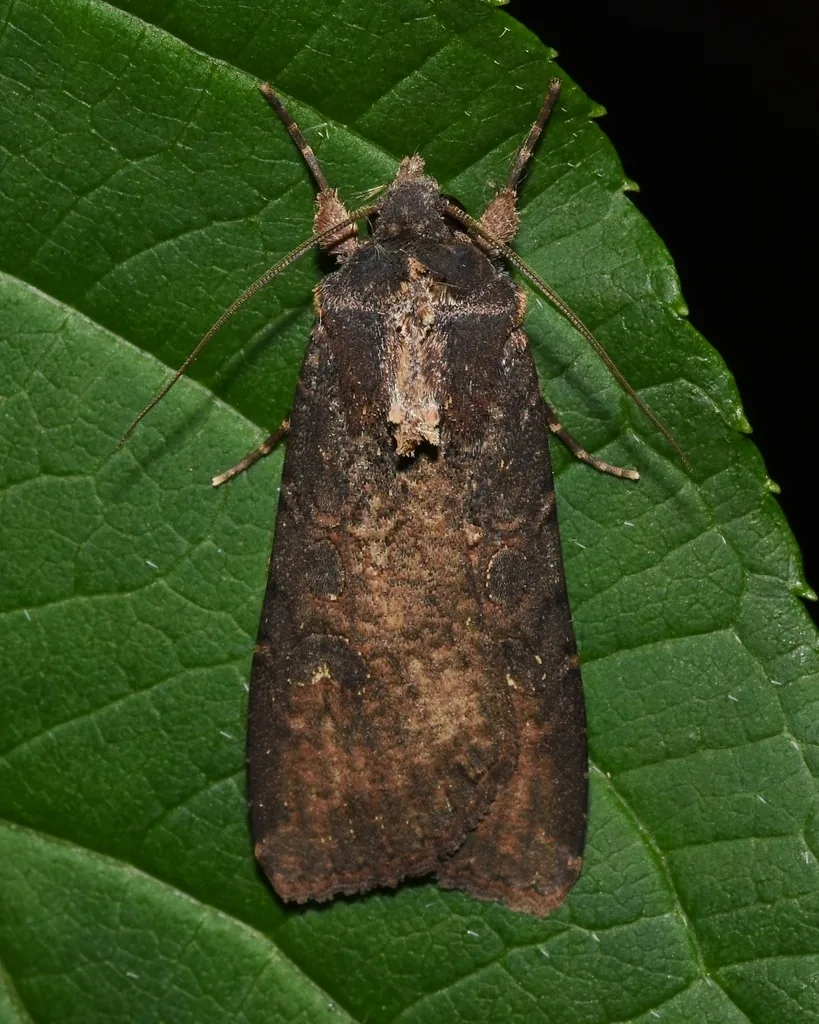
- The moth, called the pearly underwing, has brown forewings with lighter circle- and kidney-shaped spots and dull white hind wings.[3]
Look-alikes
| Look-alike | How to tell them apart |
|---|---|
| Other cutworms | Most cutworms cut stems at ground level; the variegated cutworm also climbs plants at night to feed on leaves, buds, flowers and fruit.[1][3] |
Where it lives
Iowa State says it turns up anywhere from alfalfa fields to home gardens, and extension services from Utah to Minnesota, Iowa, Missouri and Massachusetts report it. Some moths migrate north each spring; UMass says moths from the South arrive between March and June.[1][3][2][4][5]
Biology and life cycle
Moths appear in early spring and lay eggs on plant stems and leaves; UMass says that in farm fields the eggs go mostly on grasses and winter annual weeds.[1][5]
Iowa State says larvae feed for about a month before crawling to the ground to pupate in the soil. Generations overlap, and the sources give different counts; see where the sources disagree.[1][3][4]
It overwinters as pupae in the soil or as caterpillars in protected spots, and possibly as adults.[3]
The caterpillars feed at night or on very cloudy days and hide in soil cracks or under mulch and debris by day, so gardeners often see the damage without ever seeing the culprit.[1][3]
Damage and signs
- Caterpillars chew leaves, buds, flowers and fruit, and UMass says they chew shallow or deep holes in fruit in mid to late summer. On hostas, Iowa State describes large irregular holes at the leaf edges or oblong holes between the veins. Minnesota Extension adds that seedlings cut at or just above or below the soil line are usually killed, with most garden damage in spring.[5][1][2]
- Nearly all fruits, vegetables and ornamentals can be damaged, including asparagus, beans, carrots, celery, corn, cucumbers, lettuce, peas, peppers, potatoes, radishes, tomatoes, apple and cherry trees, and hostas.[1][2]
Health risk
Iowa State, Missouri, Minnesota, Utah State and UMass Extension describe plant damage only and don't mention any risk to people or pets.[1][4][2][3][5]
Control
Prevention
Spots with a history of cutworm damage tend to have it again, so check those first.[5]
Utah State advises managing weeds along field edges, and UMass says weedy and reduced-till fields tend to suffer the most damage.[3][5]
Traps and physical control
In a home garden, rake around the base of damaged plants with your fingers to find cutworms hiding in the soil or mulch, or search plants at night and remove any caterpillars feeding on the foliage.[1]
Biological control
UMass says ground beetles, parasitic flies and wasps and other general predators help reduce populations.[5]
Pesticides
For larger problems, Iowa State says to treat the soil around damaged plants with a garden spray or dust labeled for cutworms. UMass, writing for vegetable growers, suggests treating tomatoes when 1 percent of plants are infested and spraying between midnight and dawn, when cutworms feed above ground.[1][5]
Where the sources disagree
Cutting seedlings: Minnesota Extension says seedlings are usually killed when cut at or near the soil line, with most garden damage in spring; Iowa State says variegated cutworms don't clip plants at ground level as most cutworms do, and Utah State says that, unlike most cutworms, they climb plants to feed.[2][1][3]
Generations a year: Missouri says two to four; Utah State says two to three, starting in early spring, July and late summer; Iowa State says three or more.[4][3][1]
Full-grown size: Iowa State says about 1 1/2 inches; Missouri gives 1.5 to 2 inches, and Minnesota and UMass say up to 2 inches.[1][4][2][5]
Markings: Missouri and Iowa State describe a row of yellow or yellowish-white spots down the back; UMass describes diamond-shaped marks along the back and light lines along the sides.[4][1][5]
Common questions
- What is eating holes in my hostas and tomatoes at night?
- Night feeding on leaves, buds and fruit with no caterpillar in sight by day is typical of variegated cutworms, and Iowa State says the damage is especially common on hosta and petunia. Search the soil and mulch around damaged plants, or check the plants after dark.[1][5]
- Why is it called the climbing cutworm?
- Unlike most cutworms, which cut stems at ground level, it climbs plants at night to eat foliage, flowers, buds and fruit.[1][3]
Sources
- Iowa State University Extension and Outreach, “Cutworm, Variegated (Horticulture and Home Pest News).” hortnews.extension.iastate.edu/cutworm-variegated (accessed 2026-11-13)
- University of Minnesota Extension (What insect is this?), “Variegated cutworm (What insect is this?).” apps.extension.umn.edu/garden/diagnose/insect/garden/caterpillars/large/variegatedcutworm.html (accessed 2026-11-13)
- Utah State University Extension, “Variegated Cutworm (hemp pest IPM).” extension.usu.edu/planthealth/ipm/notes_ag/hemp-variegated-cutworm (accessed 2026-11-13)
- University of Missouri Extension, “Caterpillars in Your Yard and Garden (IPM1019), page 48: variegated cutworm.” extension.missouri.edu/publications/ipm1019/48 (accessed 2026-11-13)
- UMass Extension Vegetable Program, “Variegated Cutworm (Vegetable Program fact sheet).” www.umass.edu/agriculture-food-environment/vegetable/fact-sheets/variegated-cutworm (accessed 2026-11-13)
- Global Biodiversity Information Facility (GBIF), “Peridroma saucia Hübner, 1808 (GBIF Backbone Taxonomy).” api.gbif.org/v1/species/1792996 (accessed 2026-11-13)
- iNaturalist, “Peridroma saucia taxon page (order and family).” www.inaturalist.org/taxa/179339 (accessed 2026-10-06)