On this page
How to identify it
- The larva is gray to brown, or gray to greenish gray with irregular lengthwise stripes, and has a narrow dark gray stripe on each side. Mature larvae are about 1.5 inches long by SDSU Extension and 1.5 to 2 inches (4 to 5 cm) by UC IPM, which calls it somewhat larger than the variegated cutworm.[1][3]
- Like other cutworms it is a smooth-skinned caterpillar with three pairs of true legs and five pairs of abdominal prolegs that curls into a C when disturbed; it may pass through seven larval stages instead of the usual six.[2][3]
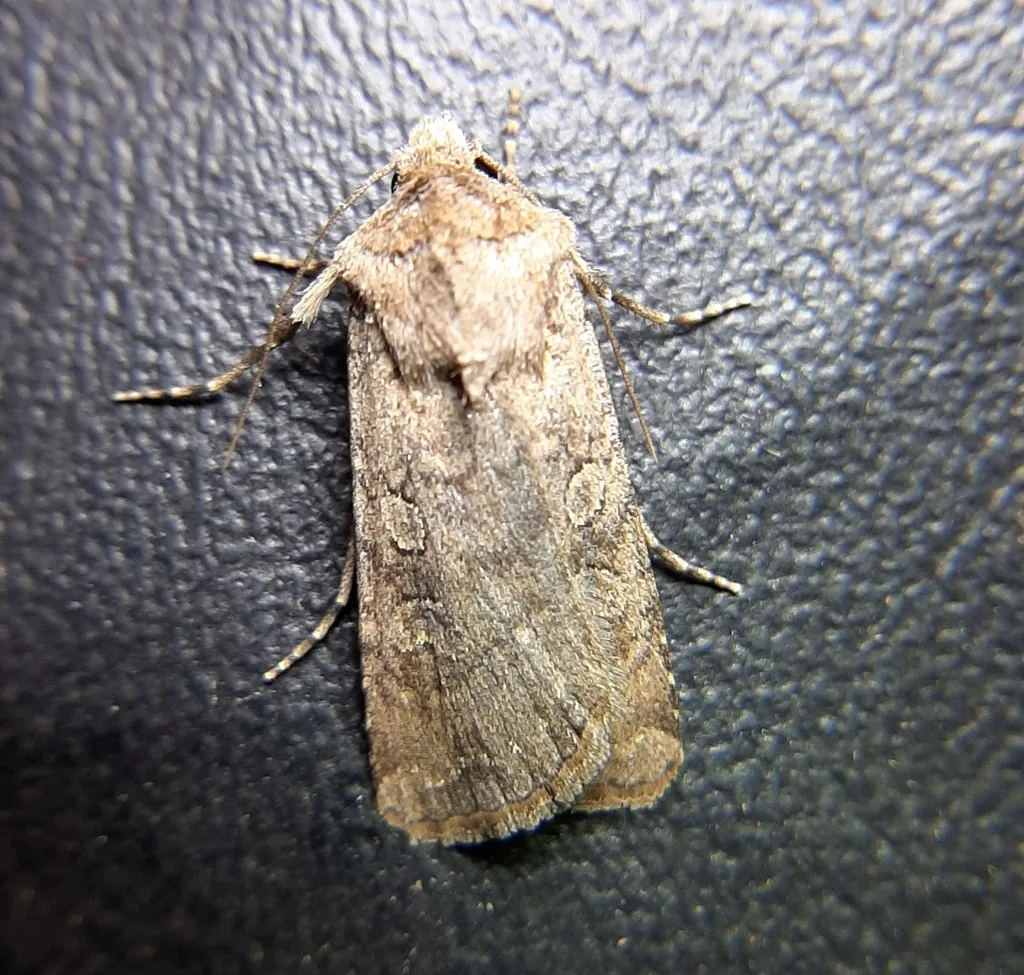
- SDSU Extension describes the moth, known as the Reaper dart, as having light-colored forewings with darker markings. In Manitoba the moths fly from early August to October, peaking in August.[1][2]
Look-alikes
| Look-alike | How to tell them apart |
|---|---|
| Redbacked cutworm | Redbacked and darksided cutworm larvae are often mixed in the same field and may be easy to confuse; the redbacked has two broad dull-red stripes along its back, while the darksided has a narrow dark gray stripe on each side.[2][1] |
| Variegated cutworm | The variegated cutworm is yellow to brown with a row of four to six yellow or pink diamond-shaped spots down the back and is a little over an inch long; the dark-sided cutworm is larger and gray to greenish gray with lengthwise stripes.[3] |
| Dingy cutworm | Another species that turns up in damaging prairie cutworm populations alongside redbacked and darksided larvae.[2] |
Where it lives
Manitoba Agriculture lists it among the cutworms of Manitoba field crops, SDSU Extension among the cutworms that can damage sunflower stands in South Dakota, and UC IPM among the cutworms of asparagus in California. GBIF holds 360 U.S. records since 1990, led by Montana (60), California (44), Michigan (28) and Colorado (26).[2][1][3][4]
Biology and life cycle
The darksided cutworm overwinters as eggs. SDSU Extension says eggs of these cutworms are laid in late summer through fall, overwinter in the soil, and hatch in spring as temperatures rise.[1][2]
The larvae feed from May to the end of June. Darksided cutworms took an average of 87 days to pass through their seven larval stages; after the last stage, larvae burrow deeper into the soil and form earthen cells to pupate. There is a single generation a season.[1][2]
Cutworms feed at night and hide during the day. An Ontario study found older darksided larvae just below the surface in wet weather but 8 to 10 cm (3 to 4 inches) down in dry weather, with most younger larvae resting 6 to 13 mm (1/4 to 1/2 inch) deep near the base of the host plant.[2]
Many predators and parasitoids attack prairie cutworms: ground beetles, rove beetles, stiletto fly larvae and wolf spiders, plus bee flies, tachinid flies and braconid, ichneumonid and encyrtid wasps. The encyrtid Copidosoma bakeri was the most common wasp parasitoid of cutworms found in Manitoba from 2012 to 2016, and wet soil during the larval stage promotes fungal diseases.[2]
Damage and signs
- Young larvae leave small notches or holes in leaves, or remove only some layers of leaf tissue and leave transparent windows. Later-stage larvae cut plants from 1 inch below to 2 inches above the soil surface, so wilted, broken or dead plants are the usual sign.[1][2]
- Darksided and redbacked cutworms do their greatest damage in row crops with low plant populations per hectare, where each cut plant matters.[2]
- In asparagus the larvae eat small holes in the tender tips of new spears at night, and one-sided feeding makes the spears curl; damage to the fern is generally rare.[3]
Health risk
Manitoba Agriculture, SDSU Extension and UC IPM treat the darksided cutworm only as a crop pest and mention no effect on people.[2][1][3]
Control
Prevention
Inspect seedlings at least weekly from mid-May to mid-June. Manitoba gives nominal thresholds by crop, such as 1 or more cutworms per square foot or 25 to 30 percent stand reduction in sunflowers, 25 to 30 percent stand reduction in canola, or 1 or more small larvae (under 2 cm) per three feet of soybean row. Confirm cutworms by digging an inch or so into the soil around a damaged plant or spear.[2][3]
Small larvae pose the greatest risk because they still have to feed and grow. Once larvae reach 30 to 35 mm, most of their feeding may already be done and chemical treatment may not be warranted.[2]
Sanitation
Control weeds in and around the field and incorporate field trash and the previous crop's residue thoroughly to reduce overwintering; these practices are acceptable in organically certified crops.[3]
Traps and physical control
Young cutworm larvae can be starved before spring seeding by letting volunteer growth reach 3 to 5 cm (1.2 to 2 inches), cultivating, and then seeding 10 to 14 days later.[2]
Biological control
Ground beetles, rove beetles, wolf spiders and a range of parasitic flies and wasps reduce cutworm populations, and disease and parasites were the main factors ending a redbacked cutworm outbreak; minimum tillage fields in Manitoba carried a greater diversity of cutworms and their parasitoids than conventionally tilled fields.[2]
Pesticides
Foliar insecticides and seed treatments are available. Foliar sprays work best when applied in the evening, and treating only infested patches rather than whole fields is sometimes the most economical choice.[2]
Where the sources disagree
Size: SDSU Extension puts mature larvae at about 1.5 inches and UC IPM at 1.5 to 2 inches (4 to 5 cm), while Manitoba says larvae that have reached 30 to 35 mm have probably done most of their feeding.[1][3][2]
How they cut plants: SDSU Extension says later-stage darksided larvae cut plants from 1 inch below to 2 inches above the soil surface; Manitoba says older larvae may cut plants at ground level.[1][2]
Common questions
- How do I tell a darksided cutworm from a redbacked cutworm?
- Look at the stripes: the redbacked cutworm has two broad dull-red stripes along its back, while the darksided cutworm is gray to brown with a narrow dark gray stripe on each side. The two are often mixed in the same field.[2][1]
- When does the darksided cutworm do its damage?
- In spring and early summer. Its eggs are laid in late summer through fall, overwinter in the soil and hatch in spring, and the larvae feed from May to the end of June, with one generation a season.[1][2]
- Why are my asparagus spears curled with holes in the tips?
- UC IPM attributes night feeding on the tender tips of new spears to cutworms including the dark-sided cutworm; one-sided feeding curls the spear. Dig an inch around a damaged spear to find the larva.[3]
Sources
- South Dakota State University Extension, “Chapter 11: Sunflower Insect Pests, P-00205-11 (A. Varenhorst, P. Rozeboom and P. Wagner, July 2021).” extension.sdstate.edu/sites/default/files/2021-08/P-00205-11.pdf (accessed 2026-11-14)
- Manitoba Agriculture, Government of Manitoba, “Cutworms in Field Crops (fact sheet, May 2024).” www.gov.mb.ca/agriculture/crops/insects/pubs/cutworms-in-field-crops.pdf (accessed 2026-11-14)
- University of California Statewide IPM Program, “Cutworms, UC Pest Management Guidelines: Asparagus.” ipm.ucanr.edu/agriculture/asparagus/cutworms/ (accessed 2026-11-14)
- Global Biodiversity Information Facility (GBIF), “Euxoa messoria: U.S. occurrence records since 1990 by state (GBIF occurrence search).” api.gbif.org/v1/occurrence/search?taxonKey=1773728&country=US&hasGeospatialIssue=false&occurrenceStatus=PRESENT&year=1990%2C2026&facet=stateProvince&facetLimit=400&limit=0 (accessed 2026-11-14)
- Global Biodiversity Information Facility (GBIF), “Euxoa messoria Harris, 1841 (GBIF Backbone Taxonomy).” api.gbif.org/v1/species/1773728 (accessed 2026-11-14)
- iNaturalist, “Euxoa messoria taxon page (order and family).” www.inaturalist.org/taxa/219965 (accessed 2026-11-10)