On this page
How to identify it
- Caterpillars are light green with a narrow white line along each side, which fades as they reach full size; newly hatched ones are pale yellow.[1][3][2]
- Full-grown caterpillars are a little over 1 inch to about 1 1/2 inches long.[1][2]
- They loop as they walk and wriggle violently, jump and flop when disturbed. Sources count the prolegs differently: the Crop Protection Network describes three pairs on the abdomen plus one pair at the tail end, Purdue says four abdominal prolegs (loopers have three), and Missouri says only three mid-abdominal prolegs.[2][3][1][4]
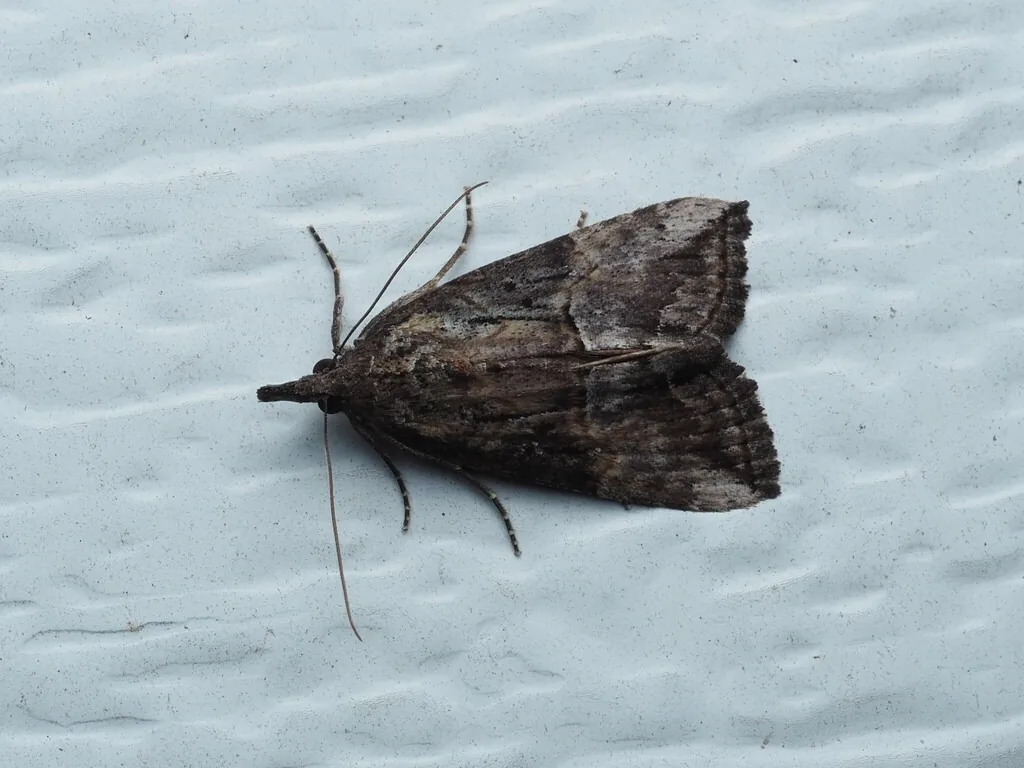
- Adults are moths with a snout projecting in front of the head; NC State describes them as mottled gray-brown and about an inch long, and the Crop Protection Network says females typically have silver wing markings while males are more uniformly charcoal.[4][2]
Look-alikes
| Look-alike | How to tell them apart |
|---|---|
| Cabbage looper | Often confused with the green cloverworm, but loopers have three pairs of prolegs instead of four.[3] |
Where it lives
Occurs from Mexico across the Atlantic Coast states and west to the Great Plains, as well as in eastern Canada; it overwinters in North Carolina.[2][4]
Biology and life cycle
Females lay eggs on both the upper and lower sides of leaves; the caterpillars go through 6 or 7 stages, and most pupate in the soil, though some pupate on the plant.[4]
Missouri reports three generations a year and Purdue two or more; caterpillars are found from summer, or late June in Indiana soybean fields, through fall.[1][3]
Damage and signs
- Young caterpillars skeletonize the underside of leaves and leave the upper surface intact; older ones eat everything but the major veins, giving plants a ragged, hail-damaged look, usually in the upper part of the plant.[3][2]
- Hosts are legumes, mainly soybean and alfalfa, plus beans, cowpeas, peas and clover.[1]
- It rarely reaches damaging levels because parasites and diseases usually keep it in check, and a few caterpillars can even help by attracting natural enemies that also attack worse pests.[3][4][2]
- Under heavy infestations, larvae can cause significant defoliation and may feed on pods once the leaf tissue is used up.[2]
Health risk
It feeds on legumes, and no cited source describes any risk to people or pets.[1][4]
Control
Biological control
Parasitic wasps and a fungal disease often control it naturally; parasitized caterpillars become mummies, so look for them before deciding on any treatment.[3][2]
Pesticides
Treatment is rarely needed, and both sources below say natural enemies often keep it below thresholds. Thresholds differ: the Crop Protection Network gives about 150 larvae per 100 sweeps, more than 15 larvae per row foot, or 30% defoliation in vegetative stages and 20% in reproductive stages; NC State uses 30% defoliation until two weeks before bloom and 15% from then until pods fill, and notes soybeans can tolerate nearly 100% leaf loss in early vegetative stages. Follow the label of any product used.[2][4]
Common questions
- What is the green caterpillar that flops around when I touch it?
- A slender green caterpillar with a white side stripe that wriggles and flops violently when disturbed is likely a green cloverworm.[4][3][1]
- Do I need to spray green cloverworms?
- Usually not; natural enemies tend to keep them below damaging levels, and plants such as soybeans can make up for lost leaves.[3][2]
Sources
- University of Missouri Extension, “Caterpillars in Your Yard and Garden (IPM1019), page 20: green cloverworm.” extension.missouri.edu/publications/ipm1019/20 (accessed 2026-11-13)
- Crop Protection Network (multi-state university extension collaboration), “Green Cloverworm in Soybean (published April 10, 2026; C. Pilcher and R. Wright).” cropprotectionnetwork.org/encyclopedia/green-cloverworm-in-soybean (accessed 2026-11-13)
- Purdue University Extension Entomology, “Green Cloverworms (Soybean) (Field Crops IPM).” ag.purdue.edu/department/entm/extension/field-crops-ipm/soybean/green-cloverworms.html (accessed 2026-11-13)
- NC State Extension, “Green Cloverworm (Soybean Insect Factsheets, D. Reisig).” diagnosis.ces.ncsu.edu/soybean/disorder/detail/green-cloverworm (accessed 2026-11-13)
- Global Biodiversity Information Facility (GBIF), “Hypena scabra (Fabricius, 1798) (GBIF Backbone Taxonomy).” api.gbif.org/v1/species/9579730 (accessed 2026-11-13)