On this page
How to identify it
- Caterpillars are green, usually with a narrow white stripe along each side and several pale lines down the back, and grow to about 1 1/2 inches. UF/IFAS gives 3 to 4 cm (1 1/8 to 1 1/2 in) at maturity, says young larvae start dusky white and turn pale green as they feed, and notes some mature larvae are entirely green.[1][2][3][4][11]
- The skin is smooth, with only a few long bristles, and the body narrows toward the head.[1][2][3][5]
- It moves by arching the middle of its body into a loop and pulling the rear end up to meet the front legs. Disturbed loopers often rear up like a cobra.[1][4][5]
- It has only two pairs of prolegs in the middle of the body, on the fifth and sixth abdominal segments; other cabbage caterpillars have four. UF/IFAS says small nipple-like vestigial prolegs under abdominal segments 3 and 4 separate it from most other loopers.[1][5][11]
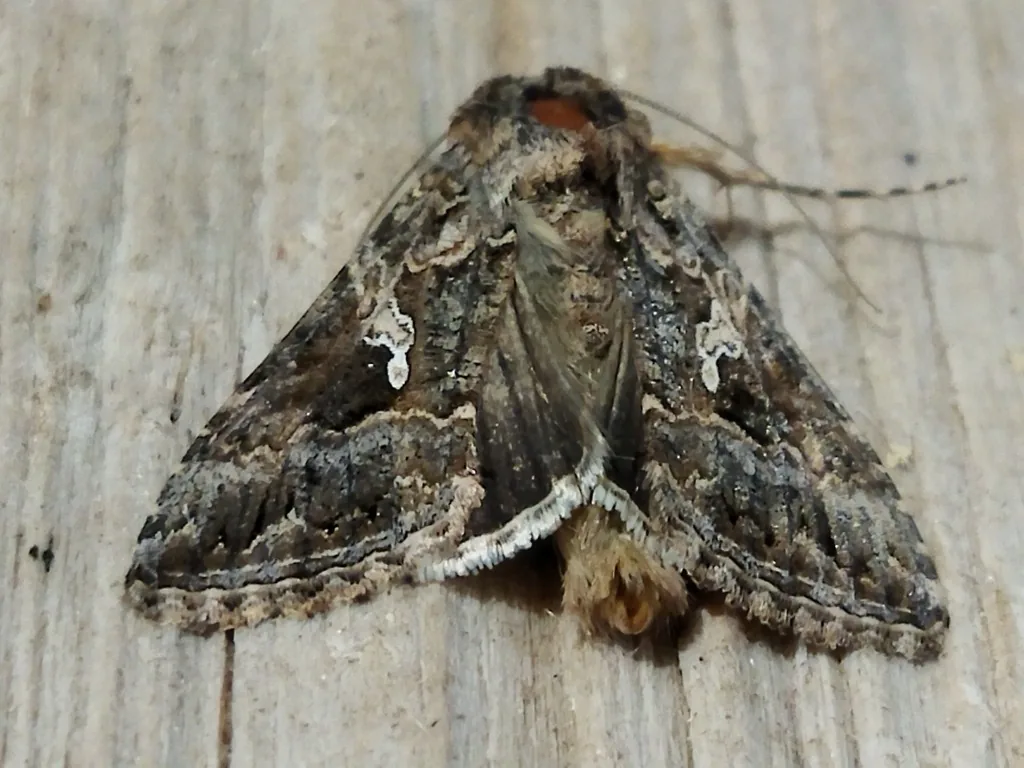
- The adult moth has mottled gray-brown forewings, each with a small silvery-white figure-8 mark, and a wingspan of about 1 1/2 inches. UF/IFAS describes the silvery mark as a U-shape and a circle or dot that are often connected, and gives a wingspan of 33 to 38 mm (1 1/3 to 1 1/2 in).[2][3][4][1][11]
- Eggs are tiny, dome-shaped and finely ridged, and are laid one at a time; NC State gives about 350 eggs per female. UF/IFAS describes them as yellowish white or greenish, about 0.6 mm across, laid on either leaf surface, with clusters of six to seven not uncommon.[1][6][3][11]
- Pupae sit in a thin, gauzy silk cocoon on the underside of leaves, in the crown of the plant or in debris, not in the soil. UF/IFAS describes a white, thin, fragile cocoon on the underside of foliage, in plant debris or among clods of soil; the pupa inside starts green, turns dark brown or black, and is about 2 cm (3/4 in) long.[3][6][5][11]
Look-alikes
| Look-alike | How to tell them apart |
|---|---|
| Imported cabbageworm | Imported cabbageworms are velvety rather than smooth, have four pairs of mid-body prolegs instead of two, and crawl without looping.[1][5] |
| Soybean looper | Also has the small vestigial prolegs, but UF/IFAS says it usually has dark legs near the head, and under high magnification shows microspines on the body that the cabbage looper lacks.[11] |
Where it lives
In northern states it mostly arrives each year from farther south: Wisconsin says the adults overwinter in the south and arrive from mid-July, UMass says it doesn't overwinter in New England, and Utah State says most pupae can't survive northern Utah's winters. In California it develops year-round in cole crops. UF/IFAS says it occurs through much of the world where cabbage-family crops are grown and through most of the United States in summer, but overwinters only in the southernmost states; in Florida, continuous activity happens only south of Orlando. Flight ranges of about 200 km (124 miles) have been estimated.[2][7][4][1][11]
Biology and life cycle
Moths fly mainly at night, and females lay their eggs singly on the leaves of host plants.[3][2][1]
Utah State gives about two weeks of larval feeding and about 30 days from egg to adult. In Wisconsin, larvae pupate four to five weeks after hatching and moths emerge 10 to 14 days later.[4][2]
Generations vary with climate: Wisconsin describes a second generation that does the most damage, Utah State gives 3-4 a year, North Carolina five to six, and California many, with numbers usually highest in fall.[2][4][3][1]
Besides cabbage-family crops, larvae feed on lettuce, spinach, beets, peas, celery, potato and tomato, on cotton, soybean and tobacco, and on ornamentals such as geraniums, mums and kalanchoe. UF/IFAS adds broccoli, cauliflower, collards, kale, mustard, radish, turnip and watercress, plus cantaloupe, cucumber, squash, sweet potato and watermelon, flowers such as chrysanthemum and snapdragon, and weeds such as lambsquarters, wild lettuce, dandelion and curly dock. Moths sip nectar from clover, goldenrod, dogbane and sunflower.[3][2][11]
UF/IFAS says egg to adult takes 18 to 25 days at 89.6°F to 69.8°F, so a generation a month is possible in good weather. There is no diapause, development stops below about 50°F to 53.6°F, and it does not tolerate prolonged cold.[11]
The adult stage averages 10 to 12 days, during which females lay 300 to 600 eggs. Moths feed and lay eggs around dusk and are even more active at night, and they lay readily at temperatures as low as 60.1°F.[11]
Populations are erratic, often very abundant one year and scarce for two to three years, which UF/IFAS links to a nuclear polyhedrosis virus that is quite lethal to loopers.[11]
Damage and signs
- Caterpillars live mainly on the undersides of leaves and feed mostly on older foliage, chewing large, ragged holes as they grow. UF/IFAS says the first three instars feed only on the lower leaf surface, leaving the upper surface intact, and the fourth and fifth chew large holes, usually away from the leaf edge. Larvae eat three times their weight in plant material daily, and feeding sites collect sticky, wet droppings.[6][1][7][11]
- On cabbage and lettuce they bore into developing heads and contaminate them with their bodies and greenish-brown droppings.[1][6][2][4]
- Most serious injury happens after heads start to form; younger plants can lose a lot of leaf area before heading without losing yield. UF/IFAS agrees that moderate defoliation of cabbage before heads form doesn't matter.[1][7][11]
- In the Northeast it generally isn't a pest until mid- to late season, with numbers usually low until late July or August.[7][2]
- Clemson notes that one looper does about as much damage as five diamondback moth caterpillars, and that an imported cabbageworm does about 2/3 the damage of a looper.[5]
Health risk
Cabbage loopers feed only on plants; the harm is chewed leaves and heads soiled with droppings in vegetable and flower crops.[1][3]
Control
Prevention
Start with transplants that are free of caterpillars.[2]
Keep them out
Floating row covers stop the moths from laying eggs on the crop. UF/IFAS agrees row covers are effective at keeping moths from laying eggs on crops.[4][2][6][3][11]
Sanitation
Clear plant debris and work crop residues in soon after harvest, and manage weeds that can shelter pupae.[4][7]
Traps and physical control
Check the underside of lower leaves for eggs and small caterpillars, look around and inside damaged heads, and pick caterpillars off by hand.[1][4][6]
Biological control
Parasitic wasps, a tachinid fly and a natural virus often hold loopers down until heading, unless broad-spectrum sprays for other pests wipe them out. UF/IFAS names the tachinid fly Voria ruralis, Copidosoma and Trichogramma wasps, and the looper virus, which spreads with rain, so loopers can be most numerous in dry weather.[1][3][6][11]
Pesticides
If treatment is needed, Bacillus thuringiensis (Bt) is the caterpillar-specific choice that spares natural enemies; spinosad is also effective, especially on young caterpillars. UF/IFAS says Bt does not disrupt beneficial insects and field resistance has been rare, though it occurs sporadically in greenhouses; neem acts as both a feeding deterrent and growth regulator.[1][4][2][6][11]
Check the label for the crop and the pest before buying anything. Wisconsin calls resistance a key concern with all caterpillar pests of cole crops (see below).[4][2]
Bt resistance in greenhouse loopers
A 2007 study described the cabbage looper as one of only two insect species known to have evolved resistance to Bacillus thuringiensis in agricultural situations.[8]
Loopers collected in 2001 from commercial greenhouses in British Columbia were 24-fold resistant to a Bt kurstaki product. Selected further in the lab, the strain became about 1000-fold resistant to Cry1Ac, the main Bt toxin in that product, and its larvae survived on Bt-producing broccoli.[9]
The resistance came from a change that stops the toxin binding in the caterpillar's gut, inherited as a recessive trait.[8][9]
Where sources disagree
Overwintering: Utah State says loopers overwinter as pupae, with adults emerging in late March to April, though most pupae die in northern Utah's cold soil. UMass says it doesn't overwinter in New England at all, and Wisconsin says the adults overwinter in the south.[4][7][2]
Pesticide resistance: NC State says the cabbage looper is not particularly resistant to pesticides on ornamentals, while greenhouse populations in British Columbia evolved resistance to Bt and Wisconsin calls resistance a key concern on cole crops.[3][9][8][2]
Size: most sources give about 1 1/2 inches when full grown; UMass gives 1 1/2 to 2 inches and Clemson 1.25 to 1.5 inches.[1][2][3][4][7][5]
Egg placement: UC IPM and Wisconsin say mostly on lower leaf surfaces, UMass underneath the foliage, while Utah State says on both upper and lower surfaces.[1][2][7][4]
Thresholds: UMass treats young plants only if at least 35% are infested, and plants between heading and harvest at 20%. Wisconsin uses 10% in the seedbed, 30% from transplanting to cupping, 20% to early heading and 10% from early heading to harvest.[7][2]
Generations: UF/IFAS gives two to three a year in Canada, five in North Carolina and five to seven in California; NC State gives five to six in North Carolina and Utah State 3-4.[11][3][4]
Eggs per female: NC State gives about 350; UF/IFAS 300 to 600.[3][11]
Pupation site: other sources here place the cocoons on leaf undersides, in the plant crown or in debris rather than in the soil; UF/IFAS includes among clods of soil.[3][6][5][11]
Overwintering: UF/IFAS says there is no diapause and it reinvades most of the United States and all of Canada each year; Utah State describes pupae overwintering in Utah soil.[11][4]
Common questions
- How do I tell a cabbage looper from a cabbageworm?
- Watch it crawl. A looper arches its back into a loop like an inchworm and has smooth skin, while the imported cabbageworm is fuzzy, has four pairs of mid-body prolegs instead of two and doesn't loop.[1][5]
- What are the dead, limp caterpillars hanging from my cabbage leaves?
- Likely loopers killed by a natural virus, which turns them into dark, liquid-filled sacks hanging from the leaves. NC State calls this virus disease a key factor in keeping loopers down. UF/IFAS says infected larvae die within five to seven days, turning creamy white, swollen and limp, then darken and rupture, dripping virus onto leaves where other loopers pick it up.[1][3][11]
- Do I need to spray as soon as I see holes?
- Not always. Before heads form, plants tolerate a lot of leaf feeding and natural enemies often keep loopers in check; protection matters most once heads develop.[1][7]
- Are some cabbage varieties less attractive to loopers?
- Somewhat. UF/IFAS reports red cabbages tended to be more resistant than kale or napa cabbage in New York, and early-maturing broccoli varieties were attacked less than late ones in Virginia, though resistance can fade under heavy feeding.[11]
Sources
- University of California Statewide IPM Program, “Cole Crops Pest Management Guidelines: Cabbage Looper.” ipm.ucanr.edu/agriculture/cole-crops/cabbage-looper/ (accessed 2026-11-11)
- University of Wisconsin-Madison Extension, “Cabbage Looper (XHT1029).” hort.extension.wisc.edu/articles/cabbage-looper/ (accessed 2026-11-11)
- NC State Extension, “Cabbage Looper on Ornamentals (PDIC Factsheet).” content.ces.ncsu.edu/cabbage-looper (accessed 2026-11-11)
- Utah State University Extension, “Cabbage Looper (Vegetable IPM Notes).” extension.usu.edu/planthealth/ipm/notes_ag/veg-cabbage-looper (accessed 2026-11-11)
- Clemson Cooperative Extension Home & Garden Information Center, “Cabbage, Broccoli & Other Cole Crop Insect Pests (HGIC 2203).” hgic.clemson.edu/factsheet/cabbage-broccoli-other-cole-crop-insect-pests/ (accessed 2026-11-11)
- University of California Statewide IPM Program, “Loopers (Pest Notes, Home and Landscape).” ipm.ucanr.edu/home-and-landscape/loopers/ (accessed 2026-11-11)
- UMass Amherst Center for Agriculture, Food, and the Environment, “Cabbage Looper.” www.umass.edu/agriculture-food-environment/vegetable/fact-sheets/cabbage-looper (accessed 2026-11-11)
- Applied and Environmental Microbiology, via PubMed, “Wang et al. (2007), Mechanism of resistance to Bacillus thuringiensis toxin Cry1Ac in a greenhouse population of the cabbage looper, Trichoplusia ni.” pubmed.ncbi.nlm.nih.gov/17189446/ (accessed 2026-11-11)
- Journal of Economic Entomology, via PubMed, “Kain et al. (2004), Inheritance of resistance to Bacillus thuringiensis Cry1Ac toxin in a greenhouse-derived strain of cabbage looper.” pubmed.ncbi.nlm.nih.gov/15666767/ (accessed 2026-11-11)
- iNaturalist, “Trichoplusia ni taxon page (order and family).” www.inaturalist.org/taxa/202789 (accessed 2026-10-06)
- University of Florida IFAS Extension, EDIS, “Cabbage Looper, Trichoplusia ni (Hübner), EENY-116/IN273 (Featured Creatures).” ask.ifas.ufl.edu/publication/IN273 (accessed 2026-11-14)