On this page
How to identify it
- Caterpillars are light to dark green with white stripes along the back and sides. The body is thickest at the rear and tapers toward the head, and full-grown loopers are about 1 1/2 inches long.[2][3][5]
- It has three pairs of true legs behind the head and only two pairs of prolegs on the abdomen, and it crawls with a distinct looping motion.[6][5]
- The true legs and head are often black. University of Florida Extension says the soybean looper may have black or green thoracic legs, while the cabbage looper's are green; Texas A&M notes it sometimes has black legs and black spots at the bases of its hairs.[3][5][1]
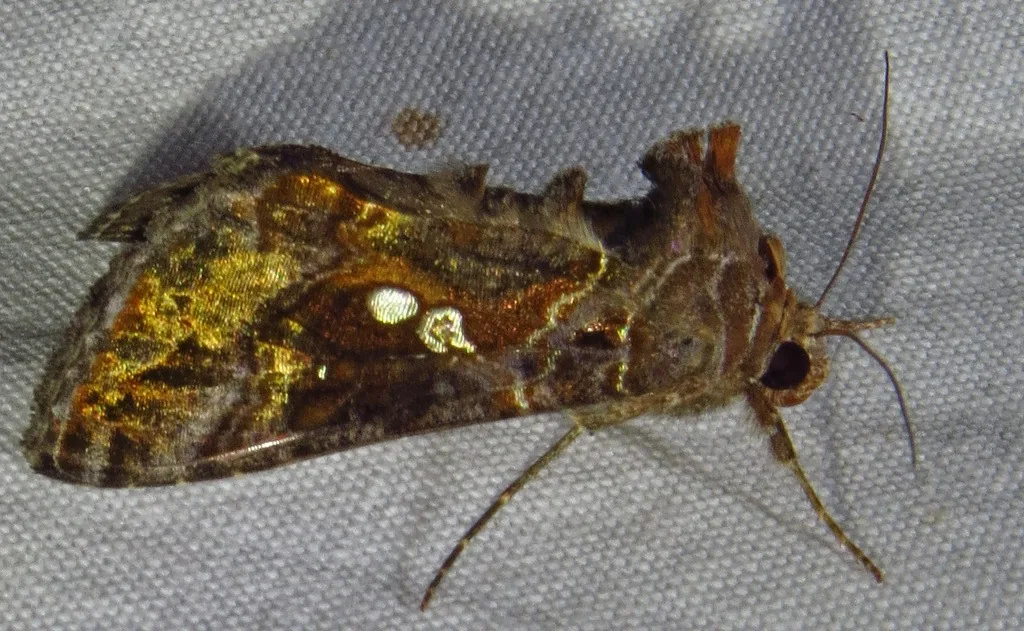
- The moth is robust and mottled brown to blackish, with a wingspan of about 1 to 1 1/2 inches. Its forewings are darker than the hindwings and carry silvery white markings, which NC State describes as a small figure eight. University of Florida Extension notes that the adult cabbage looper has similar markings.[2][3][1]
- Pupae are about 1/2 inch long and white to green, formed in a silken cocoon on the undersides of leaves. University of Florida Extension says the moths emerge during the day.[2][1]
- University of Florida Extension separates it from green caterpillars with three or more abdominal prolegs, such as the velvetbean caterpillar: the soybean looper has only two.[1]
Look-alikes
| Look-alike | How to tell them apart |
|---|---|
| Cabbage looper | The caterpillars look nearly identical: both are pale to bluish green with white stripes and loop as they crawl. The soybean looper sometimes has black legs; a reliable separation needs a look at the mandibles under magnification.[5] |
| Velvetbean caterpillar | Velvetbean caterpillars also have narrow light stripes, but they have five pairs of prolegs instead of two and thrash vigorously when disturbed.[7][6] |
| Other looper moths in pheromone traps | The cabbage looper, Rachiplusia ou, Argyrogramma verruca and Ctenoplusia oxygramma also come to soybean looper pheromone lures and can be mistaken for it. In the Florida Panhandle, C. oxygramma is the most likely to inflate counts, especially early in the season.[8] |
Where it lives
It is spread widely through the Western Hemisphere. In North America it occurs mostly in the southern and eastern United States, from Maine to Texas and west as far as California, but permanent populations are believed to be limited to south Florida and south Texas; University of Florida Extension adds that populations may also migrate in from Central and South America and the Caribbean. Each season its infestations spread as far as southern Canada, but economic infestations in soybean typically do not occur north of Texas, Arkansas, Mississippi, Alabama, Georgia and South Carolina.[2][4][1]
Biology and life cycle
Because it isn't known to survive freezing winters, it reinvades most of its range every year, migrating thousands of kilometers during spring and summer. Genetic markers suggest its migration routes differ from the fall armyworm's, apparently because soybeans and corn are planted at different times.[4]
Females lay eggs one at a time at night on the undersides of leaves in the lower half of the canopy, around 600 each. University of Florida Extension says the caterpillars usually go through six instars, though five to seven have been seen; the first lasts 3-4 days, most others 2-3 days and the last 5-6 days. Caterpillars feed for 2 to 3 weeks before pupating, and the pupal stage lasts 7 to 9 days.[2][1]
In North Carolina, moths peak in late August and caterpillars in September, mostly on later-planted soybeans. In Mississippi Delta soybean surveys from 2010 to 2012 it was the most common looper, especially from July through September, while Rachiplusia ou dominated from May to early July. In the Florida Panhandle, trap catches peaked in September and declined through December.[3][9][8]
It feeds on about 174 plant species in 39 families, including common bean, sweet potato, tobacco, alfalfa, cotton, tomato, sunflower, okra and morning glory.[2]
The adult moths feed only on nectar. Cotton nectar raises egg production, so outbreaks are more likely where soybeans grow near cotton.[2][3]
It has been recorded on 174 plants in 39 families, most in the aster, nightshade, legume, mint, mustard, grass, amaranth, spurge and mallow families. Wild hosts include Amaranthus, Oxalis, kudzu, lantana, groundcherry and cocklebur. Besides soybean, peanut, cotton and corn, University of Florida Extension lists peas, crucifers, sweet potatoes, tomatoes, bell peppers, bush beans, cucumber and watermelon, and flowers such as African daisy, begonia, carnation, chrysanthemum, geranium, lantana and sunflower.[1]
Damage and signs
- It is mainly a leaf feeder, and large populations can strip fields bare. The sources differ on pods: NC State says it does not feed on them, while a 2024 review says it eats only immature pods and leaves pods with developing seeds alone.[3][2]
- The caterpillars favor the lower canopy and the undersides of leaves, moving over the whole plant as defoliation progresses. NC State notes that this habit of staying low on leaf undersides often means poor spray coverage.[6][2]
- It is one of the most damaging soybean pests in the Mid-South and also causes significant losses in cotton, sunflower, tomato and tobacco.[2]
- It feeds from the lower, inside canopy upward and outward, so University of Florida Extension warns that the outer canopy can look undamaged until the top of the plant is defoliated. Young caterpillars eat little; most foliage is eaten by the fourth to sixth instars in the last 4-5 days of larval life.[1]
- It is mainly a foliage feeder but also feeds on pods or fruit; University of Florida Extension shows its feeding damage on a watermelon rind.[1]
Health risk
None of these sources mentions any risk to people; they treat it only as a crop pest.[2][3]
Control
Prevention
Scout the lower canopy, where early damage is easy to miss. NC State's soybean threshold for leaf-feeding caterpillars is 30% defoliation across the canopy before bloom, then 15% from about two weeks before flowering until the pods have filled. Planting earlier-maturing varieties early can also greatly reduce soybean looper problems.[3][6]
In South America, Bt soybeans expressing the Cry1Ac protein have been grown since the 2013-2014 season and manage it well; in feeding tests, soybean loopers defoliated a non-Bt variety but not a Cry1Ac variety.[2][10]
Biological control
Natural enemies include parasitic wasps (a Louisiana study found seven parasitoid species, with Copidosoma truncatellum the most abundant), predatory ants and diseases such as a nuclear polyhedrosis virus and the fungi Entomophthora gammae and Nomuraea rileyi. Insecticides used against corn earworm can kill these enemies and set off looper outbreaks.[2][3]
University of Florida Extension lists big-eyed bugs, spined soldier bugs and the parasitic wasp Copidosoma floridanum among its natural enemies. A 1972 study it cites found seven parasitoid species, two fungal pathogens (Spicaria rileyi and a Massospora species) and a mermithid nematode attacking it.[1]
Bacillus thuringiensis (Bt) formulations are commonly used against leaf-feeding caterpillars, and University of Florida Extension says they do not pose a threat to beneficial insects in the field.[1]
Pesticides
Resistance has been confirmed to pyrethroid, carbamate and organophosphate insecticides; University of Florida Extension ties this to the very wide range of crops it feeds on, and a 2024 review says resistance keeps rising. Management still leans heavily on insecticides and transgenic crops, and researchers call for more integrated approaches.[2][1]
Treatment thresholds depend on the crop and its stage. University of Florida Extension cites treating soybean when 30% foliage loss before bloom, or 15% after bloom, occurs with larvae present; cotton at about five larvae per row foot while the youngest bolls are immature; and peanut at four to eight larvae per row foot, depending on plant age and canopy health. Flower crops have lower thresholds because of cosmetic injury.[1]
Where the sources disagree
Caterpillar size: Texas A&M puts full-grown loopers at about 1 1/2 inches; University of Florida Extension says they reach 1.3 inches.[5][1]
Pods: NC State says it does not feed on pods; a 2024 review says it eats only immature pods; University of Florida Extension says it will also feed on pods or fruit.[3][2][1]
Velvetbean caterpillar prolegs: NC State counts five pairs of prolegs on the velvetbean caterpillar; University of Florida Extension's photo comparison shows four abdominal prolegs.[7][1]
Common questions
- How do I tell a soybean looper from a cabbage looper?
- They look almost the same: both are pale green with white stripes and two pairs of abdominal prolegs. Soybean loopers sometimes have black legs, but a sure identification needs a look at the mandibles under magnification.[5]
- Where on the plant do soybean loopers feed?
- They favor the lower canopy and the undersides of leaves, then spread over the whole plant as defoliation progresses, so check low in the canopy.[6][3]
- Where do soybean loopers come from each year?
- In the United States they survive winter only in south Florida and south Texas. From there they migrate north each season, reaching as far as southern Canada.[4][2]
- How can I tell a soybean looper from a velvetbean caterpillar?
- Count the abdominal prolegs. University of Florida Extension shows the soybean looper with two against the velvetbean caterpillar's four, and the soybean looper loops as it crawls. Very small velvetbean caterpillars also loop, so check the prolegs too.[1][11]
Sources
- University of Florida/IFAS Extension (Featured Creatures), “Soybean Looper, Chrysodeixis includens (Walker), EENY-695/IN1198 (E. Carter and J. L. Gillett-Kaufman).” ask.ifas.ufl.edu/publication/IN1198 (accessed 2026-11-14)
- Frontiers in Insect Science (via NCBI PubMed), “Ecological interactions, host plant defenses, and control strategies in managing soybean looper, Chrysodeixis includens (R. Debnath et al.; Frontiers in Insect Science 4: 1480940, 2024; abstract).” pubmed.ncbi.nlm.nih.gov/39726917/ (accessed 2026-11-14)
- NC State Extension, “Soybean Looper in Soybean (D. Reisig).” content.ces.ncsu.edu/soybean-looper-in-soybean (accessed 2026-11-14)
- Genes (via NCBI PubMed), “Investigating the Migratory Behavior of Soybean Looper, a Major Pest of Soybean, through Comparisons with the Corn Pest Fall Armyworm (R. N. Nagoshi et al., USDA ARS; Genes 14(7): 1495, 2023; abstract).” pubmed.ncbi.nlm.nih.gov/37510399/ (accessed 2026-11-14)
- Texas A&M AgriLife Extension, “A Key to Common Caterpillar Pests of Vegetables (B-6110).” agrilifeextension.tamu.edu/wp-content/uploads/2026/03/A-Key-to-common-Caterpillar-pests.pdf (accessed 2026-11-14)
- NC State Extension, “North Carolina Soybean Production Guide, chapter 9: Insect Management.” content.ces.ncsu.edu/north-carolina-soybean-production-guide/soybean-insect-management (accessed 2026-11-14)
- NC State Extension, “Velvetbean Caterpillar in Soybean (D. Reisig).” content.ces.ncsu.edu/velvetbean-caterpillar-in-soybean (accessed 2026-11-14)
- Journal of Economic Entomology (via NCBI PubMed), “Seasonal Flight Patterns of Chrysodeixis includens in the Florida Panhandle and Inventory of Plusiine Species Cross-Attracted to Synthetic Pheromone (T. J. Shaw et al.; Journal of Economic Entomology 114(6): 2315-2325, 2021; abstract).” pubmed.ncbi.nlm.nih.gov/34595520/ (accessed 2026-11-14)
- Journal of Economic Entomology (via NCBI PubMed), “Temporal Occurrence of Plusiinae on Soybean in the Mississippi River Delta (K. C. Allen, N. S. Little and O. P. Perera, USDA ARS; Journal of Economic Entomology 114(2): 723-727, 2021; abstract).” pubmed.ncbi.nlm.nih.gov/33438020/ (accessed 2026-11-14)
- PLoS ONE (via NCBI PubMed), “Feeding injury of major lepidopteran soybean pests in South America (P. D. Carpane et al.; PLoS ONE 17(12): e0271084, 2022; abstract).” pubmed.ncbi.nlm.nih.gov/36520803/ (accessed 2026-11-14)
- University of Florida/IFAS Extension (Featured Creatures), “Velvetbean Caterpillar, Anticarsia gemmatalis (Hübner), EENY-151/IN308 (K. A. Barbara).” ask.ifas.ufl.edu/publication/IN308 (accessed 2026-11-14)
- iNaturalist, “Chrysodeixis includens taxon page (order and family).” www.inaturalist.org/taxa/148908 (accessed 2026-11-14)