On this page
How to identify it
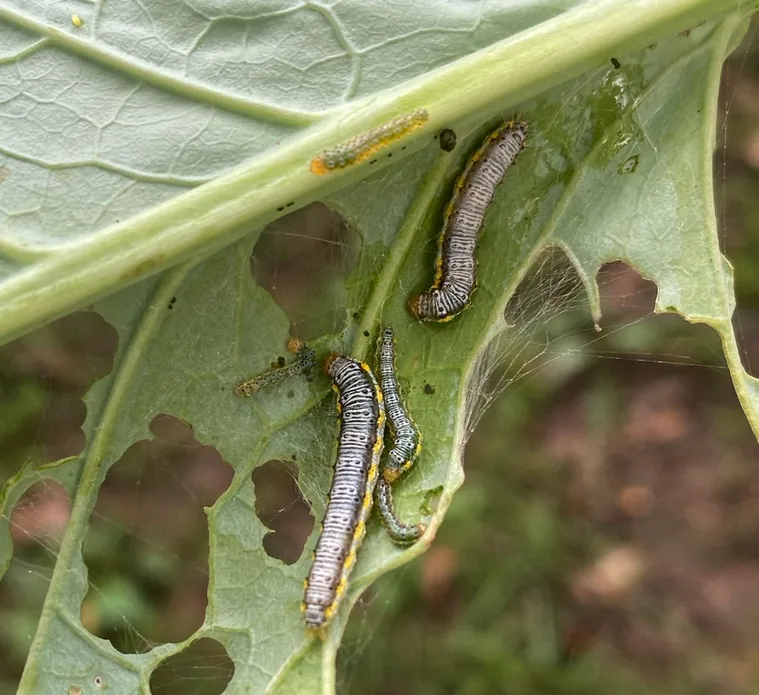
- Grown caterpillars are bluish gray on top and green underneath, with many narrow black bands across the back and a yellow line along each side. The Arkansas Arthropod Museum gives a length of up to 25 mm; Clemson, UMass, Mississippi State and Kansas State say about ¾ inch (19 mm).[1][3][4][2][5]
- Newly hatched caterpillars are uniformly gray and sparsely hairy and don't show the stripes yet. UF/IFAS describes young caterpillars as gray with stout hairs, turning bluish gray with black cross bands as they age.[1][2][10]
- The eggs are flat and yellow and are laid in overlapping clusters, like fish scales, on the undersides of leaves: 3 to 25 per batch according to UMass, up to 25 according to Clemson, and 20 to 30 according to the Arkansas Arthropod Museum.[1][4][2][3]
- Adult moths are straw-colored to brown with dark zigzag markings on the forewings and a wingspan of about 1 inch; Kansas State gives their length as 0.4 to 0.6 inches. They fly at night and usually go unnoticed. UF/IFAS describes straw-colored forewings marked with purplish-brown bands, and transparent white hind wings with a dark band near the edge.[3][6][5][10]
Look-alikes
| Look-alike | How to tell them apart |
|---|---|
| Imported cabbageworm | Its eggs are laid singly rather than in batches. The two caterpillars may be found feeding side by side on the same plant.[4][5] |
| Diamondback moth | A smaller caterpillar, under ½ inch when grown, light green and pointed at both ends, that wiggles vigorously when disturbed and may drop off the plant on a silk thread.[7] |
Where it lives
The Arkansas Arthropod Museum lists it from southern New York, West Virginia, Illinois, Colorado and Washington south to Florida, Texas and Mexico, with a report from Prince Edward Island in Canada. Once restricted to the South, it is now a serious brassica pest in southeastern New England, and Mississippi State says it now occurs beyond the traditional southern states. UF/IFAS calls it a common pest in the southeastern United States and Central America, and UConn reports it has become a significant brassica pest in Connecticut.[1][4][3][10][11]
Biology and life cycle
Eggs hatch in 2 to 10 days according to the Arkansas Arthropod Museum, or 2 to 12 days depending on temperature according to Mississippi State. The caterpillars feed for 2 to 3 weeks through four instars, then drop to the ground and pupate just under the soil surface in a tight cocoon. UF/IFAS describes pupation in the soil near the surface, in a small cocoon covered with sand.[1][3][2][4][10]
Adults emerge from the pupae 9 to 11 days later and live 1 to 3 weeks.[1]
UMass and Kansas State give two to three generations a year, and Mississippi State at least two to three in the southern states. In Mississippi it occurs in both spring and fall, and UMass says it is most abundant on late-season plantings. UF/IFAS says the life cycle generally takes about 60 days.[4][5][3][8][10]
It does not generally overwinter in New England, but a very early infestation on one Massachusetts farm suggested caterpillars had survived the winter in high-tunnel brassicas.[6]
Damage and signs
- Young caterpillars feed on leaf undersides, leaving small pinholes or clear windowpanes where the upper skin stays intact. Older ones prefer the terminal buds, can burrow into developing heads, and in heavy infestations skeletonize the leaves until only the veins remain. UConn says infested plants often end up completely skeletonized, and the caterpillars can also target terminal buds and sprouts.[1][8][3][4][5][11]
- Hosts include cabbage, broccoli, Brussels sprouts, collards, cauliflower, kale, turnips, rutabaga and bok choy. In field tests Brussels sprouts and collards were the most preferred and cabbage and kale the least.[1][3][5]
- Numbers are usually low, but in some years populations become dense and destructive; in Mississippi, spring-grown crops are sometimes heavily damaged.[1][8]
Health risk
It feeds only on plants; none of these sources reports any harm to people or pets.[1][5]
Control
Prevention
Check the tops and bottoms of leaves weekly for egg clusters, caterpillars and damage. UMass suggests treating when 5% of plants are infested. UConn uses the same 5% threshold and also says to scout weekly.[4][5][3][11]
Avoid heavy nitrogen fertilizer. Mississippi State links it to bigger caterpillar populations, because it produces more of the tender young leaves they feed on. UF/IFAS likewise says over-fertilizing with nitrogen has been shown to be directly related to increases in caterpillar numbers.[3][10]
Keep them out
Floating row covers keep the moths from laying eggs on the plants.[5][3]
Sanitation
Control wild mustard and shepherd's purse, and plow under crop debris after harvest.[4][5]
Traps and physical control
Pick off caterpillars by hand and drop them into a container of soapy water.[5]
Biological control
Parasitoids, predators and diseases attack the eggs, caterpillars and adults. UMass recommends selective insecticides that spare parasitic wasps, and Kansas State notes that purchased Trichogramma wasps attack only the eggs. UConn also advises selective insecticides to preserve parasitic wasps. UF/IFAS says several parasitoids have been identified, but their importance is not documented.[3][4][5][11][10]
Pesticides
Treat while the caterpillars are small. Bt (kurstaki) and spinosad must be eaten to work, and Kansas State says they are no longer effective once caterpillars reach ¾ inch; Mississippi State rates spinosad more effective than Bt for home gardens. Choose a product labeled for the crop and follow the label.[5][8]
Where sources disagree
Caterpillar size: the Arkansas Arthropod Museum says up to 25 mm, while Clemson, UMass, Mississippi State and Kansas State say about ¾ inch.[1][2][4][3][5]
Eggs per batch: 3 to 25 according to UMass, up to 25 according to Clemson, up to 30 according to Mississippi State, and 20 to 30 according to the Arkansas Arthropod Museum. UConn also gives 3 to 25.[4][2][3][1][11]
Generations: two to three a year according to UMass and Kansas State, at least two to three in the South according to Mississippi State, and several per growing season according to the Arkansas Arthropod Museum. UF/IFAS gives three to four a year, with a life cycle of about 60 days.[4][5][3][1][10]
Common questions
- What are the striped caterpillars eating my collards?
- Bluish-gray caterpillars with black cross-bands and a yellow side stripe, often many on one plant, are cross-striped cabbageworms.[1][2][3]
- Why are there so many caterpillars on one cabbage plant?
- Cross-striped cabbageworm moths lay their eggs in clusters rather than singly, so one plant can end up with many caterpillars while its neighbors are untouched.[1][4][8]
- Does nitrogen fertilizer make cross-striped cabbageworms worse?
- It can. UF/IFAS says over-fertilizing with nitrogen has been directly related to bigger caterpillar populations, and Mississippi State links it to the tender young leaves the caterpillars feed on.[10][3]
Sources
- University of Arkansas Arthropod Museum, “Cross-striped cabbageworm (Arthropod Museum).” arthropod.uark.edu/cross-striped-cabbageworm/ (accessed 2026-11-11)
- Clemson Cooperative Extension, Home & Garden Information Center, “Cabbage, Broccoli & Other Cole Crop Insect Pests (HGIC factsheet).” hgic.clemson.edu/factsheet/cabbage-broccoli-other-cole-crop-insect-pests/ (accessed 2026-11-11)
- Mississippi State University Extension, “Cross-Striped Cabbageworms (Evergestis rimosalis), Publication 4221 (J. Perier, 2026).” extension.msstate.edu/publications/cross-striped-cabbageworms-evergestis-rimosalis (accessed 2026-11-11)
- UMass Amherst Extension Vegetable Program, “Cross-Striped Cabbageworm (vegetable fact sheet).” www.umass.edu/agriculture-food-environment/vegetable/fact-sheets/cross-striped-cabbageworm (accessed 2026-11-11)
- Kansas State University Research and Extension, “Cross-Striped Cabbageworm: Insect Pest of Vegetable Crops (MF3505, R. Cloyd, May 2020).” bookstore.ksre.ksu.edu/pubs/MF3505.pdf (accessed 2026-11-11)
- UMass Amherst Extension Vegetable Program, “Caterpillars in Brassica Crops (vegetable fact sheet).” www.umass.edu/agriculture-food-environment/vegetable/fact-sheets/caterpillars-in-brassica-crops (accessed 2026-11-11)
- UMass Amherst Extension Vegetable Program, “Diamondback Moth (vegetable fact sheet).” www.umass.edu/agriculture-food-environment/vegetable/fact-sheets/diamondback-moth (accessed 2026-11-11)
- Mississippi State University Extension, “Cross-striped Cabbageworm, Bug's Eye View Vol. 2, No. 2 (B. Layton, 2016).” extension.msstate.edu/newsletters/bugs-eye-view/2016/cross-striped-cabbageworm-vol-2-no-2 (accessed 2026-11-11)
- iNaturalist, “Evergestis rimosalis taxon page (order and family).” www.inaturalist.org/taxa/359686 (accessed 2026-10-06)
- University of Florida, Entomology and Nematology Department, “Cross-striped Cabbageworm, Evergestis rimosalis (UF/IFAS Vegetable Arthropod Pest Photographs CD-ROM III).” entnemdept.ufl.edu/projex/gallery/dl/Vegetable_Pests_III/text/cross-striped_cabbageworm.htm (accessed 2026-11-14)
- UConn Extension Integrated Pest Management, “Vegetable Pest Alert, July 11, 2025.” ipm.cahnr.uconn.edu/vegetable-pest-alert-july-11-2025 (accessed 2026-11-14)