On this page
How to identify it
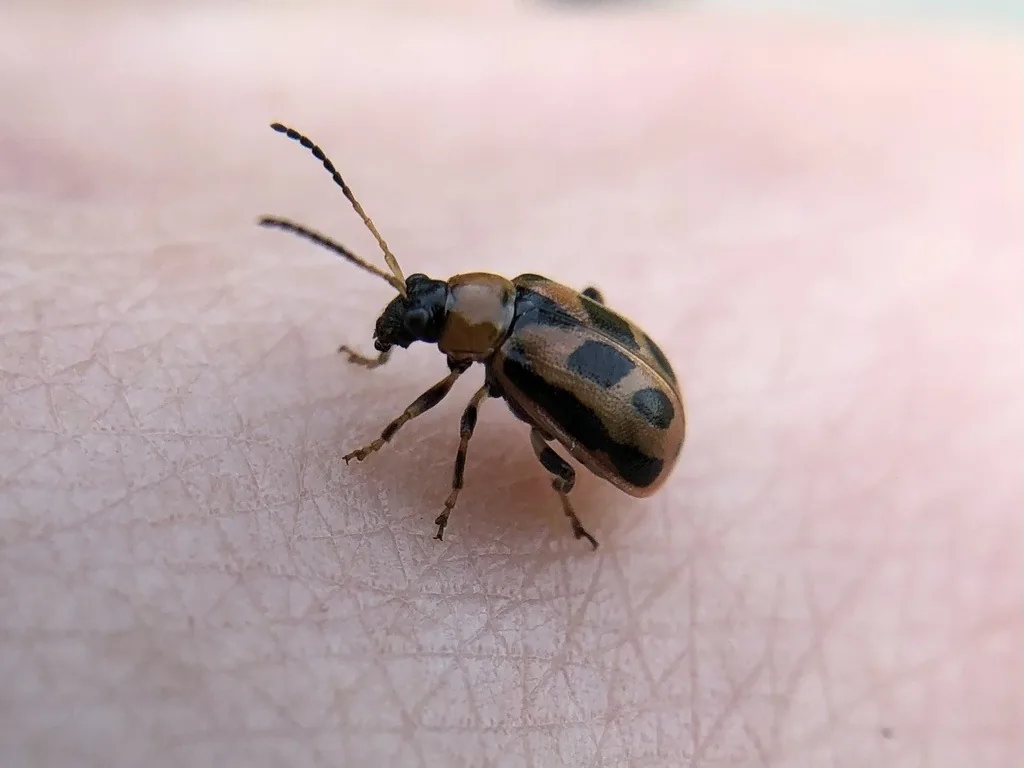
- Adults are oval and roughly 1/5 to 1/4 inch long. Color runs from yellowish green or tan to orange or red, and the four black spots on the wing covers may be reduced to two or missing.[1][3]
- The steadiest mark is a black triangle just behind the head at the base of the wing covers; most also have black edges along the wing covers.[1][3]
- Size estimates differ a little: Minnesota Extension says about 1/4 inch, Kentucky gives 1/8 to 1/4 inch, and Iowa State about 5 mm (1/5 inch).[1][2][3]
Look-alikes
| Look-alike | How to tell them apart |
|---|---|
| Cucumber beetles | Spotted cucumber beetles look similar but are larger; check for the black triangle at the base of the wing covers, which the bean leaf beetle nearly always has.[2][3] |
Where it lives
It's native to North America. Hosts are mostly legumes such as soybean, snap and dry beans, clover, alfalfa and vetch, with occasional feeding on stinging nettle, pumpkin and cucumber.[3][1]
Biology and life cycle
Adults spend the winter in leaf litter, grass clumps and wooded edges; Iowa State puts about 80% of them in woodlot leaf debris. Most die after 15 minutes at 14 F.[1][3]
Orange eggs go into the soil near bean stems. Reported hatch times vary: one to three weeks (Minnesota), about 11 days (Kentucky) or about a week (Iowa State). The white larvae feed on roots and nodules but rarely matter much.[1][2][3]
Generations depend on latitude: one in Ontario and most of Minnesota, one or two in Wisconsin, two in southern Minnesota, Iowa and Illinois, two or a partial third in Kentucky, and three in the Southeast.[1][3][2]
Spring adults gather first in alfalfa and clover, then move to soybeans as seedlings come up. Clover, bird's-foot trefoil and roundhead bush clover also served as adult food plants in an Iowa feeding study.[3][4][5]
Damage and signs
- Adults scoop pits out of seed leaves, chew almost circular holes in leaves, and scrape the green skin off pods, occasionally eating through to the seed. Heavy feeding can kill seedlings; on snap beans pod marks are mostly cosmetic.[2][1]
- In soybeans it's the main carrier of bean pod mottle virus, and pod wounds let in pod and seed fungi; NC State says the virus can be passed on with no waiting period and for several days after feeding.[3][4]
Health risk
It feeds on plants, and none of the extension sources mentions a risk to people. The plant viruses it carries don't affect snap bean varieties, according to Minnesota Extension.[1]
Control
Prevention
Plant snap beans later, early to mid-June in southern Minnesota, so seedlings miss the first wave of overwintered beetles.[1]
On larger plantings, reflective white or metallic mulch and kaolin clay can discourage feeding and egg laying. If alfalfa grows nearby, avoid cutting it while beans are young, because mowing drives beetles into the beans.[1]
Keep them out
Floating row covers with the edges buried or weighted keep beetles off young beans.[1]
Sanitation
Clean up leaf litter around the garden to remove overwintering sites.[1]
Traps and physical control
Hold a pail under plants and tap them; beetles drop when disturbed.[1]
Biological control
A native tachinid fly (Medina species) parasitizes bean leaf beetles in Minnesota; it isn't sold, so leave it to work on its own.[1]
Bean leaf beetle in soybean fields
Kentucky finds it in most soybean fields from emergence to maturity, yet economic losses are rare; it matters mainly from emergence until the first trifoliate leaf unrolls and again at pod fill.[2]
Iowa State says the biggest concern is food-grade and seed soybeans, where virus and pod-fungus damage hurt seed quality; NC State notes there are no commercially available soybean varieties resistant to the virus.[3][4]
In an Iowa study, Illinois tick-trefoil (Desmodium illinoense) turned up as a new natural host of bean pod mottle virus, one of the wild plants beetles can pick it up from.[5]
Common questions
- What's chewing round holes in my green bean leaves?
- Very likely bean leaf beetles. They leave scattered, nearly round holes about 1/8 inch across, mostly fed from the leaf undersides.[1][2]
- When should I check?
- Scout early in the season between noon and 4 p.m., when beetles are most active. Kentucky advises against sampling before mid-morning or while dew is on the plants.[1][2]
- Are the beetles on my green beans spreading a virus?
- Bean leaf beetles carry bean pod mottle virus in soybeans, but Minnesota Extension says snap bean varieties aren't affected by the diseases they spread.[1][4]
Sources
- University of Minnesota Extension, “Bean leaf beetles (Yard and garden insects).” extension.umn.edu/garden-and-home/yard-and-garden/yard-and-garden-insects/bean-leaf-beetles (accessed 2026-11-12)
- University of Kentucky Entomology, “ENTFACT-131: Bean Leaf Beetle in Kentucky Soybeans.” entomology.mgcafe.uky.edu/ef131 (accessed 2026-11-12)
- Iowa State University Extension and Outreach, Integrated Crop Management, “Bean Leaf Beetle.” crops.extension.iastate.edu/bean-leaf-beetle (accessed 2026-11-12)
- NC State Extension, “Bean Pod Mottle Virus.” content.ces.ncsu.edu/bean-pod-mottle-virus (accessed 2026-11-12)
- Journal of Economic Entomology, 2007 (via PubMed), “No-choice preference of Cerotoma trifurcata (Coleoptera: Chrysomelidae) to potential host plants of bean pod mottle virus (Comoviridae) in Iowa (abstract).” pubmed.ncbi.nlm.nih.gov/17598542/ (accessed 2026-11-12)
- Global Biodiversity Information Facility (GBIF), “Cerotoma trifurcata (Forster, 1771) (GBIF Backbone Taxonomy).” api.gbif.org/v1/species/1048531 (accessed 2026-11-12)