On this page
How to identify it
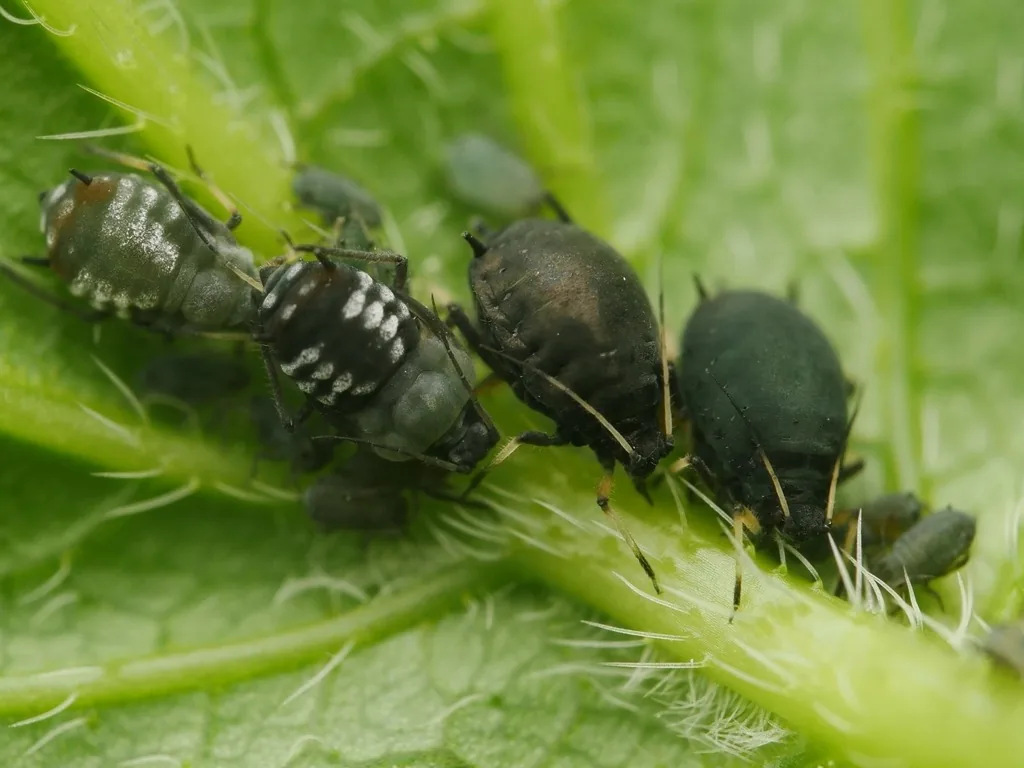
- AHDB describes wingless adults as 1.5 to 3 mm long, black or olive green, often with distinct waxy stripes, and winged adults as very dark; WSU describes bean aphids as small, pear-shaped and dark green to black.[2][1]
- They feed in tight clusters on shoot tips, young leaves and flower stems.[1][2]
- Infested leaves curl or deform and get sticky with honeydew, which draws ants and grows black sooty mold.[1]
Where it lives
WSU and the Connecticut station describe it on garden plants in Washington State and Connecticut, and the UK's AHDB on field beans and sugar beet.[1][3][2]
Biology and life cycle
WSU says it typically overwinters on hosts such as euonymus and viburnum. AHDB says eggs overwinter on spindle (Euonymus europaeus) from October to June, and winged forms move into summer crops in May and June.[1][2]
Colonies can build up very quickly in warm, humid summer weather.[2]
AHDB says breeding continues all summer, usually peaking in July and August; colonies are often attended by ants and build from the top of the plant down, crowding produces winged forms that spread, and from September to November winged forms fly back to spindle to lay eggs.[2]
Damage and signs
- Heavy feeding curls and deforms new growth; on beans it damages flowers, slows or stops pod development and makes plants wilt in dry weather.[1][2]
- AHDB says it can transmit viruses including bean leafroll virus, pea enation mosaic virus, bean yellow mosaic virus and beet yellows virus.[2]
- On faba beans, AHDB says honeydew encourages chocolate spot, while direct feeding damage on sugar beet is rarely worth controlling.[2]
Health risk
It feeds on plants. WSU, AHDB and the Connecticut station describe plant damage only and don't mention any risk to people or pets.[1][2][3]
Control
Prevention
Avoid excess nitrogen fertilizer, which boosts aphid reproduction.[1]
Traps and physical control
For small infestations, WSU suggests hand-wiping or pruning, and washing aphids off with a strong stream of water.[1]
Biological control
Lady beetles, lacewings, syrphid fly larvae, parasitic wasps and insect-pathogenic fungi are natural enemies. WSU says to avoid broad-spectrum insecticides that kill them and to control ants that guard the colonies; see where the sources disagree on how much they help.[1][3][2]
Pesticides
Insecticidal soap sprayed directly on the aphids is among the compounds the Connecticut station lists as registered for this pest in Connecticut; it says to consult the label.[3]
Where the sources disagree
Overwintering: WSU names euonymus and viburnum; AHDB names spindle (a euonymus) for the eggs and says that in mild winters active stages may also overwinter on leguminous weeds or winter beans.[1][2]
Natural enemies: WSU puts them first among non-chemical options and the Connecticut station says they can help keep numbers in check; AHDB says they may help but may not prevent virus spread, which can happen even at low aphid numbers.[1][3][2]
Common questions
- What are the clusters of tiny black bugs on my bean and nasturtium tips?
- Most likely black bean aphids, which crowd shoot tips and new leaves in summer.[1][3]
- Where do black bean aphids come from each year?
- WSU says they typically overwinter on hosts such as euonymus and viburnum; AHDB says the eggs overwinter on spindle, a euonymus, and winged aphids move to summer crops in May and June.[1][2]
Sources
- Washington State University Extension, “Bean: Bean aphids (HortSense).” hortsense.cahnrs.wsu.edu/?p=2262 (accessed 2026-11-13)
- Agriculture and Horticulture Development Board (UK), “Management of the black bean aphid in field beans and sugar beet.” ahdb.org.uk/knowledge-library/management-of-the-black-bean-aphid-in-field-beans-and-sugar-beet (accessed 2026-11-13)
- Connecticut Agricultural Experiment Station, “Plant Pest Handbook: Nasturtium (Tropaeolum).” portal.ct.gov/caes/plant-pest-handbook/pphn/nasturtium-tropaeolum (accessed 2026-11-13)
- Global Biodiversity Information Facility (GBIF), “Aphis fabae Scopoli, 1763 (GBIF Backbone Taxonomy).” api.gbif.org/v1/species/2072167 (accessed 2026-11-13)
- iNaturalist, “Aphis fabae taxon page (order and family).” www.inaturalist.org/taxa/1584763 (accessed 2026-10-06)