On this page
How to identify it
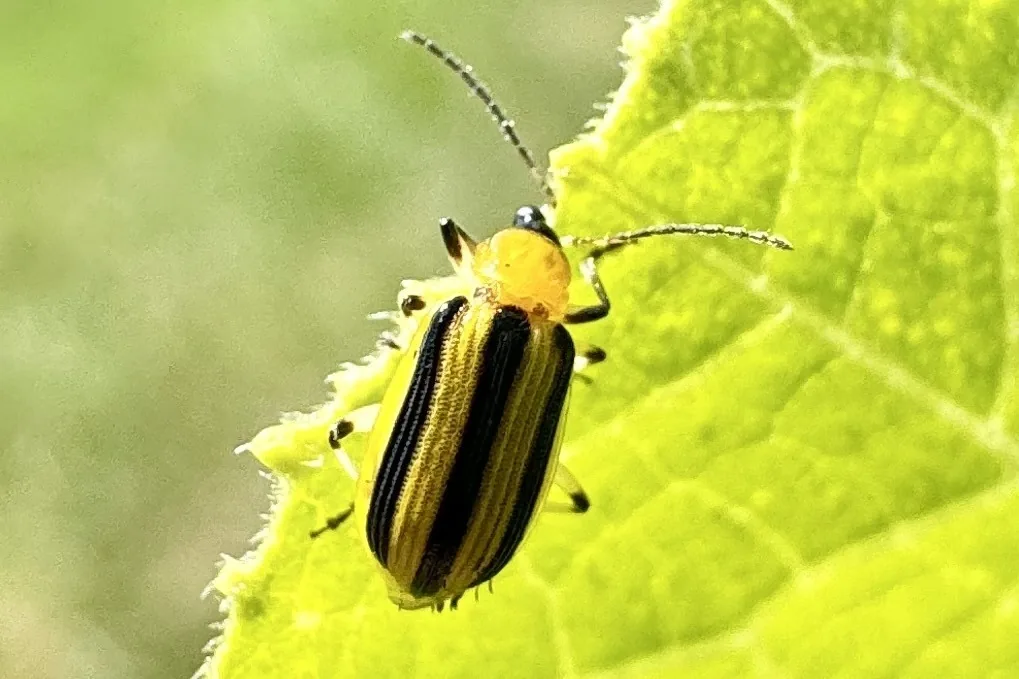
- This page centers on the striped cucumber beetle, Acalymma vittatum, a beetle about 1/5 to 1/4 inch long with yellow to yellow-green wing covers and three black stripes.[1][2][3][4]
- Its head and antennae are black, the area just behind the head is orange to yellow, and the antennae are long and threadlike. The underside of the abdomen is black.[1][4][5][3]
- The spotted cucumber beetle, also called the southern corn rootworm, is about the same size or slightly larger on average, and yellow-green with 12 black spots instead of stripes.[2][1][3]
- Larvae are slender, creamy white grubs about 3/8 inch long with a dark head and three pairs of short legs, living in the soil. Eggs are pale orange-yellow and laid in groups at the base of plants.[1][4][3][5]
Look-alikes
| Look-alike | How to tell them apart |
|---|---|
| Western corn rootworm | The striped cucumber beetle has straighter stripes than the western corn rootworm, the middle segment of its hind leg is yellow rather than black, and its underside is black where the rootworm's is yellow-green. Western corn rootworms often feed on cucurbit pollen but are not vine crop pests.[2][3] |
| Lady beetles | Cucumber beetles are sometimes mistaken for predatory lady beetles, but lady beetles have short, stubby antennae, not long threadlike ones.[5] |
| Western striped and western spotted cucumber beetles | In California the most common species is the western spotted cucumber beetle; the western striped cucumber beetle, a separate species, is yellowish orange with three black stripes.[5] |
Where it lives
Striped cucumber beetles are pests from Minnesota to Kentucky; spotted cucumber beetles do not survive Minnesota winters and fly in from the South in early summer, while California has its own western species.[1][2][5]
Biology and life cycle
Adults spend the winter in leaf litter and plant debris near field edges, buildings, fence rows and wood lots, and find host plants quickly in spring.[2][1][4][6]
Females lay eggs in soil cracks at the base of cucurbits; Wisconsin says the eggs hatch in 14 to 21 days. Larvae feed on roots and underground stems for two to four weeks, then pupate in the soil.[2][1][3][4]
Going from egg to adult takes about 40 to 60 days. In New England the new adults emerge in early to mid August and stay abundant into September before moving to field edges to overwinter.[1][4]
Kentucky growers typically see a spring peak in beetle activity lasting two to four weeks, the most important time to protect plants.[2]
The wilt bacterium, Erwinia tracheiphila, lives in the plant's water-conducting tissue and is carried through the winter by striped and spotted cucumber beetles. Kentucky says it overwinters in the gut of some striped beetles and spreads through their droppings or contaminated mouthparts when they feed in spring.[7][2][6]
Damage and signs
- Adults chew leaves, stems and blossoms and can strip small plants completely; feeding hurts most up to about the third true leaf.[1][2][3]
- Beetles can carry the bacteria that cause bacterial wilt, which plugs the plant's water-conducting tissue so vines wilt and die. Beetles are drawn to infected plants and carry the bacteria on to healthy ones.[2][1][7]
- Cucumbers and muskmelons are very susceptible to bacterial wilt, while watermelon is not, and pumpkins and winter squash tolerate heavy leaf loss once past the third leaf. Lincoln University adds that zucchini, squash and pumpkin can be infected when beetles are numerous.[1][2][4][6]
- To check for wilt, cut a wilted stem and slowly pull the cut ends apart; sticky sap that strings out like rope points to bacteria.[2]
- The beetles also spread squash mosaic virus, and UMass says striped beetles can carry cucumber mosaic virus, though less effectively than aphids.[3][4]
- Late-season feeding on fruit rinds is mostly cosmetic, and larval root feeding is usually minor compared with wilt losses.[1][2][3]
Health risk
Cucumber beetles harm plants, not people; the concern is crop loss from feeding and from bacterial wilt and other cucurbit diseases they spread.[2][5][3]
Control
Prevention
Plant a trap crop such as Blue Hubbard squash around the edge a week or two ahead of your main cucurbits, and kill the beetles that gather on it, or they will move on to the main crop.[1][3][6][4]
Rotate cucurbits with non-host crops. Wisconsin adds that less bitter cucumber varieties generally attract fewer beetles.[3][4]
Keep them out
Cover seedlings with row cover, screens or cones as soon as they emerge or are planted, and uncover them at flowering so bees can pollinate.[2][1][5][3][4]
Sanitation
Pull weeds around the garden, remove plants showing bacterial wilt promptly, and clear debris and leaf litter after the season.[1][3][6]
Traps and physical control
In small gardens, knock beetles into a bucket of soapy water, and spread thick straw around established plants to hinder egg-laying.[1][3]
Biological control
Various general predators attack cucumber beetles, though older plants can usually carry substantial numbers without serious harm.[5]
Pesticides
Infected plants can't be saved, so any control must stop beetles feeding early; treat only when numbers pass a threshold (see below), and spray before 8 a.m. or after 6 p.m. to protect bees.[2][1][6][3]
Wisconsin lists neem and other oils, insecticidal soap and pyrethrins for organic gardens and pyrethroids such as permethrin as conventional options, and notes that spinosad tends to work poorly against cucumber beetles.[3]
Where sources disagree
Generations: Minnesota and Wisconsin give one a year, while Lincoln University says Missouri usually sees two to three generations of striped cucumber beetles a season, and UC IPM says California's western species have several.[1][3][6][5]
Thresholds: Minnesota treats seedlings when a quarter of plants have two or more beetles, or older plants at 25 percent defoliation. Wisconsin and Lincoln use one beetle per plant on cucumbers and melons and five per plant on watermelon and less susceptible squash, and UMass one beetle for every two plants on wilt-susceptible crops, including summer squash and zucchini.[1][3][6][4]
Flower feeding: Minnesota says beetles feeding on pollen and flowers once crops bloom don't reduce yield, while Wisconsin says large numbers in flowers can disrupt bee pollination and reduce fruit set.[1][3]
Row covers: Minnesota says to remove them when plants start flowering, while Wisconsin says to keep them on until female flowers appear, since male flowers often open first.[1][3]
Spotted beetles in the North: Minnesota and Wisconsin say spotted cucumber beetles don't overwinter there and arrive from the South in summer, but Lincoln says that after mild winters they have been active in northern areas as early as February.[1][3][6]
Common questions
- Why did my cucumber vine suddenly wilt and die?
- Bacterial wilt spread by cucumber beetles is a common cause; a wilted leaf spreads to the whole vine, and sticky, stringy sap in a cut stem confirms it. By the time symptoms show, it is too late to save the plant.[2][6]
- Do I need to worry about cucumber beetles on pumpkins and squash?
- Mainly while plants are small. Once squash and pumpkins have four or more leaves they tolerate feeding, while cucumbers and melons stay at risk all season because of bacterial wilt.[1][4]
- Are the beetles in my squash flowers hurting the crop?
- Usually not much. Minnesota says pollen and blossom feeding after flowering begins doesn't reduce yield and late-season fruit feeding is cosmetic, though Wisconsin warns that large crowds in flowers can disrupt pollination.[1][3]
Sources
- University of Minnesota Extension, “Cucumber Beetles.” extension.umn.edu/garden-and-home/yard-and-garden/yard-and-garden-insects/cucumber-beetles (accessed 2026-11-11)
- University of Kentucky Entomology, “Cucumber Beetles (ENTFACT-311).” entomology.ca.uky.edu/ef311 (accessed 2026-11-11)
- University of Wisconsin-Madison Extension, “Cucumber Beetle (Wisconsin Horticulture).” hort.extension.wisc.edu/articles/cucumber-beetles/ (accessed 2026-11-11)
- UMass Amherst Center for Agriculture, Food, and the Environment, “Striped Cucumber Beetle (vegetable fact sheet).” www.umass.edu/agriculture-food-environment/vegetable/fact-sheets/striped-cucumber-beetle (accessed 2026-11-11)
- University of California Statewide IPM Program, “Cucumber Beetles (Pest Notes, Home and Landscape).” ipm.ucanr.edu/home-and-landscape/cucumber-beetles/ (accessed 2026-11-11)
- Lincoln University Cooperative Extension, “Cucumber Beetles in Missouri: Life Cycle, Monitoring and Management, FS 18-I-2017 (J. Pinero).” www.lincolnu.edu/_files/publications/cucumber-beetles-in-missouri-life-cycle,-monitoring-and-management-fs-18i2017.pdf (accessed 2026-11-11)
- Plant Disease, via PubMed, “Rojas et al. (2015), Bacterial wilt of cucurbits: resurrecting a classic pathosystem.” pubmed.ncbi.nlm.nih.gov/30699691/ (accessed 2026-11-11)
- iNaturalist, “Acalymma vittatum taxon page (order and family).” www.inaturalist.org/taxa/154287 (accessed 2026-10-06)