On this page
How to identify it
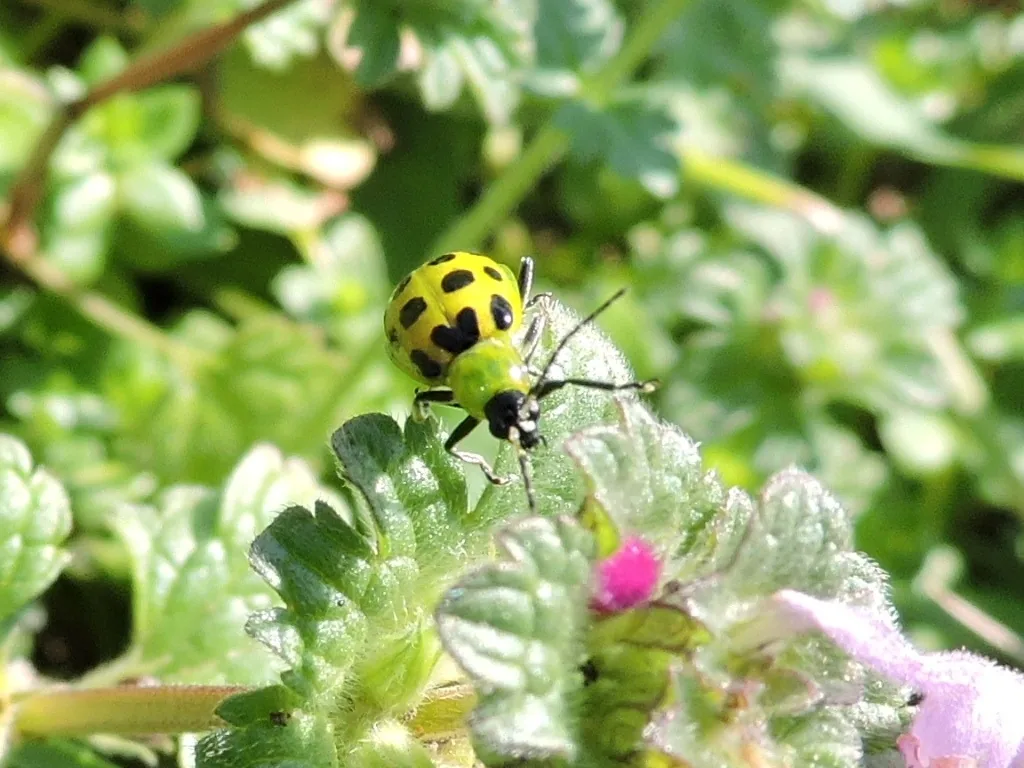
- Adults are about 1/4 inch long, yellow-green with 12 black spots on the wing covers and a black head, legs and antennae. Kentucky notes they are larger on average than striped cucumber beetles. UF/IFAS gives 6.4 mm (1/4 in) and beaded black antennae about 1.6 mm long.[1][5][3][6][11]
- Larvae live in the soil and are slender, worm-like and yellowish-white, about 8-12 mm long, with a dark head and last body segment and three pairs of short legs. UF/IFAS gives almost 12 mm (1/2 in), with a slender white body, three pairs of brown legs, a brown head and a dark-brown plate on the last segment.[5][6][3][11]
- Eggs are yellow-orange and laid in the soil near host plants. UF/IFAS says they are oval, about 0.7 mm long, laid in clusters of 25–50 in soil crevices at or near the base of cucurbit plants, and depend on soil moisture to survive.[6][5][11]
- Pupae are white at first and turn yellowish with age, about 7.5 mm long, with a pair of stout spines at the tip of the abdomen.[11]
Look-alikes
| Look-alike | How to tell them apart |
|---|---|
| Striped cucumber beetle | About the same size and color but with three black stripes instead of spots. In Minnesota and Wisconsin it is the more common of the two and the one that matters early in the season.[2][3] |
| Banded cucumber beetle | A related Diabrotica beetle native to the neotropics whose range has expanded to include most of the US peanut-growing area; in a Georgia peanut study it outnumbered the southern corn rootworm. In Florida, UF/IFAS says the banded cucumber beetle is more common in the south of the state and the spotted cucumber beetle in north Florida.[7][11] |
Where it lives
Native to the United States; the European Food Safety Authority's plant health panel lists this subspecies from North and Central America. In Minnesota and Wisconsin it doesn't overwinter and arrives from the South in late June or July. UC IPM names the western spotted cucumber beetle, the same species, as the most abundant cucumber beetle in California. UF/IFAS says it occurs throughout the United States from Mexico to Canada, is most abundant and destructive in the South, overwinters in southern states and disperses north each year, and isn't troublesome in sandy soils.[7][8][2][3][6][11]
Biology and life cycle
Adults overwinter in protected outdoor spots and become active at temperatures above 50°F in spring. UF/IFAS says unmated adults overwinter under leaves and debris around woodlands and buildings, leave in late March, and lay eggs from late April to early June.[5][1][6][11]
In the North the beetles fly in from the South: Minnesota says in late June or early July, and Wisconsin early to mid July. In Missouri they appear in cucurbit fields from mid-June to early July.[2][3][4]
Females lay eggs in the soil near host plants such as corn and other grasses and legumes, and the larvae develop on the roots before pupating in the soil (see below on cucurbits).[2][5][8][6]
Adults feed on tender parts of a very wide range of plants: the EFSA review counts hosts in 40 more botanical families beyond those used for egg-laying, and Utah State lists beans, corn, cucurbits, potato, tomato, small grains, ornamentals, grasses and weeds.[8][5]
UF/IFAS says eggs usually hatch in 6–9 days but can take up to 30 days in cool conditions; larvae take about 2–3½ weeks, pupae 6–10 days, and first-generation adults appear in late June to early July.[11]
A life cycle takes about six to nine weeks. There are generally two generations a year, with one reported in Oregon and three in southern California and Alabama.[11]
Adults are long-lived, 60 days in summer and up to 200 days in winter, start laying eggs 2–3 weeks after emerging, and are most active in the morning and late afternoon.[11]
Damage and signs
- Adults chew irregular holes in leaves and feed on flowers, pollen and fruit rinds; feeding matters most while cucurbit plants are small. UF/IFAS says adult feeding on cucurbit plants or transplants has been reported to cause wilting and lower yields.[5][3][1][11]
- Spotted and striped cucumber beetles both carry Erwinia tracheiphila, the bacterium behind bacterial wilt of cucurbits. The beetles keep it in their gut over the winter and spread it as they feed and leave droppings on plants; cucumbers and muskmelons suffer most.[9][4][1][8]
- Bacterial wilt is mainly a problem in the Midwest and Northeast; the EFSA review describes the bacterium as restricted to temperate midwestern and eastern North America.[9][8]
- Larvae feed on the roots of corn, small grains, beans, sweet pea and grasses but don't usually cause noticeable damage in gardens. In Georgia it is a pest of peanuts, and a study there found more rootworm injury to peanut pods in fields bordered by corn.[6][7]
- In Minnesota they are rarely seen early in the season and are usually too few to need treatment, and Wisconsin says their late arrival makes them less likely to be a serious problem.[2][3]
- Larvae feed on roots and tunnel through stems, badly damaging small plants but doing less harm to large ones with developed roots; their feeding may make Fusarium wilt more likely.[11]
- Larvae called rindworms scar the rind of fruit lying on the soil, and smooth-skinned melons are most at risk before the skin hardens. Scarred fruit loses market value.[11]
- UF/IFAS says the beetles also carry squash mosaic, cucumber mosaic, bean mosaic and maize chlorotic mottle viruses, and that watermelons are not affected by bacterial wilt.[11]
Health risk
Spotted cucumber beetles are crop pests; the harm is leaf and flower feeding and the bacterial wilt they spread to cucurbits.[1][3][4]
Control
Prevention
Keep the area weed free, use plastic or organic mulches and drip irrigation, and destroy crop residues after harvest. UF/IFAS adds avoiding planting cucurbits near beans, corn, small grains and grassy weeds, delaying planting until beetles have dispersed, and using straw mulch, which slows beetles and shelters wolf spiders that eat them.[5][4][11]
A Blue Hubbard squash trap crop set out around the edge two weeks ahead of the main crop draws cucumber beetles away; kill the beetles that gather on it. UF/IFAS also says to plant trap crops two weeks before the main crop along the border.[4][3][2][11]
Choose cucurbit varieties lower in cucurbitacin, the bitter compound that draws cucumber beetles to the plants.[11]
Keep them out
Protect small plants with row covers, screens or cones, and uncover them at flowering so pollinators can reach the flowers.[1][2][4]
Traps and physical control
Yellow sticky cards pick up cucumber beetles, but Lincoln University found them better at catching striped beetles than spotted ones, so scout plants two to three times a week while they are small, then weekly.[4]
Biological control
Natural enemies include a tachinid fly, Beauveria fungus, a nematode, soldier and ground beetles, braconid wasps, spiders, harvestmen and bats; commercially available fungi and insect-parasitic nematodes have shown some activity against larvae in soil.[11]
Pesticides
Utah State suggests treatment when two or more beetles are found per plant on 25% of plants; Lincoln uses one beetle per plant on muskmelon and cucumber and five per plant on zucchini, squash and watermelon. UF/IFAS suggests checking five plants at five spots (25 plants) and taking action at five or more beetles per mature plant, or right away if young plants show unacceptable damage.[5][4][11]
Once a plant has bacterial wilt it can't be saved, so control has to stop beetle feeding early.[1][4][3]
For organic gardens Wisconsin lists neem and other oils, insecticidal soap and pyrethrins, and notes that spinosad tends to work poorly against cucumber beetles.[3]
Where sources disagree
Overwintering in the North: Minnesota and Wisconsin say spotted cucumber beetles don't survive their winters and migrate in each summer, while Lincoln University says that after mild winters they have been active in northern areas as early as February.[2][3][4]
Generations: Minnesota and Wisconsin give one a year and Utah State two per season, while the EFSA review calls the subspecies multivoltine, meaning more than one generation a year.[2][3][5][8]
Egg-laying on cucurbits: Lincoln says spotted beetles don't reproduce in cucurbits, and Minnesota says they lay eggs on non-cucurbit plants such as corn and other grasses. Utah State lists cucurbits among the plants they lay eggs near, and the EFSA review includes the squash family among egg-laying hosts.[4][2][5][8]
Larval period: UC IPM says cucumber beetle larvae feed for 2 to 6 weeks, while Utah State says pupation comes about 2 months after the eggs hatch.[6][5]
Spring activity: other sources here give temperatures above about 50°F; UF/IFAS says overwintering adults become active at 59°F–68°F.[5][1][6][11]
Generations: UF/IFAS gives generally two a year, one in Oregon and three in southern California and Alabama.[11]
Bacterial wilt pathogen: the UF/IFAS sheet names the bacterium Pseudomonas lachrymans, while the peer-reviewed literature on this page names Erwinia tracheiphila.[11][9]
Spinosad: UF/IFAS lists kaolin clay, pyrethrum and spinosad as organic options that help to some extent; Wisconsin says spinosad tends to work poorly against cucumber beetles.[11][3]
Egg-laying on cucurbits: UF/IFAS says females lay eggs in soil at or near the base of cucurbit plants.[11]
Common questions
- What are the yellow beetles with black spots on my squash?
- Likely spotted cucumber beetles: yellow-green, about 1/4 inch long, with 12 black spots and a black head. Striped cucumber beetles have three stripes instead.[1][5][3]
- Why did my cucumber vines wilt suddenly?
- Bacterial wilt carried by cucumber beetles is a common cause. Cut a wilted stem and slowly pull the ends apart: sticky sap that strings out points to bacteria. Infected plants can't be saved.[1][4]
- Is the spotted cucumber beetle the same as the southern corn rootworm?
- Yes. Southern corn rootworm is another common name for the same beetle, Diabrotica undecimpunctata howardi; its larvae feed on the roots of corn, grasses and other plants.[1][2][6]
- What is scarring the rinds of my melons?
- Possibly rindworms, the larvae of spotted cucumber beetles, which feed on the surface of fruit lying on the soil. UF/IFAS says smooth-skinned melons are most at risk before the skin hardens.[11]
Sources
- University of Kentucky Entomology, “Cucumber Beetles (ENTFACT-311).” entomology.ca.uky.edu/ef311 (accessed 2026-11-11)
- University of Minnesota Extension, “Cucumber Beetles.” extension.umn.edu/garden-and-home/yard-and-garden/yard-and-garden-insects/cucumber-beetles (accessed 2026-11-11)
- University of Wisconsin-Madison Extension, “Cucumber Beetle (Wisconsin Horticulture).” hort.extension.wisc.edu/articles/cucumber-beetles/ (accessed 2026-11-11)
- Lincoln University Cooperative Extension, “Cucumber Beetles in Missouri: Life Cycle, Monitoring and Management, FS 18-I-2017 (J. Pinero).” www.lincolnu.edu/_files/publications/cucumber-beetles-in-missouri-life-cycle,-monitoring-and-management-fs-18i2017.pdf (accessed 2026-11-11)
- Utah State University Extension (Integrated Pest Management), “Spotted Cucumber Beetle (hemp pest fact sheet).” extension.usu.edu/planthealth/ipm/notes_ag/hemp-spotted-cucumber-beetle.php (accessed 2026-11-11)
- University of California Statewide IPM Program, “Cucumber Beetles (Pest Notes, Home and Landscape).” ipm.ucanr.edu/home-and-landscape/cucumber-beetles/ (accessed 2026-11-11)
- Journal of Economic Entomology, via PubMed, “Sutton, Skipper, Fair and Abney (2024), Landscape factors affect relative abundance of rootworm species and pod injury in Georgia peanuts.” pubmed.ncbi.nlm.nih.gov/39393412/ (accessed 2026-11-11)
- EFSA Journal, via PubMed, “EFSA Panel on Plant Health (2020), Pest categorisation of Diabrotica undecimpunctata howardi.” pubmed.ncbi.nlm.nih.gov/33318768/ (accessed 2026-11-11)
- Plant Disease, via PubMed, “Rojas et al. (2015), Bacterial wilt of cucurbits: resurrecting a classic pathosystem.” pubmed.ncbi.nlm.nih.gov/30699691/ (accessed 2026-11-11)
- iNaturalist, “Diabrotica undecimpunctata taxon page (order and family).” www.inaturalist.org/taxa/55487 (accessed 2026-10-06)
- University of Florida IFAS Extension, EDIS, “Spotted Cucumber Beetle, Diabrotica undecimpunctata howardi Barber, EENY572/IN1008 (Featured Creatures).” ask.ifas.ufl.edu/publication/IN1008 (accessed 2026-11-14)