On this page
How to identify it
- Adults are about 1/4 inch long; USDA's Diabrotica ID tool gives a body length of 5.0 to 5.3 mm. UF/IFAS gives 5 to 6 mm (3/16 to 1/4 inch).[2][3][4]
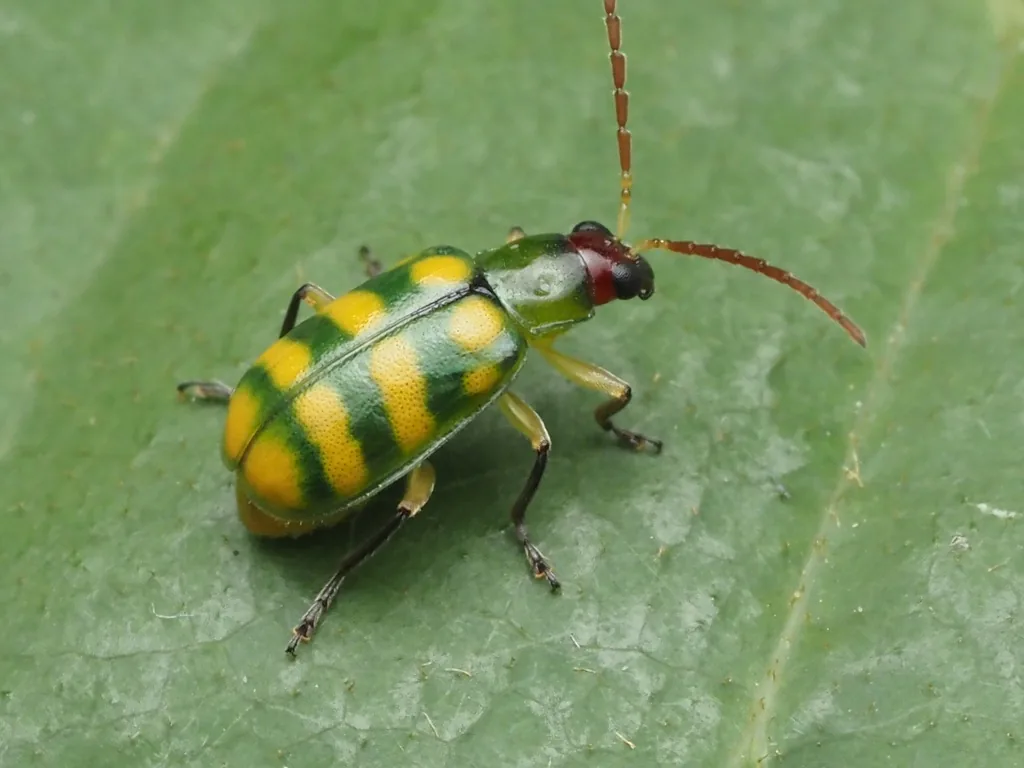
- Clemson describes the adult as yellowish-green with three bright green bands across the wing covers. The Crop Protection Network describes the same pattern the other way round, as a light green beetle with four yellow bands, so expect a banded yellow-and-green look rather than spots or long stripes.[5][2]
- The head is dark reddish-brown to orange. The legs are light green near the body and dark brown to black on the outer segments.[2][3]
- Fully grown larvae are about 1/3 inch long, cream-colored, with a black head and a black plate at the tip of the abdomen. They live in the soil.[2]
- UF/IFAS describes a red head and black thorax, usually three green cross-bands on the wing covers (sometimes with a bluish tint) and a thin green stripe down the center of the back. The banding varies and is sometimes almost absent.[4]
- Eggs are yellow ovals about 0.6 mm long, laid in cracks in the soil. Larvae start out white and may turn pale yellow depending on what they eat; the three larval stages are about 2.3, 4.5 and 8.9 mm long.[4]
Look-alikes
| Look-alike | How to tell them apart |
|---|---|
| Striped and spotted cucumber beetles | The spotted cucumber beetle is yellowish-green with 11 black spots and a black head; the striped cucumber beetle is yellow with three black stripes running lengthwise. The banded beetle's green bands run across the wing covers.[5] |
Where it lives
Its known range runs from the southern United States through Mexico and Central America to Colombia, Venezuela and Cuba. In the U.S. it is found mainly in the southern tier of states and now covers most of the peanut-growing region. UF/IFAS says that until the early 1900s its U.S. range was limited to southern Arizona and Texas. It has since spread across the southern states from North Carolina to southern California, and its intolerance of freezing temperatures probably keeps it from moving farther north. In Florida it occurs statewide and is most abundant on the organic soils near Lake Okeechobee.[3][2][1][4]
Biology and life cycle
Adults and larvae both feed on a wide range of plants. Larvae feed on the roots of corn, beans and peanuts.[6][1]
It has no winter or dry-season egg diapause. Instead it breeds continuously, with several generations a year; how many depends on latitude. UF/IFAS reports up to six to seven generations a year in Louisiana and Texas, with a life cycle as short as 45 days under optimal conditions.[6][4]
In Georgia peanut fields monitored in 2021 and 2022, adult numbers peaked twice each year, banded cucumber beetles outnumbered southern corn rootworms, and beetles were most abundant in fields bordered by corn.[1]
Eggs hatch in five to nine days, larvae feed in the soil for usually 11 to 17 days, and pupation in the soil takes four to six days.[4]
Adults mate about six days after emerging and start laying eggs about 16 days later. A female normally lays 2 to 15 clusters of up to 100 eggs, as many as 850 in all, and adults live 17 to 44 days, 26 on average.[4]
Damage and signs
- Recorded vegetable hosts include cucumber, squash, beet, bean, pea, sweet potato, okra, corn, lettuce, onion and cabbages; it has also been found on mango, avocado, mulberry, potato and white clover. UF/IFAS adds that adults prefer the cucumber, rose, legume and mustard families, and that bean and soybean are especially favored.[3][4]
- Clemson lists it with the spotted and striped cucumber beetles as very harmful to cucurbits, especially young plants. Cucumber beetles feed on all parts of the plant, including flowers and fruit.[5]
- In soybean, larvae feed on roots and adults feed on seedling leaves after emergence and later on stems, leaves, flowers and pods.[2]
- In Georgia peanuts, pod injury was greater in fields bordered by corn.[1]
- UF/IFAS says it can damage foliage, blossoms, silk, kernels, the plant crown and roots. The most frequent serious injury is adults stripping leaves and larvae feeding on the roots of seedlings, and some of the worst comes from larvae feeding on sweet potato roots.[4]
- It is known to spread virus diseases in beans, and larval feeding might make Fusarium wilt more common and severe.[4]
Health risk
It feeds on plants. None of the extension, USDA or research sources used here mention any risk to people or pets. UF/IFAS describes it only as a crop pest.[5][2][3][4]
Control
Prevention
Keep weeds down in and around the garden. UF/IFAS notes that many weeds are hosts, so clean cultivation or other weed control helps protect seedlings.[5][4]
In sweet potato, cultivars partly resistant to cucumber beetle injury are known; UF/IFAS says such information seems to be lacking for other crops.[4]
Traps and physical control
In a home garden, fabric row covers keep beetles off young plants; remove them when the plants flower so they can be pollinated. Handpicking is slow but works. UF/IFAS also suggests screening or row covers to keep adults off seedlings.[5][4]
Biological control
Several predators and parasites attack cucumber beetles. Insect-killing nematodes protected corn roots from banded cucumber beetle larvae in a 2019 study when applied before the larvae started feeding. UF/IFAS adds that a mermithid nematode infected 20 to 40 percent of beetles in South Carolina from May through October, that ants are important egg predators in the tropics, and that Steinernema nematodes, which are readily available, have worked under experimental conditions.[5][7][4]
Pesticides
No sampling plan or threshold has been set for this beetle. In soybean, a soil insecticide at planting may protect roots early in the season, and standard defoliation thresholds apply to leaf feeding. If you use an insecticide, read and follow the label. UF/IFAS says granular insecticides are most often applied in a band over the row at planting or soon after, and foliar sprays are sometimes needed to protect seedlings, but adults are rarely abundant enough on large plants to warrant control.[2][4]
More from the research literature
A 2019 study in the journal Insects found that beneficial insect-killing nematodes packed in alginate beads killed banded cucumber beetle larvae as well as sprayed nematodes did and protected corn roots, but only when applied in time: the treatment failed when larvae had started feeding a week before the beads went down.[7]
A 2020 review of the pest Diabrotica beetles of South America notes that because these beetles breed all year, crop rotation does not help much against them. Parasites of the adults give little control. Insecticides and Bt corn are the main tools there, while Beauveria fungus, insect-killing nematodes and lure-based baits look promising.[6]
Where the sources disagree
Adult size: USDA's Diabrotica ID tool gives a body length of 5.0 to 5.3 mm, while UF/IFAS gives 5 to 6 mm.[3][4]
Head color: the Crop Protection Network and USDA's ID tool describe the head as dark reddish-brown to orange, while UF/IFAS calls it red, with a black thorax.[2][3][4]
Common questions
- What are the green-banded beetles on my cucumbers?
- Probably banded cucumber beetles: small yellowish-green beetles with green bands across the back, found mainly in the southern states.[5][2][3]
- Do they damage roots?
- Yes. The larvae live in the soil and feed on roots, and in peanuts they injure the pods.[2][6][1]
- How many eggs does one beetle lay?
- UF/IFAS says a female normally lays 2 to 15 clusters of up to 100 eggs each, as many as 850 in all, in cracks in the soil.[4]
- Does it damage sweet potatoes?
- Yes. UF/IFAS says some of the most serious injury comes from larvae feeding on sweet potato roots, and that partly resistant sweet potato cultivars are known.[4]
Sources
- Journal of Economic Entomology, via PubMed, “Landscape factors affect relative abundance of rootworm species and pod injury in Georgia peanuts (Sutton, Skipper, Fair and Abney 2024).” pubmed.ncbi.nlm.nih.gov/39393412/ (accessed 2026-11-11)
- Crop Protection Network (multi-state university extension collaboration), “Banded Cucumber Beetle in Soybean.” cropprotectionnetwork.org/encyclopedia/banded-cucumber-beetle-in-soybean (accessed 2026-11-11)
- USDA APHIS PPQ Identification Technology Program (IDtools), “Diabrotica balteata (Diabrotica ID: species page; Derunkov, Konstantinov, Tishechkin, Hartje and Redford).” idtools.org/diabrotica/index.cfm?packageID=1116&entityID=3586 (accessed 2026-11-11)
- University of Florida IFAS Extension (EDIS), “Banded Cucumber Beetle, Diabrotica balteata LeConte, EENY-093/IN250 (J. L. Capinera; Featured Creatures).” ask.ifas.ufl.edu/publication/IN250 (accessed 2026-11-14)
- Clemson Cooperative Extension, Home & Garden Information Center, “Cucumber, Squash, Melon & Other Cucurbit Insect Pests (HGIC).” hgic.clemson.edu/factsheet/cucumber-squash-melon-other-cucurbit-insect-pests/ (accessed 2026-11-11)
- Insects, via PubMed, “Biology and Management of Pest Diabrotica Species in South America (Cabrera Walsh et al. 2020).” pubmed.ncbi.nlm.nih.gov/32650377/ (accessed 2026-11-11)
- Peer-reviewed literature (PubMed), “Encapsulated Entomopathogenic Nematodes Can Protect Maize Plants from Diabrotica balteata Larvae (Jaffuel G et al., Insects, 2019).” pubmed.ncbi.nlm.nih.gov/31905809/ (accessed 2026-11-11)
- iNaturalist, “Diabrotica balteata taxon page (order and family).” www.inaturalist.org/taxa/310923 (accessed 2026-10-06)