On this page
How to identify it
- The caterpillar is dark brown to black on top with a bronze sheen, three narrow yellow stripes running the length of the body and a broad white-yellow stripe down each side. It has three pairs of true legs and four pairs of abdominal prolegs and reaches about 1.5 to 1.75 inches when mature.[1][2]
- Iowa State adds that the head is light brown and the first body segment behind the head is a bit darker, and calls the stripes golden yellow. Fully grown caterpillars are about 1.5 to 1.75 inches long.[7][1][8]
- Cutworm larvae of the common turf species look very similar and are hard to tell apart; the black cutworm is dark green to gray or black with a pale stripe down the back, the granulate cutworm dark brown to gray with yellow-gray side stripes, and the variegated cutworm gray to brown with an orange side stripe.[2]
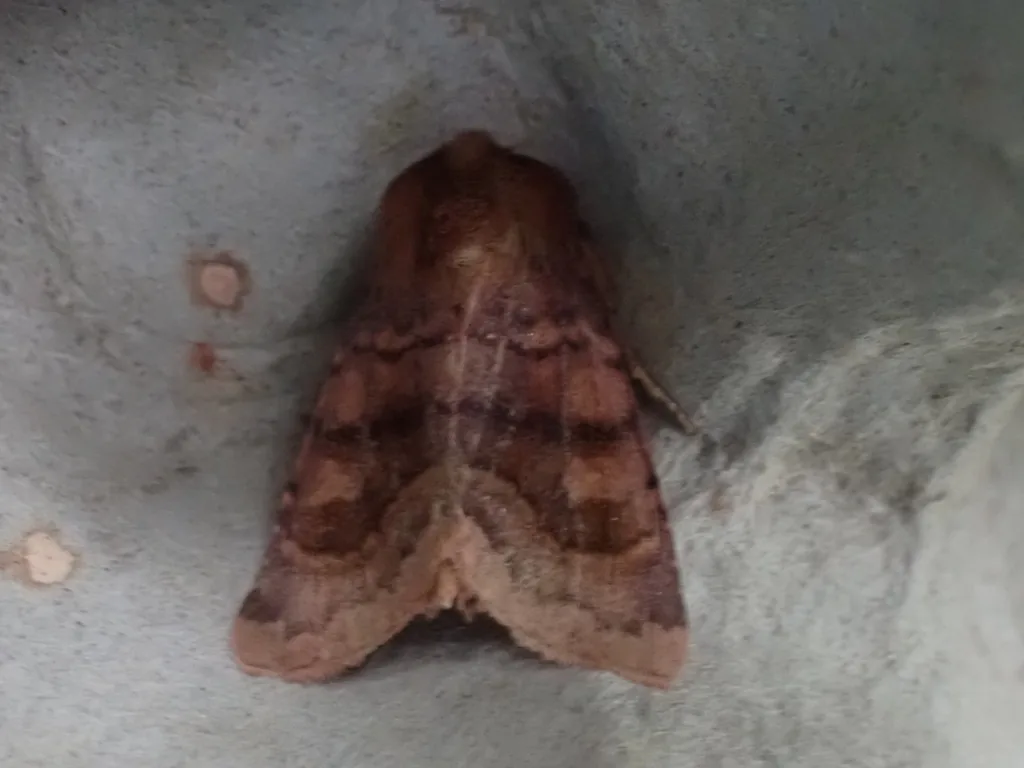
- Adult turf cutworm moths are generally gray-brown with wingspans of about 1.4 to 1.8 inches.[2]
Look-alikes
| Look-alike | How to tell them apart |
|---|---|
| Black cutworm | Dark green to gray or black with a pale stripe down the back rather than the bronzed cutworm's bronze sheen and three yellow stripes; the black cutworm prefers closely mowed bentgrass and perennial rye.[2] |
| Variegated cutworm | Gray to brown with an orange lateral stripe; the bronzed cutworm is dark brown with a bronze sheen.[2] |
| Granulate cutworm | Dark brown to gray with yellow-gray lateral stripes but without the bronze sheen and the three narrow yellow stripes.[2] |
| White grubs | Grub damage comes from feeding below ground on turf roots, whereas cutworms clip the blades close to or at the soil surface.[1] |
| True armyworm | Iowa State says the bronzed cutworm is more likely to be confused with the true armyworm than with other cutworms; compare the overall look and the head capsule. Bronzed cutworms are dark brown with a bronze sheen and a light brown head.[7] |
Where it lives
A native North American cutworm. GBIF's U.S. records since 1990 come from 51 states and districts, most from Pennsylvania, Wisconsin, Illinois, Massachusetts, Ohio and New York. It is listed among the cutworms most often found on North Carolina turf and in Minnesota gardens. Idaho Fish and Game lists it as a native, regularly occurring moth in Idaho, and Iowa State calls it native to Iowa.[5][2][3][10][7]
Biology and life cycle
The bronzed cutworm has a single generation each year, and the caterpillars are active in late spring; a South Dakota State entomologist found one in a garden in the week before June 3, 2021.[1][9]
The caterpillars feed in the evening or at night and hide in plant debris or soil during the day, so it is common to find clipped plants and no larvae.[1][3]
It is native to Minnesota, where it overwinters as eggs or larvae in weedy or grassy areas.[3]
A University of Minnesota applicator training manual says it overwinters as eggs that hatch in early spring, with fully grown larvae by late April and pupation in mid-August. South Dakota State says the moths lay eggs in grassy areas from September to October.[9][8]
Turf cutworms in general lay their eggs singly on the tips of leaf blades; the eggs hatch in 3 to 10 days, the larvae tunnel into the thatch or use aeration holes to reach the soil, finish development in 20 to 45 days and pupate for about two weeks.[2]
A fun fact: the bolas spider Mastophora hutchinsoni catches male bronzed cutworm moths by mimicking the female's sex pheromone, and researchers identified two of its pheromone components.[4]
Damage and signs
- In lawns, bronzed cutworm feeding produces small brown circular patches 2 to 10 inches across, because the caterpillars clip grass blades close to or at the soil surface. Large populations can cause extensive injury, though grass normally outgrows the feeding unless it is already stressed, and unwatered lawns in dry conditions may fail to recover.[1]
- In gardens the bronzed cutworm can seriously injure young plants, clipping and killing seedlings, which matters most when cool evenings keep newly planted seedlings growing slowly.[1]
- Turf cutworms emerge at night to chew stems and blades near the soil, leaving circular dead spots, finger-sized brown crescents or ball-mark-like spots on golf greens; they are typically active in spring and fall, can strip large areas at ground level, and damage can be worse after aerification.[2]
- Iowa State calls it an occasional pest that has killed plants in a central Iowa pasture.[7]
- It is not a common corn pest in South Dakota, but it can become a problem when corn is planted into ground that was grassland, cutting or clipping the young plants above the soil.[8]
Health risk
The sources treat the bronzed cutworm only as a lawn and garden pest and mention no effect on people.[1][2]
Control
Prevention
Scout by watching lawns for small brown spots and garden plants for leaf feeding, wilting or plants cut off near the soil, since the caterpillars themselves hide by day. For turf, NC State's general threshold of 2 to 6 larvae per square yard may indicate a need for treatment.[1][2]
Keep lawns watered: grass normally outgrows bronzed cutworm feeding unless it is stressed, and dry, unwatered lawns are the ones that may not recover.[1]
For a field or plot that was grass and is going to corn, South Dakota State says managing it before September lowers the risk, because the moths lay eggs in grassy areas in September and October. Scout from corn emergence weekly until the fifth-leaf stage.[8]
Keep them out
Protect young garden plants with rings of aluminum foil or cardboard around the stems, set one-to-two inches below ground and extending two-to-three inches above the soil, so the cutworms cannot clip the stems.[1][3]
Sanitation
Remove weeds, which serve as alternate hosts for young cutworm larvae, and till the garden before planting and in fall to expose larvae and pupae. In turf, collecting clippings from a freshly mowed area may help remove eggs laid on the tips of leaf blades.[3][2]
Traps and physical control
Check gardens in the late afternoon and evening when cutworms are active, and drop any you find into soapy water.[3]
Pesticides
Pesticides are usually not necessary in the home garden. Insecticide control is difficult because the caterpillars feed at night; dusting plants may deter feeding but washes off with rain or watering.[3][1]
For turf, NC State lists insecticides including Bt products, azadirachtin (Neemix), spinosad (Conserve), carbaryl (Sevin), bifenthrin (Talstar) and chlorantraniliprole (Acelepryn). Mow 24 hours before treating and apply in the evening for night-time contact.[2]
Where sources disagree
How it overwinters: University of Minnesota Extension says the bronzed cutworm overwinters as eggs or larvae in weedy or grassy areas; the university's turf-moth applicator manual says it overwinters as eggs that hatch in early spring.[3][9]
Common questions
- What makes the small brown circles in my lawn in late spring?
- Bronzed cutworms clipping grass blades at the soil surface leave brown circular patches 2 to 10 inches across; the grass usually grows back if the lawn is watered and otherwise healthy.[1]
- How do I protect seedlings from bronzed cutworms?
- Put a collar of aluminum foil or cardboard around each stem, buried one to two inches and standing two to three inches above the soil, and check new transplants for clipped plants.[1]
- How can I recognize a bronzed cutworm?
- A dark brown caterpillar with a bronze sheen, three narrow yellow stripes along the back and a broad pale yellow stripe on each side, up to about 1.75 inches long, hiding in the thatch or soil by day.[1][2]
- Do bronzed cutworms need to be sprayed in a home garden?
- Usually not: Minnesota Extension says pesticides are usually not necessary in the home garden. Collars, weeding, and hand-picking in the evening protect transplants.[3][1]
- Do bronzed cutworms attack corn or pastures?
- Sometimes. Iowa State reports plant death in a central Iowa pasture, and South Dakota State says it can cut young corn planted into former grassland, though it is not a common corn pest there.[7][8]
Sources
- South Dakota State University Extension, “Bronzed Cutworms Are Active (June 3, 2021).” extension.sdstate.edu/bronzed-cutworms-are-active (accessed 2026-11-12)
- NC State Extension, North Carolina State University, “Cutworms in Turf, NC State Extension Publications.” content.ces.ncsu.edu/cutworm-in-turf (accessed 2026-11-12)
- University of Minnesota Extension, “Cutworms.” extension.umn.edu/yard-and-garden-insects/cutworms (accessed 2026-11-12)
- Journal of Chemical Ecology 2004, via PubMed, “Sex pheromone components of the bronzed cutworm, Nephelodes minians, a prey species of a bolas spider, Mastophora hutchinsoni.” pubmed.ncbi.nlm.nih.gov/15609836/ (accessed 2026-11-12)
- Global Biodiversity Information Facility (GBIF), “Nephelodes minians: U.S. occurrence records since 1990 by state (GBIF occurrence search).” api.gbif.org/v1/occurrence/search?taxonKey=1765172&country=US&hasGeospatialIssue=false&occurrenceStatus=PRESENT&year=1990%2C2026&facet=stateProvince&facetLimit=400&limit=0 (accessed 2026-11-12)
- iNaturalist, “Nephelodes minians taxon page (order and family).” www.inaturalist.org/taxa/153076 (accessed 2026-11-12)
- Iowa State University Extension and Outreach (Integrated Crop Management), “Refresh your Cutworm Identification Skills.” crops.extension.iastate.edu/post/refresh-your-cutworm-identification-skills (accessed 2026-11-12)
- South Dakota State University Extension, “Watch Corn for Bronzed Cutworm Activity.” extension.sdstate.edu/watch-corn-bronzed-cutworm-activity (accessed 2026-11-12)
- University of Minnesota Pesticide Safety and Environmental Education, “Turf Moths (pesticide applicator training chapter).” pesticidecert.cfans.umn.edu/sites/pesticidecert.cfans.umn.edu/files/2022-04/8.Turf_Moths.pdf (accessed 2026-11-12)
- Idaho Department of Fish and Game, Species Catalog, “Nephelodes minians (Bronzed Cutworm Moth).” idfg.idaho.gov/species/taxa/32280 (accessed 2026-11-12)