On this page
How to identify it
- Grown larvae are dusty brown and 1 to 1 1/2 inches long, with rougher, more granular skin than the black cutworm. UC IPM notes the color varies but is lighter than a black cutworm's. UF/IFAS describes grayish to reddish brown larvae with dull yellowish slanting marks on each abdominal segment, a weak gray line along the side below the breathing pores with white or yellow spots, and a yellowish to brownish head.[1][2][4]
- Like other cutworms they curl into a C shape when disturbed, a posture behind one of their Latin American names, which means curled caterpillar.[2][3]
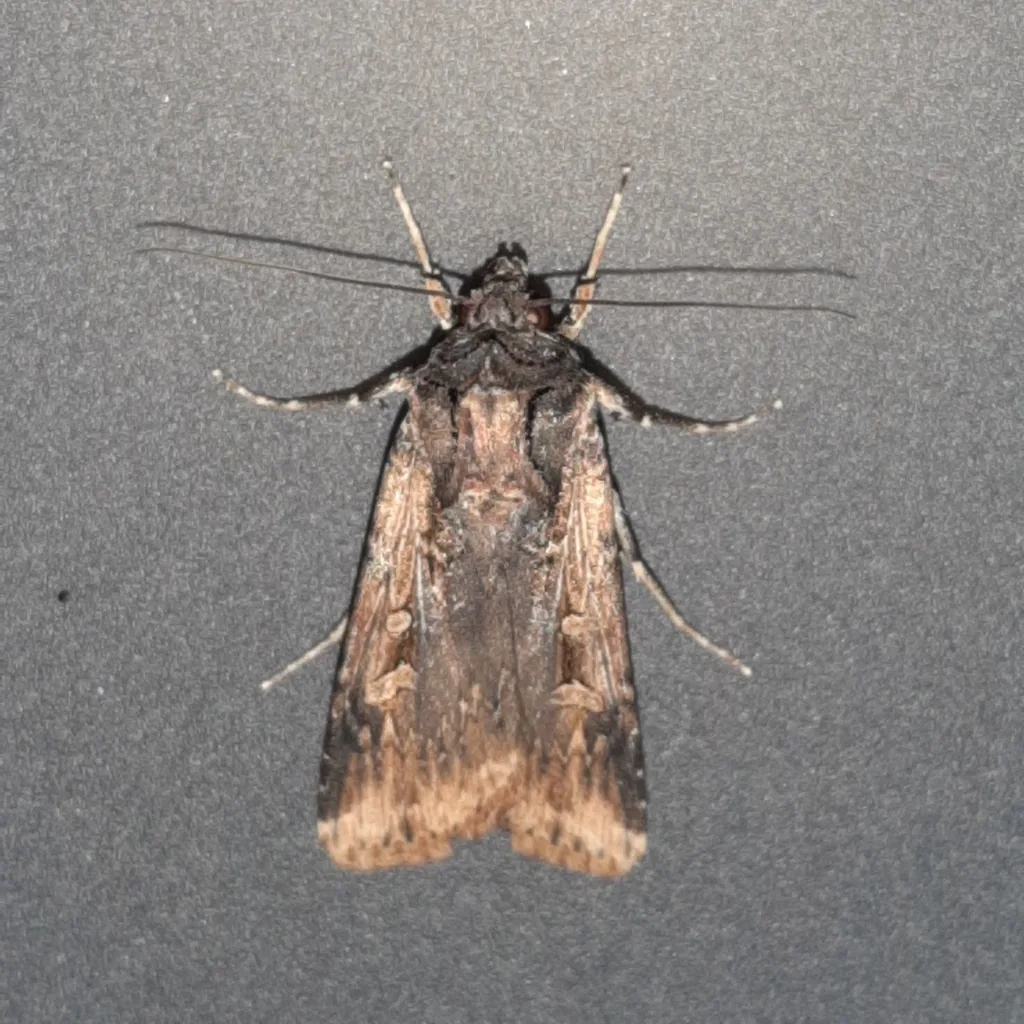
- The moth has yellowish-brown forewings and a wingspan of 1 1/2 to 1 3/4 inches. UF/IFAS gives a wingspan of 31 to 43 mm (1 1/4 to 1 5/8 in). Forewings vary in shades of brown and gray, are often yellowish brown and lighter toward the tip, and bear a bean-shaped and a round spot joined by a small, sharp black bar; hind wings are white, dusky at the edges and along the veins.[1][4]
- Cutworm eggs are white and laid singly or in small clusters, and the pupae, formed in the soil, are dark brown or mahogany and about 3/4 inch long. UF/IFAS says granulate cutworm eggs are hemispherical with 36 to 40 narrow ridges, 0.60 to 0.71 mm across, white at first and darkening with age; pupae are 15 to 21 mm (5/8 to 7/8 in) long and lie 3 to 12 cm deep in the soil.[1][4]
Look-alikes
| Look-alike | How to tell them apart |
|---|---|
| Black cutworm | Black cutworm larvae are dark greasy gray to black, covered with smooth black granules, and grow to 1 1/2 to 1 3/4 inches. UC IPM adds that the black cutworm may tunnel into the soil, dragging plant parts with it.[1][2] |
| Variegated cutworm | Variegated cutworm larvae have a distinct pale yellow dot on the middle of the back of each segment and grow to about 2 inches; young ones climb plants to feed on leaves.[1] |
| Corn earworm (cotton bollworm) | On cotton, granulate cutworm eggs are sometimes mistaken for eggs of the more serious cotton bollworm; UF/IFAS says telling them apart may avoid an unnecessary treatment.[4] |
| Tobacco budworm | Its eggs on cotton can also be confused with granulate cutworm eggs, UF/IFAS notes, and the budworm is the more serious pest there.[4] |
Where it lives
Specht and colleagues map it from Nova Scotia, Canada, to Rio Grande do Sul in southern Brazil, including Bermuda and the Caribbean islands. NC State Extension says it is more abundant southward, and that in North Carolina cutworms are more of a problem in the coastal plain. UF/IFAS calls it native to the Western Hemisphere and mainly tropical: occasionally found as far north as the northern US and southern Canada but apparently not breeding there, not known from the northwestern US, regular south of the Ohio River and most frequent in the southernmost states from Georgia to California.[3][1][4]
Biology and life cycle
Cutworms spend the winter as larvae or pupae. Overwintered larvae feed in early spring and pupate in the soil, and moths emerge two to four weeks later. Females lay hundreds of eggs at night on the undersides of leaves, and in warm weather the eggs hatch in three to five days. In the South it can be found all year: UF/IFAS says adults, eggs and larvae have been collected in every month in Louisiana and Florida, with Florida adults most common April to June. Tennessee has three generations, with pupae of the September generation overwintering, while farther south it is thought to breed almost continuously. The full life cycle normally takes 50 to 70 days.[1][4]
Larvae feed for three to four weeks before pupating in the soil, and most cutworms complete three or four generations a year in North Carolina. For this species, UF/IFAS says young larvae stay on foliage day and night for a few days before hiding by day under debris or very shallowly in soil, sometimes partly exposed. There are five to seven instars, most often six, and larval development takes about 25 days with six instars, 22 with five and 32 with seven.[1][4]
In a laboratory study at 25°C, the egg stage lasted 3 days, the larval stage about 17 days and the pupal stage about 13 days. All larvae went through five instars, and adult pairs lived 6 to 18 days. UF/IFAS, citing other studies, gives egg hatch in 3 to 5 days, a pupal stage of 10 to 20 days, mating about 1 day after emergence and adult life of 10 to 20 days, averaging about 14.[3][4]
Larvae can feed on debris and survive for weeks without food, then move off in search of host plants. Some cutworms start out on winter weeds and switch to transplants once those weeds are tilled under.[3][5]
Females produce 800 to 1,600 eggs, laid singly or in small clusters on the upper surface of leaves, UF/IFAS says.[4]
Damage and signs
- Larvae hide under dirt clods and in soil cracks by day and come out at night to cut off young plants near the ground, either eating them on the spot or dragging them below the soil to eat later. They also destroy emerging seedlings of peas, beans and okra. UF/IFAS adds that larvae through about the second instar feed on the underside of leaves and skeletonize them, then eat whole leaves; a six-instar larva eats about 150 sq cm (23.3 sq in) of foliage and a seven-instar larva up to 240 sq cm (37.2 sq in).[1][5][4]
- Injury includes lost seedlings, chewed leaves, and boring into fruit and stems. UF/IFAS says older larvae climb to feed on foliage and feed on or burrow into fruit such as tomato, watermelon and eggplant, and because it feeds at the soil surface it is sometimes a major part of the rindworm complex that damages cucurbit fruit lying on the soil.[3][4]
- Specht and colleagues list 159 host plants in 41 families, led by legumes, grasses, the aster family, cabbage-family crops and the nightshade family. Many are native weeds, which can be a source of infestation for nearby crops. UF/IFAS lists vegetables from bean, cabbage and carrot to sweet potato, tomato and watermelon; crops such as alfalfa, cotton, peanut, soybean, strawberry and tobacco; and weeds such as thorny amaranth, cocklebur, dandelion, passion vine, plantain and shepherd's purse.[3][4]
Health risk
It feeds on plants; none of these sources reports a risk to people or pets.[1][3]
Control
Prevention
Destroy crop residues, keep the garden weed-free in winter, and plant a few more than you need to allow for some losses. Farm guidance cited by Specht and colleagues is to kill weeds 4 to 6 weeks before planting so larvae don't move from weeds to the crop.[2][3]
Moth numbers can be monitored with blacklight traps, UF/IFAS says.[4]
Keep them out
Put collars of cardboard, wax paper or aluminum foil around transplants, pushed about an inch into the soil and standing a couple of inches above it. UF/IFAS notes that moths easily get around barriers during the growing season, so netting or row cover may also be needed to keep egg-laying moths off plants in the home garden.[5][2][4]
Traps and physical control
Dig through the top inch or so of soil around a cut plant to find the caterpillar, or hand-pick them at night with a flashlight.[5][2]
Biological control
Microbes, predators, parasitoids, bats and birds all attack cutworms, including this species. UF/IFAS lists braconid and ichneumonid wasps and tachinid flies that parasitize it, plus a microsporidian disease reported from Florida and a granulosis virus, though the importance of natural pathogens is uncertain.[3][4]
Pesticides
Inspect new transplants often, since damage happens fast. NC State Extension notes a bait may be used in infested beds; Mississippi State Extension suggests spraying a six- to eight-inch band of soil around each transplant with bifenthrin or permethrin right after planting and watering. Read and follow the label. UF/IFAS says baits, particularly bran-based baits, seem particularly effective against the larvae.[1][5][4]
Where sources disagree
Underground or not: Specht and colleagues describe granulate cutworm larvae moving beneath the soil surface by day, which shelters them from natural enemies and from sprays on the foliage. UC IPM says that, unlike the black cutworm, the granulate cutworm does not tunnel into the soil. UF/IFAS says the larva buries itself very shallowly, even remaining partly exposed by day.[3][2][4]
Eggs per female: NC State says cutworm females lay hundreds of eggs on the undersides of leaves; UF/IFAS says granulate cutworm females produce 800 to 1,600 eggs on the upper surface of foliage.[1][4]
Instars and adult life: in Specht and colleagues' lab study at 25°C, all larvae had five instars and adult pairs lived 6 to 18 days; UF/IFAS says six instars is most common (five to seven) and adults live 10 to 20 days, averaging about 14.[3][4]
Wingspan: NC State gives 1 1/2 to 1 3/4 inches; UF/IFAS gives 31 to 43 mm (1 1/4 to 1 5/8 in).[1][4]
Northern range: Specht and colleagues map it north to Nova Scotia; UF/IFAS says it is occasionally found as far north as the northern US and southern Canada but appears not to breed at those latitudes.[3][4]
Weeds: Mississippi State says some cutworms start on winter weeds, and Specht and colleagues note many of its hosts are native weeds; UF/IFAS says many cutworm species have a great affinity for weedy fields but the granulate cutworm seems to lack this association.[5][3][4]
Common questions
- What's cutting my seedlings at night in the South?
- Often a cutworm, and the granulate cutworm is more abundant in the South. Dig through the top inch of soil around a cut plant to find the caterpillar. UF/IFAS calls it the most commonly occurring cutworm in Florida.[1][5][4]
- Do baits work?
- NC State Extension lists a bait as an option for infested plant beds and new transplants. UC IPM leans on collars, hand-picking at night, and Bacillus thuringiensis or spinosad sprays on larger plants. UF/IFAS says bran-based baits seem particularly effective.[1][2][4]
Sources
- NC State Extension Publications, “Pests of Tomato (Cutworms section).” content.ces.ncsu.edu/publication/pests-of-tomato (accessed 2026-11-14)
- University of California Statewide IPM Program, “Cutworms (Home and Landscape).” ipm.ucanr.edu/home-and-landscape/cutworms/ (accessed 2026-11-14)
- Journal of Insect Science, via PubMed, “The Granulate Cutworm (Lepidoptera: Noctuidae): Biological Parameters Under Controlled Conditions, Host Plants, and Distribution in the Americas (Specht et al. 2020).” pubmed.ncbi.nlm.nih.gov/33159527/ (accessed 2026-11-14)
- University of Florida/IFAS Extension (Featured Creatures), “Granulate Cutworm, Feltia subterranea (Fabricius), EENY-559/IN997.” ask.ifas.ufl.edu/publication/IN997 (accessed 2026-11-14)
- Mississippi State University Extension, “Granulate Cutworm, Vol. 2, No. 6.” extension.msstate.edu/newsletters/bugs-eye-view/2016/granulate-cutworm-vol-2-no-6 (accessed 2026-11-14)
- iNaturalist, “Feltia subterranea taxon page (order and family).” www.inaturalist.org/taxa/152979 (accessed 2026-11-14)