On this page
How to identify it
- Full-grown caterpillars vary a lot in color: green, yellow, pink, red, tan, maroon, brown or nearly black, with paler or darker stripes along the body. UC IPM and Clemson put their length at about 1 1/2 inches; Wisconsin says up to 2 inches. UF/IFAS says the body is usually marked with a broad dark stripe along each side above the breathing pores and a light yellow to white stripe below them, often with a pair of narrow dark stripes along the center of the back.[1][2][5][3][6]
- The head is plain, without spots: brown according to Kentucky, yellow according to Wisconsin. UF/IFAS describes it as orange or light brown with a white net-like pattern.[1][2][6]
- The skin is covered with tiny spines that make older caterpillars feel rough to the touch; a hand lens shows them best.[1][4]
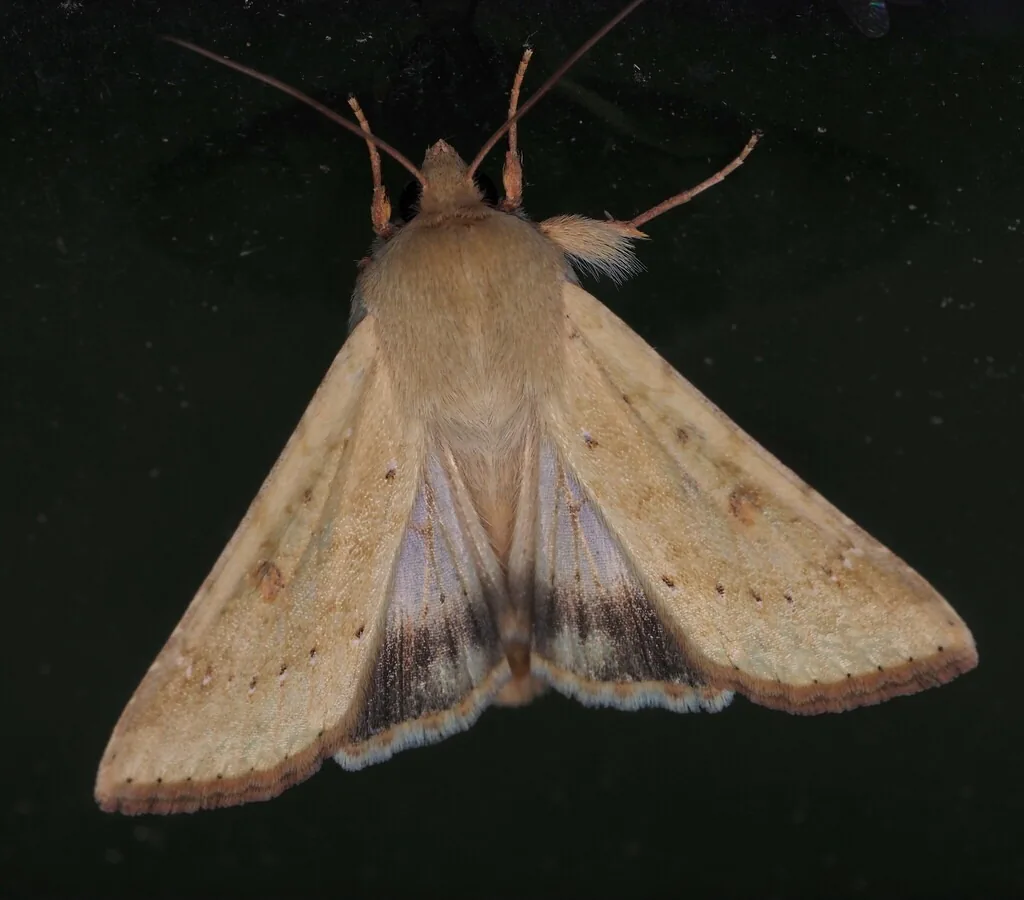
- The moth spans about 1 to 1 1/2 inches. Males are usually light yellowish olive and females yellowish brown to pinkish brown, each forewing has a dark spot near the center, and the hind wings are dull white with a dark gray band near the edge. UF/IFAS gives a wingspan of 32 to 45 mm and says the forewing spot is especially distinct seen from below; the hind wings are creamy white near the body and blackish toward the edge.[1][4][5][6]
- Eggs are tiny, round and ribbed, and laid one at a time. They are white or cream when laid and develop a reddish brown ring after about a day. UF/IFAS gives a diameter of about 0.5 to 0.6 mm.[4][5][2][6]
Look-alikes
| Look-alike | How to tell them apart |
|---|---|
| Fall armyworm | A fall armyworm has a pale, upside-down Y on the front of its head and sometimes four black dots on the back of each abdominal segment. A corn earworm's head is unmarked, and its skin is covered with tiny spines. UF/IFAS adds that fall armyworm and European corn borer, the other common corn caterpillars, lack the spines and have dark heads.[7][1][6] |
| Tobacco budworm | A close relative that is very hard to tell apart as a caterpillar without magnification; the youngest caterpillars can't be separated at all. The adult moths can usually be told apart by wing color. UF/IFAS says tobacco budworm rarely is a vegetable pest and never feeds on corn; under magnification its spines on certain body segments are about half the height of the bumps they sit on, versus a quarter or less in corn earworm.[8][6] |
Where it lives
It occurs throughout the Western Hemisphere, from Canada to Argentina. Pupae can survive the winter only up to roughly the 40th parallel; farther north they die from spending too long at near-freezing temperatures. In Wisconsin few survive the winter, and most earworms there come from moths that fly north from the Gulf States, so late-summer flights are the damaging ones. GBIF has about 13,500 U.S. records since 1990, most from Texas, then Colorado, Oklahoma, Illinois, Missouri, Ohio, Indiana and Wisconsin. UF/IFAS says it is found throughout North America except northern Canada and Alaska. In the East it normally survives winter only to about 40 degrees north latitude, about Kansas, Ohio, Virginia and southern New Jersey, but it is highly dispersive and spreads north from southern states every year; in the milder Pacific Northwest it can overwinter at least as far north as southern Washington.[3][9][2][10][11][6]
Biology and life cycle
The moths are most active in the evening and at night. Females lay single eggs on leaves and especially on fresh corn silk, and Wisconsin says each female can lay up to 1,000 eggs. UF/IFAS gives 500 to 3,000 eggs per female, up to 35 a day, and says egg-laying starts about three days after the moth emerges; even ears with dry silk receive eggs.[5][1][2][6]
Hatch time depends on temperature. Wisconsin gives 1 to 8 days and says eggs can hatch within 24 hours in hot weather; UC IPM gives 5 to 7 days for sweet corn. UF/IFAS says about three to four days.[2][5][6]
The caterpillars are cannibals, so you rarely find more than one in an ear or a fruit. UF/IFAS notes that young caterpillars are not cannibalistic, so several may feed together at first; they turn aggressive as they mature.[1][2][3][6]
Caterpillars finish feeding in about two weeks (14 to 16 days in Kentucky), drop to the ground and pupate 1 to 9 inches deep in the soil. The moth comes out about two weeks later, so a generation takes about 30 days in midsummer. UF/IFAS puts the pupal chamber 5 to 10 cm (2 to 4 in) below the surface and the pupal stage at about 13 days in summer (range 10 to 25).[1][2][6]
Kentucky usually sees about four overlapping generations a year, with egg-laying moths around for most of the season. UF/IFAS lists about one generation a year in northern areas such as most of Canada, Minnesota and western New York, two in the northeastern states, four to five in Louisiana and southern California, and perhaps seven in southern Florida and southern Texas.[1][6]
UF/IFAS says the moths are mainly nocturnal and hide in vegetation by day, though they sometimes feed on nectar, and adults are reported to live five to 15 days.[6]
Damage and signs
- In corn, young caterpillars feed on the silks, clipping them off, then move into the tip of the ear and eat kernels, leaving a mess of droppings. The damaged tip also draws sap beetles. UF/IFAS says injury may stay at the tip or extend half the length of the ear, the feeding helps plant-disease fungi get started, and caterpillars may bore straight into ears that have not yet produced silk.[5][2][1][6]
- In tomatoes, young caterpillars bore in at the stem end, preferring green fruit, and leave a messy, watery cavity full of droppings and shed skins. Damaged fruit ripens early, and one caterpillar may move through several small fruits. UF/IFAS adds that tomatoes are more likely to be hit when corn is not silking, since moths prefer to lay on fresh corn silk; bean, cantaloupe, cucumber, squash and pumpkin can be injured the same way.[4][3][6]
- Numbers build as summer goes on: UC IPM says it is most abundant in August and September, and Kentucky says late-season sweet corn is at greatest risk. UF/IFAS says throughout its range populations are highest, and most damaging, late in the growing season, and it does the most harm where it overwinters.[5][1][4][6]
- A 2016 review found that it has become a much bigger problem in U.S. sweet corn over the past two decades.[12]
- UF/IFAS says corn and tomato are perhaps its favorite vegetable hosts, but it also attacks artichoke, asparagus, cabbage, cantaloupe, cucumber, eggplant, lettuce, lima bean, melon, okra, pea, pepper, potato, pumpkin, snap bean, spinach, squash, sweet potato and watermelon, plus field crops such as sorghum, soybean and cotton and fruits and flowers including strawberry, rose and geranium.[6]
Health risk
The extension sources describe it only as a pest of corn, tomatoes and other crops. The harm is to the harvest: ruined ear tips and tomatoes.[1][4][3]
Control
Prevention
Plant sweet corn early. Early and midseason plantings face fewer moths and need fewer treatments than corn that silks in late summer. UF/IFAS notes that in northern areas it is sometimes possible to plant or harvest early enough to escape injury.[1][5][6]
Varieties with long, tight husks tend to get less damage than those with loose husks. UF/IFAS says resistance comes from husk tightness and ear length, which block access to the kernels, or from chemical factors such as maysin, but it is not complete on its own.[1][6]
Tillage, especially in autumn, can significantly reduce how many pupae survive the winter in southern locations, UF/IFAS says.[6]
Biological control
Trichogramma wasps and other parasites kill many eggs, and minute pirate bugs, lacewings and damsel bugs eat eggs and small caterpillars. Parasitized eggs usually turn black, so check for them before spraying tomatoes. UF/IFAS reports that releases of Trichogramma egg parasites in California and Florida reached 40 to 80% parasitism, with fruit damage of about 3%, and that tomato is especially suited to such releases.[4][5][2][6]
An organic option described by Wisconsin Extension combines Bt with vegetable oil in a single applicator; timed correctly, it can give 80 to 90 percent control.[2]
UF/IFAS says commercially available insect-attacking nematodes give good suppression of developing caterpillars when applied to corn silk, which suits home gardens.[6]
Pesticides
Treat at egg hatch, while caterpillars are still on the silks or leaves. Once they are inside the ear or fruit, sprays can't reach them. In corn, start when silks first appear.[5][1][2][4]
Bt and spinosad are acceptable for organic growing. Some earworm populations in the Midwest resist pyrethroids, the class most often used on sweet corn. UF/IFAS says it has become resistant to many insecticides because it is treated so often over such a wide area, and resistance to Bt corn is increasingly a problem.[4][5][1][2][6]
In home gardens, UF/IFAS says mineral oil applied to the corn silks five to seven days after silking has insecticidal effects and can give good control.[6]
Where the sources disagree
Eggs per female: Wisconsin says up to 1,000; UF/IFAS gives 500 to 3,000.[2][6]
Egg color: UC IPM and Wisconsin describe eggs as white or cream, developing a reddish brown ring; UF/IFAS says they are pale green when laid, turning yellowish and then gray.[4][5][2][6]
Head color: Kentucky says brown and Wisconsin yellow, both unspotted; UF/IFAS says orange or light brown with a white net-like pattern.[1][2][6]
Common questions
- How much of the ear does an earworm ruin?
- Usually just the tip. The caterpillar stays near the end of the ear, but it eats kernels and fouls the tip with droppings, so damaged tips are usually cut off, and the damage draws sap beetles. UF/IFAS says injury can extend half the length of the ear.[2][5][1][6]
- Are corn earworm and tomato fruitworm the same insect?
- Yes. Helicoverpa zea is called corn earworm, tomato fruitworm or cotton bollworm, depending on the crop.[3][2]
- Why doesn't spraying my corn stop earworms?
- Newly hatched caterpillars move down the silks into the ear within a day or so, where sprays can't reach them. Spraying only helps when it is timed to egg hatch, and late-season corn needs the most protection.[1][5][2]
- Do natural enemies control corn earworm?
- Only partly. UF/IFAS says over 100 insect species have been seen feeding on it and eggs may be heavily parasitized, but natural enemies usually don't prevent crop injury.[6]
Sources
- University of Kentucky Entomology, “ENTFACT-318: Corn Earworm Management in Sweet Corn (R. Bessin, rev. 1/26).” entomology.mgcafe.uky.edu/ef318 (accessed 2026-11-14)
- University of Wisconsin-Extension, “Corn earworm (A3655, Delahaut, Cullen and Wedberg).” hort.extension.wisc.edu/files/2014/11/A3655.pdf (accessed 2026-11-14)
- Clemson Cooperative Extension, Home & Garden Information Center, “Tomato Insect Pests (HGIC factsheet).” hgic.clemson.edu/factsheet/tomato-insect-pests/ (accessed 2026-11-14)
- University of California Statewide IPM Program, “Tomato Pest Management Guidelines: Tomato Fruitworm.” ipm.ucanr.edu/agriculture/tomato/tomato-fruitworm/ (accessed 2026-11-14)
- University of California Statewide IPM Program, “Corn Earworm (Corn Pest Management Guidelines).” ipm.ucanr.edu/agriculture/corn/corn-earworm/ (accessed 2026-11-14)
- University of Florida/IFAS Extension (Featured Creatures), “Corn Earworm, Helicoverpa zea (Boddie), EENY-145/IN302.” ask.ifas.ufl.edu/publication/IN302 (accessed 2026-11-14). Its mineral-oil amount and spray-interval lines are not used (no rates).
- NC State Extension, “Fall Armyworms in Turf.” content.ces.ncsu.edu/fall-armyworm-in-turf (accessed 2026-11-14)
- NC State Extension, “Tobacco Budworms.” content.ces.ncsu.edu/tobacco-budworms (accessed 2026-11-14)
- Environmental Entomology, via PubMed, “Cold hardiness of Helicoverpa zea pupae (Morey et al. 2012).” pubmed.ncbi.nlm.nih.gov/22525073/ (accessed 2026-11-14)
- Global Biodiversity Information Facility (GBIF), “Helicoverpa zea: U.S. occurrence records since 1990 by state (GBIF occurrence search).” api.gbif.org/v1/occurrence/search?taxonKey=1792564&country=US&hasGeospatialIssue=false&occurrenceStatus=PRESENT&year=1990%2C2026&facet=stateProvince&facetLimit=400&limit=0 (accessed 2026-11-14). Exact count at access: 13,451 U.S. records since 1990 (Texas 4,013; Colorado 1,053; Oklahoma 957; Illinois 919; Missouri 465; Ohio 355; Indiana 354; Wisconsin 341).
- Global Biodiversity Information Facility (GBIF), “Helicoverpa zea: occurrence records since 1990 by country (GBIF occurrence search).” api.gbif.org/v1/occurrence/search?taxonKey=1792564&hasGeospatialIssue=false&occurrenceStatus=PRESENT&year=1990%2C2026&facet=country&limit=0 (accessed 2026-11-14). Exact counts at access: 14,567 records since 1990; United States 13,451, Canada 733, Brazil 140, Mexico 123, Argentina 28.
- Journal of Economic Entomology, via PubMed, “Biology, Ecology, and Evolving Management of Helicoverpa zea in Sweet Corn in the United States (Olmstead, Nault and Shelton 2016).” pubmed.ncbi.nlm.nih.gov/27329622/ (accessed 2026-11-14)
- iNaturalist, “Helicoverpa zea taxon page (order and family).” www.inaturalist.org/taxa/118492 (accessed 2026-11-14)