On this page
How to identify it
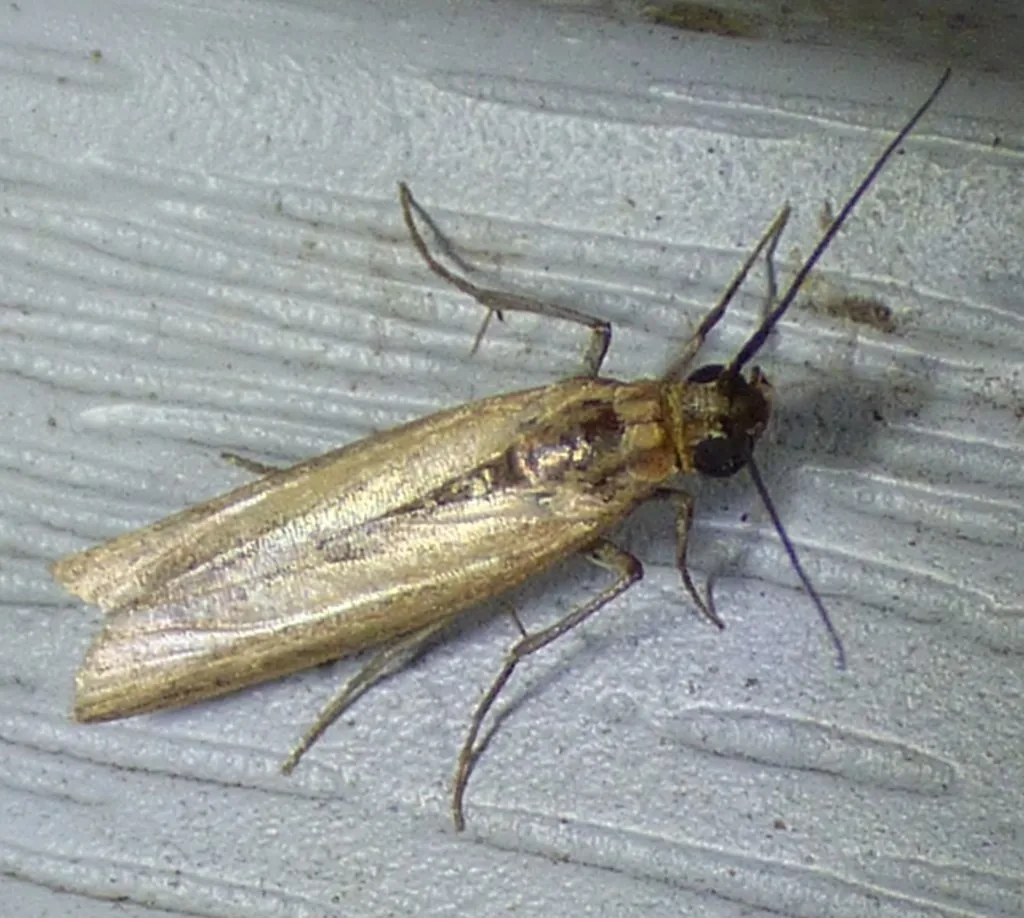
- Adults are small, slender, silver to buff-gray moths about 1/2 to 5/8 inch long, often seen resting on sunflower heads in early morning and evening during bloom.[1][2]
- Newly hatched larvae are pale yellow; older ones turn brown or purplish with light stripes running lengthwise and reach about 3/4 inch.[1][3]
- Infested heads look trashy, with webbing across the face of the head.[1]
- At rest the moth holds its wings tightly against the body; South Dakota State gives a wingspan of 1/2 to 1 inch.[5]
Where it lives
It is a pest of field sunflowers from Texas north through Nebraska and South Dakota, where moths arrive each year from the southern United States, and UMass Extension describes the same caterpillar damaging garden echinacea and sunflowers.[1][2][5][3]
Biology and life cycle
Moths are drawn to plants just starting to bloom; nearly 80 percent of eggs are laid within 4 to 7 days after the buds open, and they hatch in 24 to 72 hours. South Dakota State says a female can lay up to 400 eggs near the base of the florets.[1][5]
Young larvae feed on pollen and florets for about 5 to 6 days, then tunnel into the seeds; Texas A&M says a single larva can destroy up to 12 seeds over its 15 to 19 days of feeding.[1][3]
Most full-grown larvae drop to the ground on silk threads and pupate in crevices or under leaf litter, and some larvae spend the winter underground.[3]
In Texas, infestations are heaviest when early-planted fields bloom in May and June, with a smaller flight later in the season.[1]
The moths do not overwinter in the north: they spend winter in the southern United States and fly north each season, reaching South Dakota during bloom. In Nebraska a second generation of adults emerges two to three weeks after the first infestation.[5][2]
Fun fact: female sunflower moths start their mating calls at a younger age when sunflower pollen is nearby, and they then call longer and mature eggs faster. They respond to the pollen's scent even when they cannot touch it.[6]
Damage and signs
- Larvae destroy seeds and head tissue, and their feeding can open heads to head rot; in gardens, infested echinacea flowers fade fast and set no seed heads.[1][3]
- Larval feeding opens heads to Rhizopus head rot, which South Dakota State calls the main source of yield loss from this moth; Texas A&M says the disease can cut yields up to 50 percent. Damaging outbreaks are not common in western Nebraska but occur every 7 to 10 years.[5][1][2]
Health risk
It feeds only on plants; Texas A&M, Nebraska, UMass and South Dakota State Extension mention no risk to people or pets.[1][2][3][5]
Control
Prevention
In Nebraska, sunflowers planted after June 1 usually escape the main moth flight.[2]
In South Dakota, later planting dates reduce the chance that moths reach damaging numbers. Scout heads for moths in the early morning or early evening, when they are easiest to find.[5][2]
Biological control
On garden flowers, Bacillus thuringiensis subsp. kurstaki can be used on young larvae before they tunnel into the seeds.[3]
Pesticides
For field sunflowers, Texas A&M says insecticides should go on when 15 to 25 percent of plants are blooming and moths are in the field, a narrow window because bloom moves fast; Nebraska notes pyrethroids can help protect the heads. South Dakota State advises spraying in the evening, when moths are most active and pollinators less so. Follow the label.[1][2][5]
Where sources disagree
Seeds per larva: Texas A&M says up to 12 seeds, South Dakota State 3 to 12, and Nebraska an average of 4 to 6.[1][5][2]
Young larva color: Texas A&M and UMass describe newly hatched larvae as pale yellow; South Dakota State describes the caterpillars as black with light stripes and an orange head, turning light brown with white stripes as they mature.[1][3][5]
Adult size: Texas A&M gives about 1/2 inch long, Nebraska 5/8 inch long, and South Dakota State a wingspan of 1/2 to 1 inch.[1][2][5]
Common questions
- What is eating the centers of my echinacea and sunflowers?
- Possibly sunflower moth caterpillars, which feed on the florets and then tunnel into the developing seeds.[3][1]
- When are sunflower moths active?
- During bloom: moths lay most of their eggs within a week after buds open, so that's the time to watch.[1][2]
- Can I spray sunflower moth caterpillars once they are inside the seeds?
- Sprays work best before then. UMass recommends Bacillus thuringiensis subsp. kurstaki on young larvae, and Texas A&M notes the young larvae are exposed on the flower surface only for their first 5 to 6 days.[3][1]
Sources
- Texas A&M AgriLife Extension, “Sunflowers, E-579 (insect pests of sunflower).” extensionentomology.tamu.edu/wp-content/uploads/2021/09/E-579-Sunflowers.pdf (accessed 2026-11-12)
- University of Nebraska-Lincoln Extension, “Sunflower Head Moth Outbreak is Coming On Strong (CropWatch, July 26, 2012).” cropwatch.unl.edu/sunflower-head-moth-outbreak-coming-strong-unl-cropwatch-july-26-2012 (accessed 2026-11-12)
- UMass Extension Greenhouse Crops and Floriculture Program, “Sunflower Moth Caterpillar.” www.umass.edu/agriculture-food-environment/greenhouse-floriculture/photos/sunflower-moth-caterpillar (accessed 2026-11-12)
- iNaturalist, “Homoeosoma electella taxon page (order and family).” www.inaturalist.org/taxa/343382 (accessed 2026-11-12)
- South Dakota State University Extension, “Chapter 11: Sunflower Insect Pests (iGrow Sunflower, P-00205-11).” extension.sdstate.edu/sites/default/files/2021-08/P-00205-11.pdf (accessed 2026-11-12)
- Oecologia (1989), via PubMed, “Host plant pollen influences calling behavior and ovarian development of the sunflower moth, Homoeosoma electellum.” pubmed.ncbi.nlm.nih.gov/28313107/ (accessed 2026-11-12). Cited from the PubMed abstract.