On this page
How to identify it
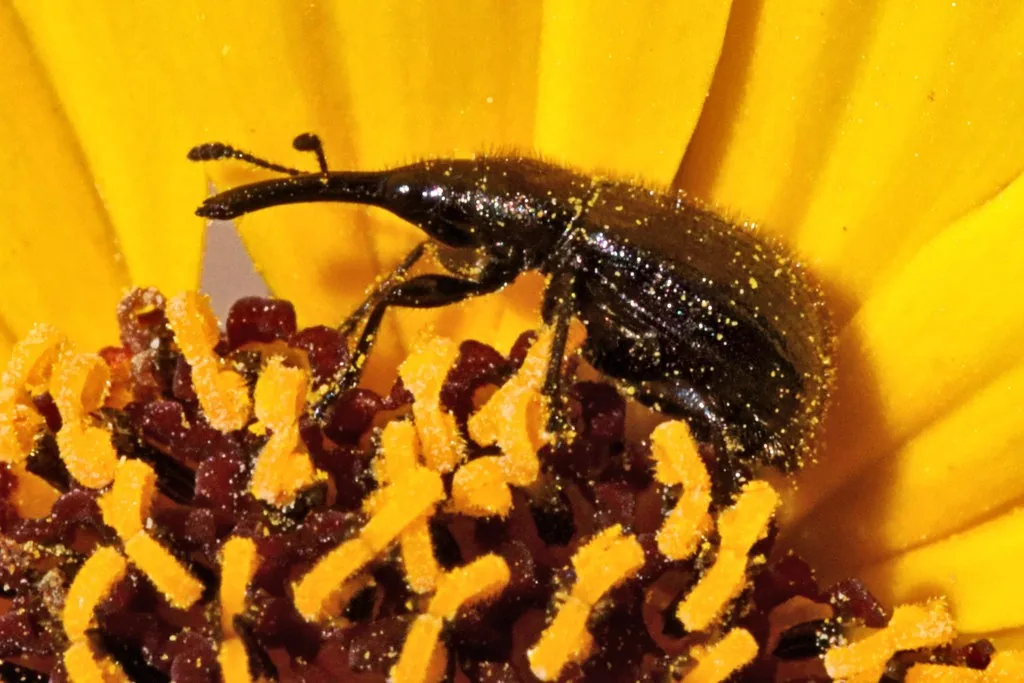
- The adult is a shiny black, slightly hairy weevil about 1/3 inch long, with a long, curved snout and fairly soft wing covers. South Dakota State notes a slight bronze luster that is characteristic of the species.[1][2][3]
- The damage is the easiest way to recognize it: flower heads, and sometimes leaves, hang partly severed from the plant. Open a clipped head and you will often find pairs of adult weevils covered in pollen.[1][2]
- Larvae are about 1/4 inch long, C-shaped and yellow or cream colored with a brown head. They are found developing in fallen sunflower heads.[2]
Where it lives
Colorado State describes it as widespread in eastern Colorado, Kansas State reports it in Kansas sunflower fields, and South Dakota State calls it an occasional pest of sunflower in South Dakota. Colorado State cites losses of up to 25% recorded in individual fields in North Dakota. It is associated with native sunflowers, especially the common sunflower, and in Illinois tallgrass prairies it lives on Silphium plants.[2][1][3][4]
Biology and life cycle
There is one generation a year. Adults emerge in early summer and are on sunflowers by July, as the plants approach bloom, feeding on pollen; South Dakota State says they are active in July and August and each adult stays active for 2 to 3 weeks.[1][2][3]
Only females are thought to do the clipping. Before laying eggs, a female punctures and girdles the stalk below a developing flower so the head droops; if buds are not yet available, weevils sometimes cut leaf stalks instead. Kansas State suggests the clipping may make the head less suitable for other flower-feeding insects that would compete with the larvae.[1][2]
Eggs are laid in the hanging head. Kansas State says they are thought to hatch only after the head falls to the ground. The larvae feed on the decaying head, along with flowers and pollen, through four stages.[1][2]
Where the larvae spend the winter differs by source (see Where the sources disagree). They pupate the following year and emerge as adults in early summer.[1][2][3]
Besides sunflowers, it occasionally attacks related plants. In Illinois prairies, adults fed and laid eggs on three Silphium species and strongly preferred Silphium terebinthinaceum; the larvae feed on the developing seeds.[2][4]
In a study of wild common sunflowers, headclipping weevil damage was highest early in the flowering season and hurt plant fitness, so plants that bloomed when the weevils were less abundant did better.[5]
Damage and signs
- Adults girdle the flower stalks and leaf petioles, leaving flower heads partly severed and hanging.[1][2]
- In home gardens the damage is generally aesthetic. In fields it usually affects only a small share of plants in border rows or along field margins, with about 1 to 3% of heads clipped, although losses up to 25% have been recorded in individual North Dakota fields and the weevil has been abundant enough in some years in Kansas to cause appreciable yield losses.[2][1][3]
Health risk
Kansas State, Colorado State and South Dakota State describe it only as a pest of sunflowers; no cited source describes any risk to people or pets.[1][2][3]
Control
Prevention
Scout fields for clipped, hanging heads, starting with the border rows where damage is usually concentrated. South Dakota State suggests checking several plants in different parts of the field, for example along an X pattern, and counting the adult weevils.[2][1][3]
Traps and physical control
In a garden, cut off hanging heads, open them and look for pairs of pollen-covered weevils; the larvae develop in clipped heads that fall to the ground. Colorado State notes the weevil can be difficult to manage in small gardens, and the injury there is generally aesthetic and typically needs no management.[1][2]
Pesticides
Treatment is rarely warranted, and the sources set the point for treating differently (see Where the sources disagree). Kansas State says sprays aimed at sunflower moth usually give some control; if you do treat for headclipping weevils, Kansas State and Colorado State say to direct the spray at the backs of the flower heads.[1][2]
Where the sources disagree
Size: Kansas State gives about 1.0 cm (1/3 inch), Colorado State about 8.5 mm (1/3 inch) from the rear of the abdomen to the tip of the snout, and South Dakota State approximately 1/3 inch.[1][2][3]
Overwintering: Kansas State and Colorado State say mature larvae leave the head and burrow into the soil, Colorado State putting this in October; South Dakota State says the larvae feed and develop within the detached heads, where they overwinter.[1][2][3]
Thresholds: Kansas State suggests treatment when 10% or more of heads are clipped and adults are still active; Colorado State says no specific economic thresholds have been set and mentions the Kansas figure; South Dakota State first says there are no established thresholds, then recommends one adult for every two plants scouted or more than 5% of the field's heads clipped.[1][2][3]
Common questions
- Why are my sunflower heads hanging from the stalk?
- The sunflower headclipping weevil is one likely cause. Adults girdle the stalk just under the flower head, leaving it partly severed and hanging. Open a hanging head and look for small black weevils covered in pollen.[1][2]
- Should I spray my garden sunflowers for headclipping weevils?
- Usually not. In home gardens the injury is generally aesthetic and typically needs no management. In fields, Kansas State suggests treatment only when 10% or more of heads are clipped and adults are still active, with the spray aimed at the backs of the heads.[2][1]
- Why does the weevil cut off the flower heads?
- Only females are thought to do it, and they lay their eggs in the clipped head, where the larvae develop. Kansas State suggests clipping may make the head less suitable for other insects that would compete with the larvae.[1]
- Does the headclipping weevil only attack sunflowers?
- Mostly native and cultivated sunflowers, but it occasionally attacks related plants; in Illinois prairies it feeds and lays eggs on three Silphium species.[2][4]
Sources
- Kansas State University Department of Entomology, “Sunflower Headclipping Weevil (Sunflower Insects).” entomology.k-state.edu/extension/crop-protection/sunflowers/sunflower-headclipping-weevil.html (accessed 2026-11-13)
- Colorado State University Agricultural Biology, “Sunflower headclipping weevil.” agsci.colostate.edu/agbio/ipm-pests/sunflower-headclipping-weevil/ (accessed 2026-11-13)
- South Dakota State University Extension, “Chapter 11: Sunflower Insect Pests, P-00205-11 (A. Varenhorst, P. Rozeboom and P. Wagner, July 2021).” extension.sdstate.edu/sites/default/files/2021-08/P-00205-11.pdf (accessed 2026-11-13)
- Environmental Entomology, via PubMed, “Consequences of habitat fragmentation for the prairie-endemic weevil Haplorhynchites aeneus (Kluger et al. 2011).” pubmed.ncbi.nlm.nih.gov/22217753/ (accessed 2026-11-13). Cited from the PubMed abstract.
- Oecologia, via PubMed, “Herbivory and natural selection on flowering phenology in wild sunflower, Helianthus annuus (Pilson 2000).” pubmed.ncbi.nlm.nih.gov/28307959/ (accessed 2026-11-13). Cited from the PubMed abstract.
- Global Biodiversity Information Facility (GBIF), “Haplorhynchites aeneus (Boheman, 1829) (GBIF Backbone Taxonomy).” api.gbif.org/v1/species/4292477 (accessed 2026-11-13)