On this page
How to identify it
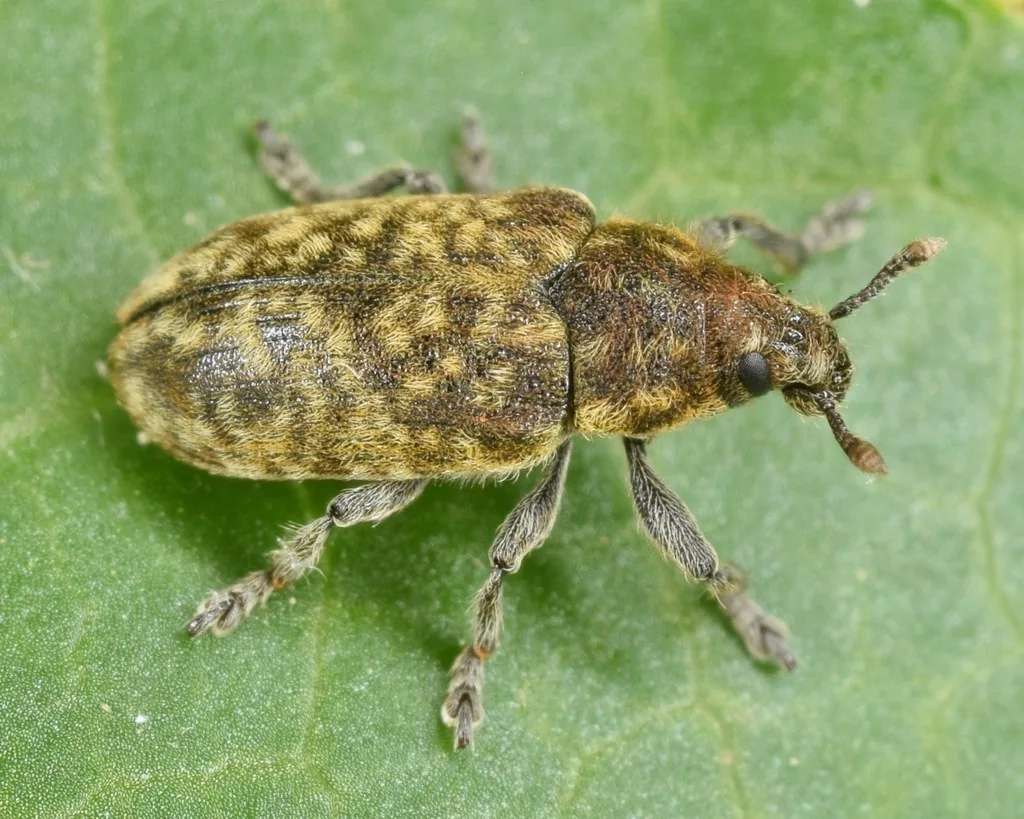
- Adults are up to 6 mm long, dark brown or black with tufts of yellowish hair that give them a mottled look in spring. As they age they lose some of the hairs and turn brownish black.[1]
- The eggs are the easiest sign: laid on buds, stems and the bracts of the flower heads, each is covered with chewed plant material that becomes tan with age and looks like part of the plant.[1]
- Larvae are white, C-shaped grubs with a brown head, up to 4 mm long, feeding inside the seed heads; several larvae typically share one head.[1]
- Adult feeding leaves rounded holes over the whole leaf surface, though this damage is typically minor.[1]
Look-alikes
| Look-alike | How to tell them apart |
|---|---|
| Musk thistle crown weevil (Trichosirocalus horridus) | The other weevil released against musk thistle (from 1974 in the eastern US and 1975 in Canada): about 4 mm, round, brown with white mottling, with obvious spines on the thorax and a long snout. Its larvae feed at the root-stem junction rather than in the seed heads, and the field guide says the seedhead weevil is effective on musk thistle in the eastern US in combination with this weevil and plant competition. IBiocontrol says the crown weevil has also been seen feeding on native Cirsium thistles, so interstate transport is not permitted in the USA and some states prohibit its redistribution.[1][6] |
| Thistle head weevil (Larinus carlinae) | Another weevil whose larvae develop in thistle flower heads; the field guide notes that seedhead weevil adults have shorter snouts than Larinus carlinae.[1] |
Where it lives
Three strains collected from three thistle hosts in France and Italy were released in the US from 1969 on musk, plumeless, Scotch, Italian, slenderflower and milk thistle (the Scotch thistle releases failed), and weevils from France went onto plumeless and musk thistle in Manitoba, Ontario and Quebec from 1968. It spread naturally to bull and Canada thistle in the western US, and naturally and by redistribution to bull, Canada and marsh thistle in western Canada and bull thistle in Ontario. It does best in meadows and moist areas with moderate temperatures; where summer arrives quickly it cannot use the later-developing flower heads. IBiocontrol, summarizing the 2024 NAISMA review, gives its native range as Europe and lists its North American hosts as musk, plumeless, Italian, slenderflower, milk, bull, Canada and marsh thistle.[1][5]
Biology and life cycle
Overwintered adults emerge in early spring and lay eggs on the bracts of the developing flower heads and on the stems.[1]
Larvae hatch in late spring and early summer, develop through four instars and burrow into the seed heads, where they feed on the receptacle tissue and developing seeds. IBiocontrol adds that the larvae burrow through the bracts or mine the plant stems until they reach the seed head.[1][5]
They pupate inside the heads in late summer as the seeds mature. The new adults are out only briefly before overwintering in sheltered areas. There is one generation a year.[1]
It typically prefers Carduus thistles (musk, plumeless, Italian and slenderflower) over other thistles. On plumeless thistle only the early flower heads are attacked, so impact is usually low, and on Canada thistle it is largely ineffective because cutting seed does not stop the plant spreading by its roots.[1]
Damage and signs
- Larval feeding destroys some of the seed. Seed consumption does not kill existing plants, but it does help reduce the rate of thistle spread.[1]
- A study of musk thistle in the United States and New Zealand found that the weevil both reduces seed production and keeps seeds from being released and carried on the wind. The mechanism depended on the place: in the US the largest effect came through seeds falling faster, and in New Zealand through reduced seed production.[3]
- In the eastern US it is abundant on musk thistle and effective there in combination with the musk thistle crown weevil and plant competition. In western states it is abundant on Italian and slenderflower thistle and can be effective on early-blooming plants, but only with plant competition, and its impact on bull and milk thistle is minimal. In Canada it attacks over 90 percent of musk thistle flower heads, reducing seed production by about half, and is credited with controlling musk thistle, especially where plant competition is present.[1]
- It attacks 22 of the 90 Cirsium species native to the US. A review of weed biocontrol found that more than 99 percent of the 512 agents released had no known significant adverse effects on nontarget plants, and that the largest direct impacts came from two agents, the cactus moth on native cacti and this weevil on native thistles, introductions the authors say would not be permitted today.[1][2]
Health risk
It is a plant-feeding weevil. The USDA Forest Service field guide and the Ecological Applications study don't mention any risk to people or pets.[1][3]
Control
Prevention
Do not collect or move this weevil in the United States. Because it attacks native thistles, its US redistribution permits were revoked in 2000, and it is no longer approved for redistribution in the US. IBiocontrol lists it as not approved in the USA but approved in Canada.[1][5]
Biological control
Where it already occurs on musk thistle it needs no control. The field guide credits its effect on musk thistle to working alongside plant competition (and, in the eastern US, the crown weevil), and says it does best in meadows and moist areas with moderate temperatures.[1]
Where the sources disagree
How it slows spread: the field guide describes the effect as destroyed seed, while a US and New Zealand study found that in the United States the larger effect came from seeds falling faster, with reduced seed production mattering most only in New Zealand.[1][3]
Musk thistle results: for Canada the field guide credits the weevil with controlling musk thistle, especially with plant competition; for the eastern US it says the weevil is effective only in combination with the crown weevil and plant competition.[1]
How larvae reach the seed: the field guide says they burrow into the seed heads; IBiocontrol says they burrow through the bracts or mine the stems to get there.[1][5]
Common questions
- What are the tan bumps on my thistle flower heads?
- Probably egg caps of the thistle seedhead weevil. Its eggs, laid on buds, bracts and stems, are covered with chewed plant material that becomes tan with age and looks like part of the plant.[1]
- Can I move seedhead weevils to a new thistle patch?
- Not in the United States. Its redistribution permits were revoked in 2000 because it attacks native thistles, and it is no longer approved for redistribution in the US.[1]
- Will it get rid of my thistles?
- No. Seed feeding does not kill existing plants; it helps slow spread. The weevil is largely ineffective on Canada thistle and has minimal impact on bull and milk thistle in the western US, and its successes on musk thistle have come with plant competition.[1]
- Is it still approved anywhere?
- In Canada. IBiocontrol, which summarizes the 2024 NAISMA review, lists it as approved in Canada and not approved in the USA.[5]
Sources
- USDA Forest Service, Forest Health Technology Enterprise Team, “Field Guide for the Biological Control of Weeds in Eastern North America (FHTET-2016-04), by Winston, Randall, Blossey, Tipping, Lake and Hough-Goldstein (2017).” www.fs.usda.gov/foresthealth/technology/pdfs/FHTET-2016-04_Biocontrol_Field_Guide.pdf (accessed 2026-11-14). Read from the Forest Service PDF; agent entries for each weed.
- PLoS ONE, full text in PubMed Central (PMC3890286), “Suckling and Sforza. What magnitude are observed non-target impacts from weed biocontrol? PLoS ONE 9: e84847 (2014), doi:10.1371/journal.pone.0084847.” pmc.ncbi.nlm.nih.gov/articles/PMC3890286/ (accessed 2026-11-14). Read in full text through PubMed Central.
- Ecological Applications (via PubMed), “Marchetto, Shea, Kelly, Groenteman, Sezen and Jongejans. Unrecognized impact of a biocontrol agent on the spread rate of an invasive thistle. Ecological Applications 24: 1178-1187 (2014), doi:10.1890/13-1309.1.” pubmed.ncbi.nlm.nih.gov/25154105/ (accessed 2026-11-14). Cited from the abstract, read through NCBI E-utilities.
- Global Biodiversity Information Facility (GBIF), “Rhinocyllus conicus (Froelich, 1792) (GBIF Backbone Taxonomy).” api.gbif.org/v1/species/4291199 (accessed 2026-11-14). ACCEPTED; order Coleoptera, family Curculionidae; read 2026-11-14.
- IBiocontrol / North American Invasive Species Management Association, “Musk thistle head weevil, Rhinocyllus conicus (agent profile summarizing Randall et al. 2024, Introduced Thistle Biocontrol Agents: History and Ecology in North America, NAISMA-BCW-2024-8).” ibiocontrol.org/bio/rhinocyllus-conicus/ (accessed 2026-11-14)
- IBiocontrol / North American Invasive Species Management Association, “Thistle crown weevil, Trichosirocalus horridus (agent profile summarizing Randall et al. 2024, Introduced Thistle Biocontrol Agents: History and Ecology in North America, NAISMA-BCW-2024-8).” ibiocontrol.org/bio/trichosirocalus-horridus/ (accessed 2026-11-14)